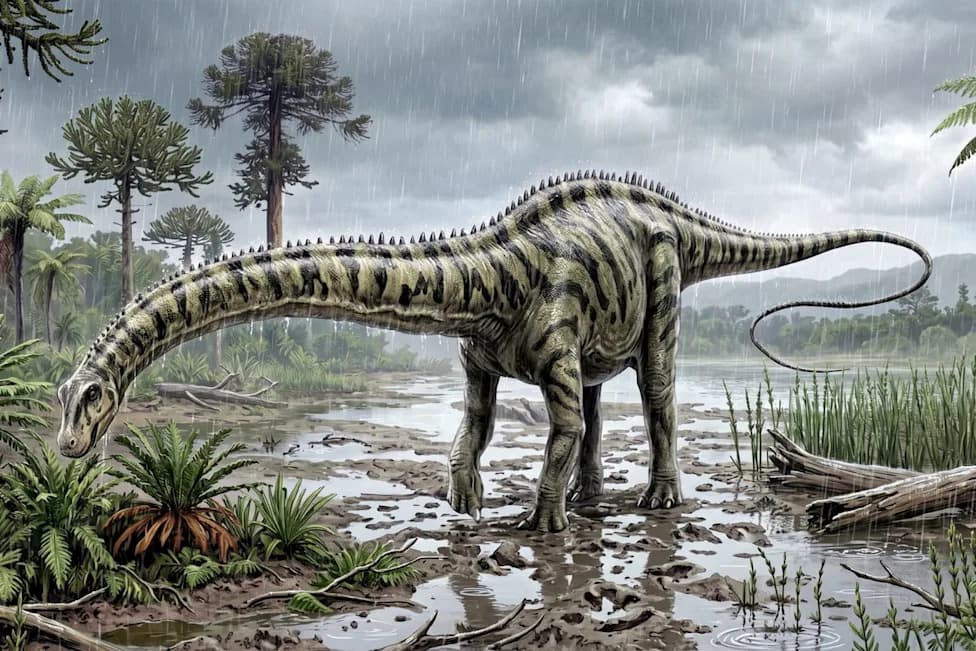
Musango matusadonaensis, a new dinosaur species from about 210 million years ago, was identified from partial hind-leg fossils found on Spurwing Island, Lake Kariba. Estimated at 1.5 m at the hip and ~390 kg, it is classified as an early sauropodomorph. The find — only the fifth dinosaur species described from Zimbabwe — was published in the Journal of Systematic Paleontology and highlights how much of Africa remains underexplored by paleontologists.
New 210-Million-Year-Old Dinosaur Discovered in Zimbabwe — Musango matusadonaensis
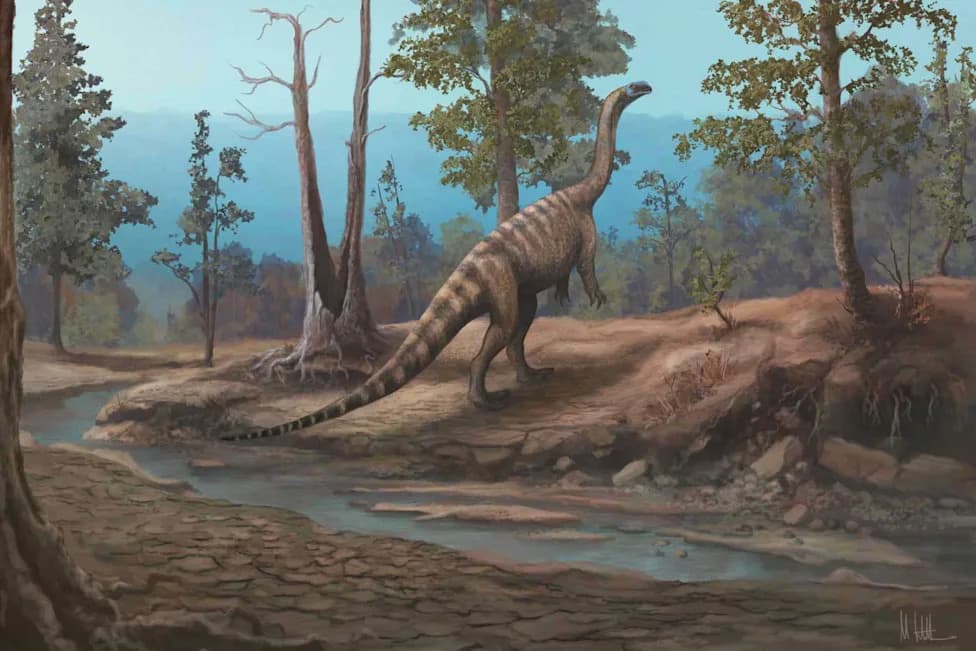
Musango MatusadonaensisCredit: Witton
A set of fossilized leg bones found along the shores of Lake Kariba has revealed a previously unknown dinosaur species that lived about 210 million years ago. The discovery, reported in the Journal of Systematic Paleontology, sheds light on the early evolution and distribution of dinosaurs in southern Africa.
Discovery and Context
The remains were recovered during a 2018 field expedition to Spurwing Island, Lake Kariba, by an international team from Zimbabwe, South Africa and the United Kingdom. The fossils include parts of a hind limb — thigh, shin and ankle bones — that were well enough preserved to show distinctive anatomy. These features led researchers to recognize the specimen as a new species.
Introducing Musango matusadonaensis
The new dinosaur has been named Musango matusadonaensis. Lead author Professor Paul Barrett of the Natural History Museum, London, described the find as nearly accidental: "We were walking along the shoreline when I noticed these leg bones eroding out of the ground," he said. "After we excavated the fossils, we realised it was quite different from the dinosaurs you might expect to find in the area." Barrett adds that this is the first dinosaur he has described that he personally discovered in the field.
Size, Classification and Relationships
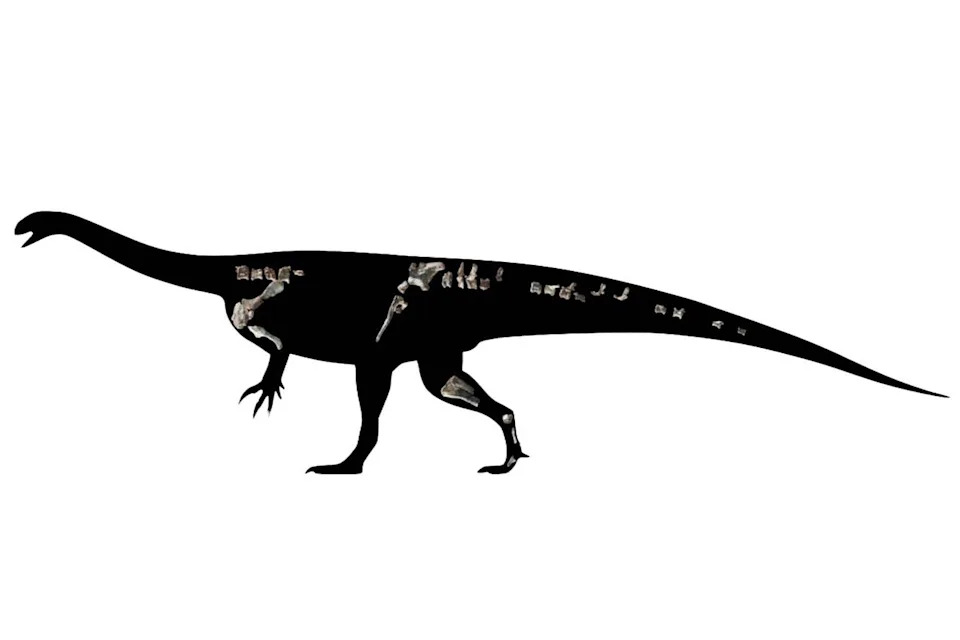
Musango MatusandonaensisCredit: Brandon Stuart
Based on the preserved leg elements, researchers estimate that Musango matusadonaensis stood roughly 1.5 meters (about 5 feet) tall at the hip and weighed around 390 kilograms (about 860 pounds). Anatomical traits place it within the sauropodomorphs — an early group of long-necked dinosaurs that would later give rise to the giant sauropods. Comparative analyses suggest affinities with taxa previously reported from Argentina and South Africa, supporting the idea that early dinosaurs dispersed across once-connected landmasses of Gondwana during the Late Triassic.
Name and Local Significance
The name honors local fieldwork connections: it recognizes the research team's houseboat (Musankwa), which served as a floating laboratory, and references the Matusadona region near the Sanyati River where the fossils were found. The specimen is only the fifth dinosaur species formally reported from Zimbabwe, highlighting the country's emerging importance for paleontology.
Why This Matters
Co-author Dr. Kimberley Chapelle emphasized that the scarcity of African dinosaur records is largely due to undersampling rather than an actual absence of dinosaurs: "Put simply, there have been fewer people looking for and unearthing dinosaurs in comparison with other regions of the world." The discovery of Musango matusadonaensis underscores the potential for further significant finds in underexplored regions around Lake Kariba and elsewhere in Africa.
Publication
The formal description appears in the Journal of Systematic Paleontology, and the discovery strengthens our understanding of Triassic dinosaur diversity and biogeography in southern Gondwana.
Help us improve.