Arbaeen, observed 40 days after Ashura, draws millions to Karbala to mourn Husayn ibn Ali, who was killed in 680 C.E. The pilgrimage emphasizes sacrifice, resistance to injustice and communal care, with volunteer-run mawākib providing free food, shelter and medical aid along routes such as the 48-mile walk from Najaf. After suppression under Saddam Hussein, Arbaeen reopened after 2003 and now attracts more than 20 million people, shaping religious devotion, political narratives and cultural expression across the Shiite world.
Why Arbaeen Draws Millions: The Shiite Pilgrimage of Mourning, Sacrifice and Solidarity
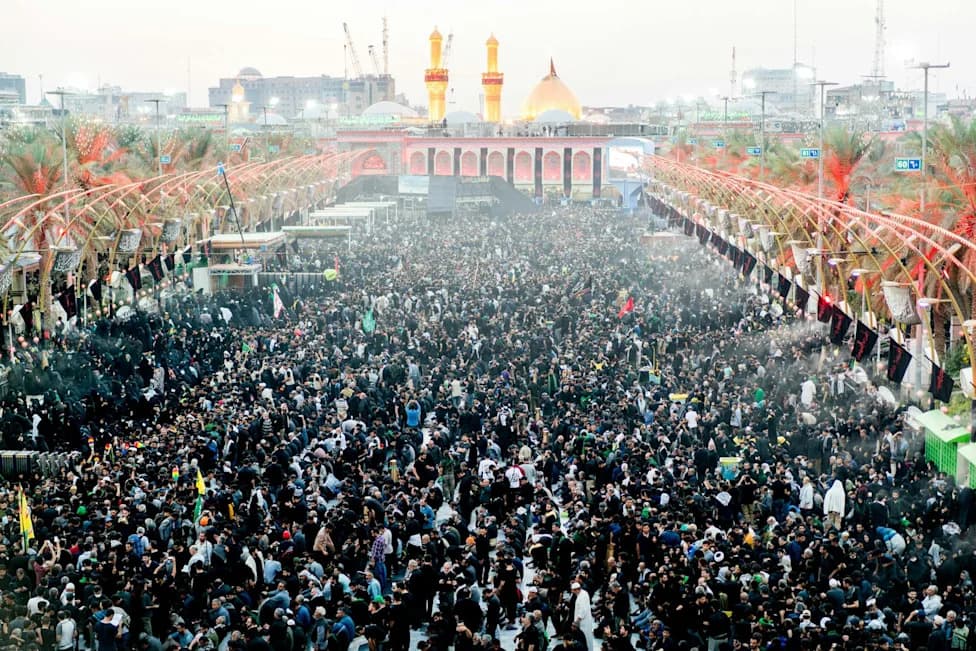
Pilgrims crowd the Imam Husayn shrine in Karbala, Iraq, during Arbaeen, one of the world's largest annual religious pilgrimages.MASTER/Moment via Getty Images
Each year millions of pilgrims travel on foot from the deserts of southern Iraq to the holy city of Karbala to observe Arbaeen, one of the world’s largest annual religious gatherings. In 2026, observers are expected to converge on Karbala on Aug. 5.
What Arbaeen Commemorates
Arbaeen occurs 40 days after Ashura, the day that marks the killing of Husayn ibn Ali, the Prophet Muhammad’s grandson, in 680 C.E. It concludes the forty-day mourning period that begins with the Islamic month of Muharram. For Shiite Muslims, Husayn’s death at Karbala is not only a historical event but a moral and spiritual sacrifice: a stand against tyranny and a call to uphold justice and ethical conduct even under great pressure.
History: Karbala, Husayn and the Aftermath
After the deaths of Ali — Muhammad’s cousin and son-in-law — and Ali’s elder son Hasan, leadership passed to the Umayyad dynasty under Yazid. Husayn refused to accept Yazid’s claim because he judged him morally unfit to lead the Muslim community. In 680 C.E., Husayn and a small group of family and followers were surrounded by a much larger army near Karbala and were killed; roughly 70 companions died with him. Women and children from his household were taken captive and marched to the Umayyad capital, Damascus.
Following the battle, survivors returning from captivity paused at Husayn’s grave. They were joined by Jabir ibn Abdullah al-Ansari, a companion of the Prophet, who is traditionally regarded as the first pilgrim to visit Husayn’s tomb. Arbaeen commemorates that visit and marks the end of the mourning period. Symbolically, Husayn’s death is sometimes described as the shattering of the world; Arbaeen is experienced as a restoration of meaning and communal resolve.
The Pilgrimage Today
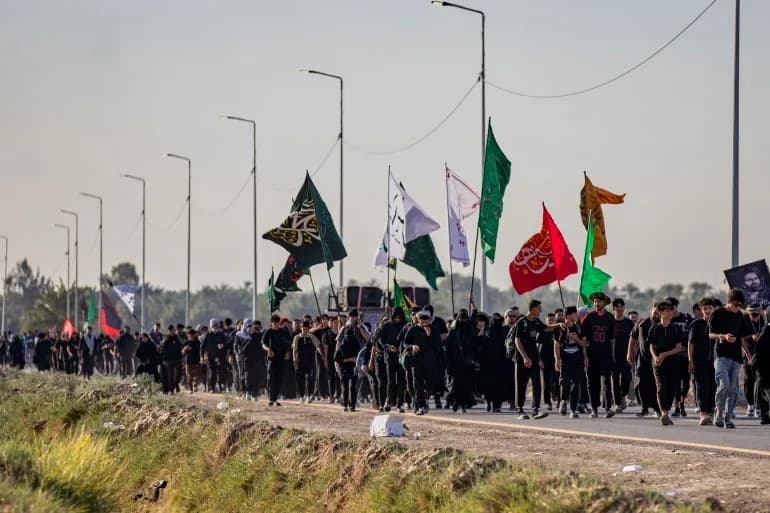
The best-known route runs roughly 48 miles (about 78 kilometers) from Najaf — where Ali is buried — to Husayn’s shrine in Karbala. The journey typically takes around three days on foot. Along the road, thousands of mawākib (volunteer tents and stations) offer free food, tea, medical care and places to rest. The scale of this communal hospitality is striking, especially given Iraq’s decades of conflict and instability.
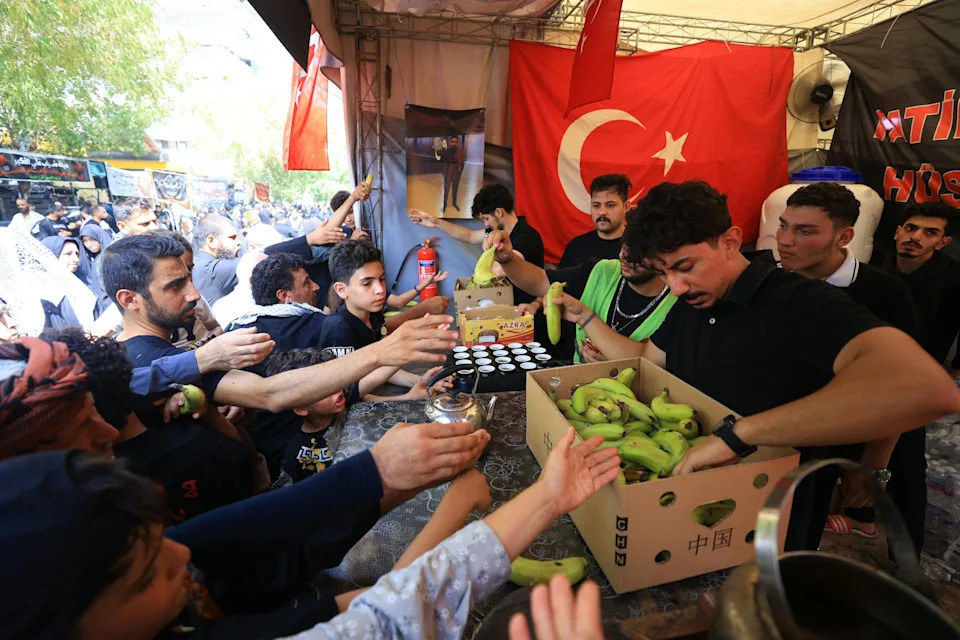
Food and beverage are offered to Arbaeen pilgrims.Murtadha Al-Sudani/Anadolu via Getty Images
In recent years, attendance has been estimated at more than 20 million people, which by many measures makes Arbaeen the largest annual gathering on earth.
Political and Cultural Legacy
Public observance of Arbaeen was heavily restricted under Saddam Hussein (1979–2003), and the pilgrimage was effectively banned during much of his rule. After the 2003 U.S.-led invasion of Iraq, the walk resumed openly and rapidly grew to attract millions from around the world.
Husayn’s martyrdom resonates beyond devotional practice: it has shaped political imagination and action. Scholars describe a “Karbala paradigm” in which Husayn’s resistance serves as a model for opposing oppression. A notable example was the 1979 Iranian Revolution, when Ayatollah Khomeini invoked Karbala imagery—casting the shah as Yazid and positioning himself as a Husayn-like reformer returned from exile.
The story of Karbala has also inspired rich cultural responses across languages and regions. Poetry, drama and ritual performances adapt the grief and remembrance to local contexts while preserving the central themes of sacrifice and justice.
From Mir Anees’s 19th-Century Urdu Epic, "The Battle of Karbala":
Then little Sakina drew near, and softly cried:
"My uncle — where is he? Why does the throng press so?
Let me lay my blessing where his brow is dyed with light; may God keep every harm below.
He lifts the standard high — let his renown be mine, for he is Ali's splendour, Ali's living sign."
For the millions who walk to Karbala each Arbaeen, the pilgrimage is at once ancient and immediate: standing at the grave of a man slain fourteen centuries ago, worshippers affirm that moral courage and refusal to submit to injustice remain vital today.
This article is republished from The Conversation. It was written by Iqbal Akhtar, Florida International University.
Help us improve.