Record heat and drought in parts of northern Italy and southern France have triggered unprecedentedly early grape harvests, with some vineyards beginning picks in late July. Growers warn that concentrated sugars from heat may increase alcohol levels and complicate quality forecasts, while drought has forced the uprooting of vines in some estates. Producers are adopting water-saving techniques, experimenting with soil management and considering higher-altitude plantings as they adapt to a warmer climate.
Europe’s Earliest Ever Grape Harvests: Italian and French Growers Grapple With Record Heat
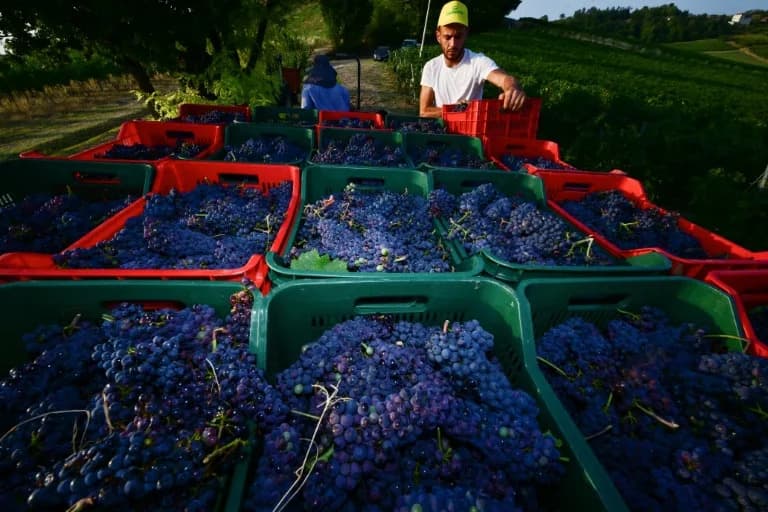
Predicting the quality of a harvest spread over 5 months is an oenological challenge for wineries (Stefano RELLANDINI)
Scorching, record-breaking temperatures have pushed vineyards in northern Italy and southern France into unusually early harvests, forcing winemakers to adapt practices, reassess quality expectations and manage shrinking water supplies.
Historic Early Picking
In Oltrepo Pavese, a wine-producing area south of Pavia, pickers began harvesting on July 27–28 — the first time grapes have been taken in July there — according to Matteo Castellani of the Coldiretti farming union. The same early-ripening pattern is visible across several southern French appellations, where producers began harvesting in late July rather than the usual August timeframe.
“This year is historic because the grapes have never been harvested in July before,” said Matteo Castellani.
Quality Questions: Sugar, Ripeness and Alcohol
Coldiretti warns that higher temperatures and drought can concentrate sugars in grapes, raising potential alcohol levels and complicating quality forecasts for vintners. Sangiovese, Italy’s most common variety, may be picked as early as mid-August in Tuscany instead of the usual September–November window. Federico De Filippi, three days into his harvest at the Defilippi - I Gessi estate, said maturation was currently "perfect" and alcohol levels were "optimal," but he cautioned that sustained heat could force an even earlier and shorter harvest to avoid overripe grapes.
Drought And Vineyard Losses
Southern French growers have also felt the strain. Alain Gleyzes in La Palme (Aude) started a night harvest of Muscat on July 30, calling the date "exceptional" after 43 years in the trade. Following two very dry seasons, Gleyzes said he had to uproot roughly one-third of more than 60 hectares in 2025; about 30% of his vines wilted due to drought.
Twin sisters and tenth-generation growers Camille and Audrey Lalaurie near Narbonne noted a long-term shift: harvests that took place around August 25 two decades ago now begin much earlier, with the 2026 vintage starting in the first days of August.
Adaptation: From Water Management To Moving Vines
Producers are responding with practical adaptations. Jean-Marc Lafage in the Pyrenees-Orientales reported being about 10 days ahead of a normal schedule and recruiting non-field staff to help with the rush. Lafage is experimenting with soil-improving composts to boost water storage and reduce irrigation needs. "We have become more water farmers than vine growers," he said, noting that some appellations — such as Banyuls and Collioure — are considering planting at slightly higher altitudes to find cooler conditions.
Outlook
Scientists link the increasing frequency and intensity of heatwaves and droughts to human-driven climate change, and vintners say the industry must adapt. While some losses and trade-offs are unavoidable, several producers expressed cautious optimism that improved data and new practices can help mitigate the worst impacts on quality and yields.
Key players and locations mentioned: Oltrepo Pavese (northern Italy), Defilippi - I Gessi estate, Coldiretti farming union, Tuscany (Sangiovese forecasts), La Palme and Fitou (Aude), Narbonne, Pyrenees-Orientales (Lafage estate), Banyuls and Collioure appellations.
Help us improve.