False social media posts in Indonesia resurrect a debunked "depopulation" conspiracy, claiming a "global elite" uses food, drugs and vaccines to change sexual orientation. Experts cited by AFP — including public‑health practitioners and infectious‑disease specialists — say there is no scientific evidence for these claims and describe them as "scientifically impossible." The narrative is spreading on Instagram, TikTok and Facebook amid rising anti‑LGBTQ sentiment and political moves that could criminalise LGBTQ people, and it carries real harms for public health and vulnerable communities.
Debunked 'Depopulation' Claims Link Vaccines and Food to Changing Sexual Orientation, Fueling Anti‑LGBTQ Sentiment in Indonesia
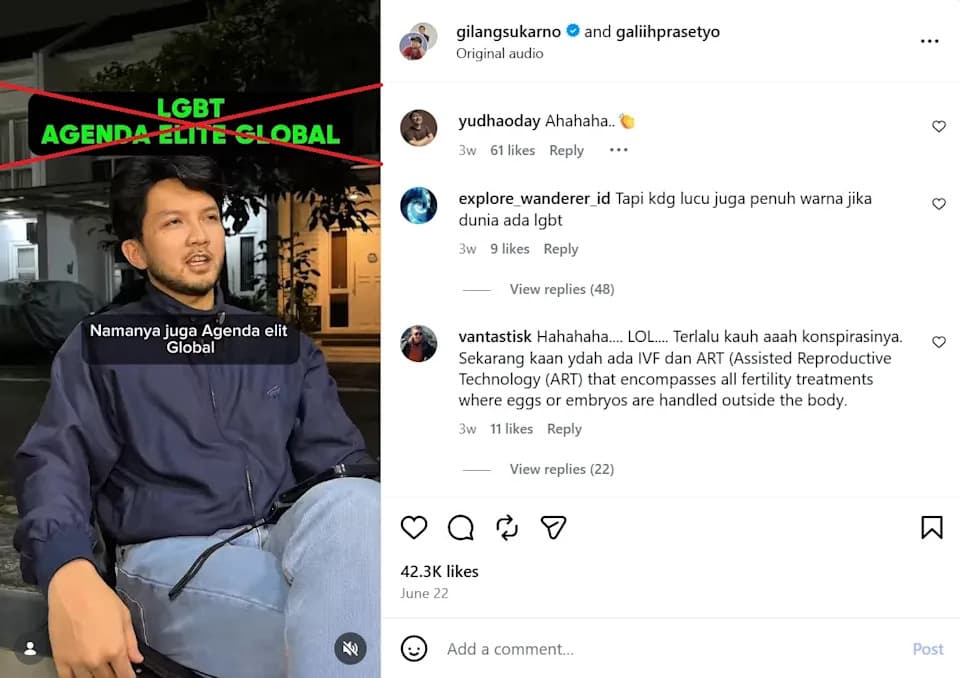
Screenshot of the false post captured on July 28, 2026, with a red X added by AFP
False online claims in Indonesia are spreading a conspiratorial narrative that a secretive "global elite" is using food, drugs and vaccines to change people’s sexual orientation as part of a so‑called "depopulation agenda." The story, which resurfaced after gaining traction during the Covid‑19 pandemic, has been repeatedly debunked by public‑health experts and infectious disease specialists.
An Indonesian‑language caption on an Instagram clip shared on June 22, 2026, declared: "LGBT is a Global Elite Agenda." The video — viewed more than 700,000 times — shows two social media creators claiming that LGBTQ people are being targeted because they allegedly do not reproduce "in the conventional way" and are therefore part of an international scheme to reduce population numbers.
"They change sexual orientation through food, drugs and vaccines," one host asserts in the clip.
Variants of the claim have circulated on TikTok and Facebook as anti‑LGBTQ sentiment rises in the world’s most populous Muslim‑majority country. AFP marked one screenshot of a viral post with a red X to indicate the claim is misleading.
Political And Social Context
Indonesia does not criminalise same‑sex relations at the national level; however, Aceh province enforces a local sharia code that outlaws gay sex. Despite the absence of a national ban, targeted attacks and harassment against LGBTQ people are regularly reported across the archipelago.
Recent developments have intensified the environment for such false narratives: in late June, the country’s top Islamic clerical body said it was preparing draft measures that could criminalise LGBTQ individuals and rights advocates. An earlier national defence policy regulation issued under President Prabowo Subianto listed LGBTQ "culture" among non‑military threats alongside trafficking, resource theft, terrorism, atheism and radicalism.
Expert Rebuttals And Public‑Health Impact
Experts contacted by AFP say there is no scientific basis for the claims that diet, supplements, medications or vaccines can change a person’s sexual orientation.
Putri Widi Saraswati, a global public‑health practitioner based in the Netherlands, told AFP that "there is no scientific evidence" supporting the idea that sexual orientation can be changed by external interventions. She noted that current scientific understanding points to sexual orientation arising from a complex interplay of biological and developmental factors, many acting before birth.
The World Health Organization also emphasizes that sexuality is shaped by biological, psychological, social, cultural and other factors — not by vaccines or food.
Herman Kosasih, a medical doctor with experience in infectious disease programmes in Indonesia, called the claims "scientifically impossible." He explained that vaccines work by training the immune system to recognise and fight pathogens; they do not alter personality traits, sexual orientation or an individual's genetic code.
Sean Whelan, head of Molecular Microbiology at Washington University School of Medicine in St. Louis, described the misinformation as dehumanising toward LGBTQ people and warned it undermines public trust in vaccination and other life‑saving health measures. "Vaccines save lives and promote health," he told AFP, adding that misinformation can have a "strongly negative impact" on public health.
Why This Matters
Conspiracy claims that link vaccines to population control circulated widely during the Covid‑19 pandemic and continue to resurface, often targeting vulnerable communities. Beyond being factually false, such narratives can increase stigma, justify discrimination, and discourage people from taking part in public‑health programmes that protect communities from disease.
AFP and other fact‑checking outlets have repeatedly debunked depopulation claims tied to vaccines. The recent wave of posts in Indonesia reflects both persistent misinformation trends and a charged political climate that is increasingly hostile to LGBTQ rights.
For more reporting on misinformation and LGBTQ issues, see AFP’s fact‑checking coverage.
Help us improve.