Divers working off Salcombe in southwest England have recovered a rare Bronze Age sword that spent around 3,000 years on the seabed. The weapon, found by members of the South West Maritime Archaeological Group, likely dates to the middle or late Bronze Age, though erosion complicates precise dating. The find strengthens evidence of Bronze Age seafaring and trade in the Salcombe area and will be offered to the British Museum for detailed study. Conservation and laboratory analysis may reveal the sword's origin, manufacture and how it came to rest on the seabed.
Rare Bronze Age Sword Recovered Near Salcombe After Around 3,000 Years Underwater
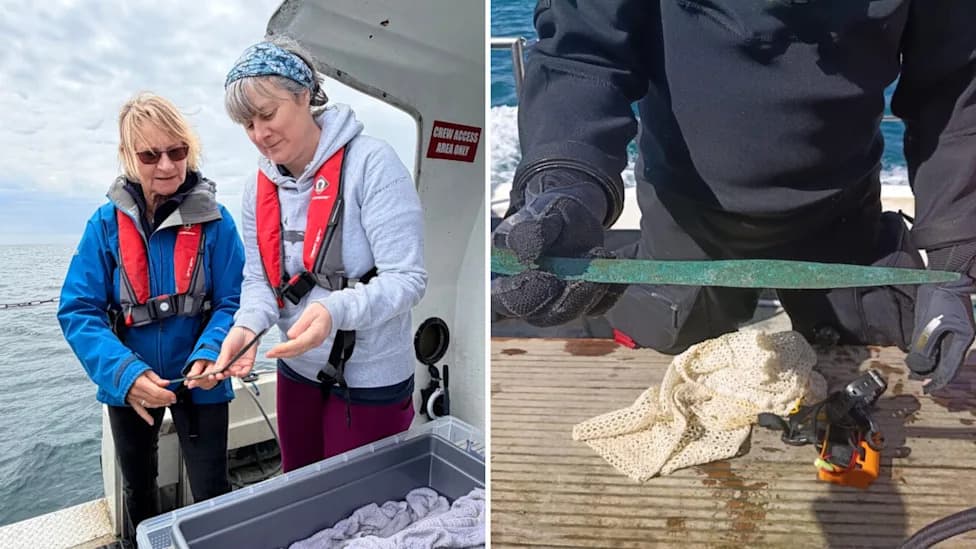
Photo Credit: South West Maritime Archaeological Group
Divers surveying a maritime archaeological site off England's southwest coast have recovered a rare Bronze Age sword that lay on the seabed for roughly 3,000 years near Salcombe. The discovery, made during a field survey earlier this year, is far older than the 17th-century wrecks that originally attracted the team.
Members of the South West Maritime Archaeological Group (SWMAG) located the weapon while examining a site already known for both 17th-century shipwreck material and much older prehistoric finds, according to Fox 5 New York. Archaeologists Becky Gill and Catherine Gill recovered the sword in the Salcombe area, a location recognised internationally for its prehistoric maritime significance.
"A kid at Christmas does not come close to the excitement of finding this sword," Catherine Gill said.
Dating, Condition and Context
Specialists tentatively date the sword to the middle or late Bronze Age. Centuries of burial under seawater and erosion have blurred some diagnostic details, making a precise date and typological classification difficult without further laboratory analysis.
The Salcombe waters have produced multiple finds linking the area to Bronze Age seafaring and trade. This sword adds weight to the idea that this stretch of coast was an active maritime route for travel, exchange and the movement of people and materials long before better-known later wrecks.
Why the Find Matters
Bronze Age swords provide direct evidence about metalworking techniques, social status, warfare or ceremonial practice, and long-distance connections between communities. Each artifact recovered from this period helps archaeologists fill gaps in a fragmentary prehistoric record.
Conservation and Next Steps
Underwater artifacts are vulnerable to ongoing erosion, shifting sediments and disturbance, so careful surveying, recovery and conservation are essential to preserve context and extract scientific value. The sword will be offered to the British Museum, where specialists can conduct metallurgical analysis, typological comparison and other studies to better understand how it was made, where it originated, and how it came to rest on the seabed off southwest England.
Further analysis may also clarify whether the find represents loss from a ship, a deliberate deposition, or some other means of entering the marine environment. Until conservation and study are complete, many questions will remain about the object's makers and final users more than three millennia ago.
Help us improve.