NASA's PACE satellite and an ISS photographer captured seasonal coccolithophore blooms that turn large areas of the Black Sea from deep navy to bright turquoise. These microscopic phytoplankton, armored in reflective calcium carbonate plates, scatter sunlight across the surface and help sequester carbon when their plates sink to the seafloor. PACE’s improved spectral sensitivity and revisit frequency make it uniquely suited to monitor bloom timing, extent, and ecosystem changes at basin scale.
Why the Black Sea Turns Turquoise: NASA’s PACE and an ISS Photo Reveal Massive Coccolithophore Blooms
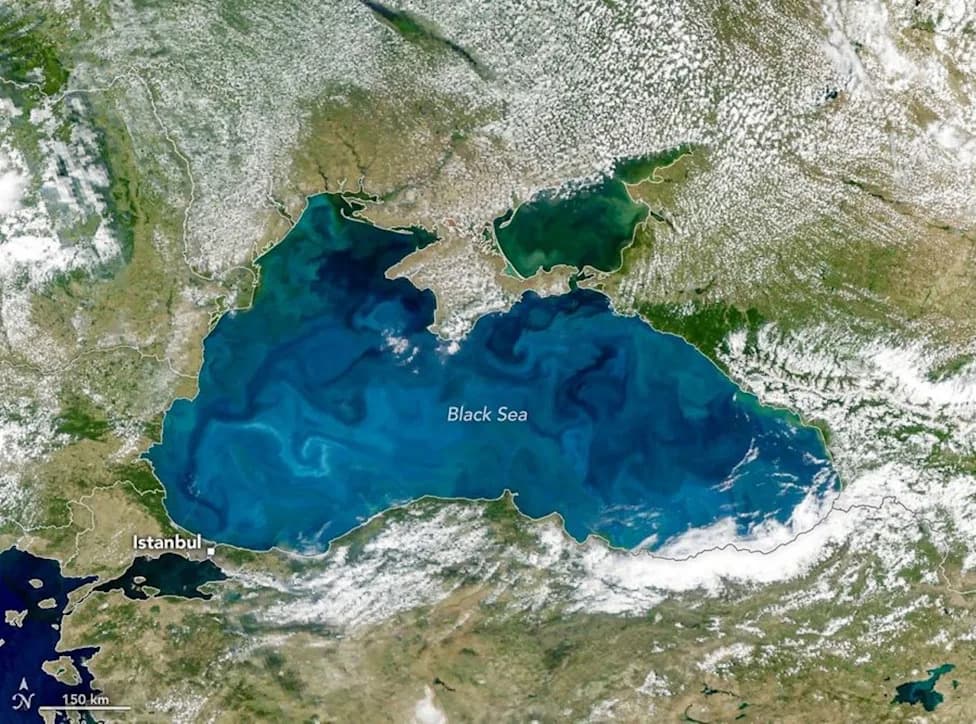
Image: NASA Earth Observatory
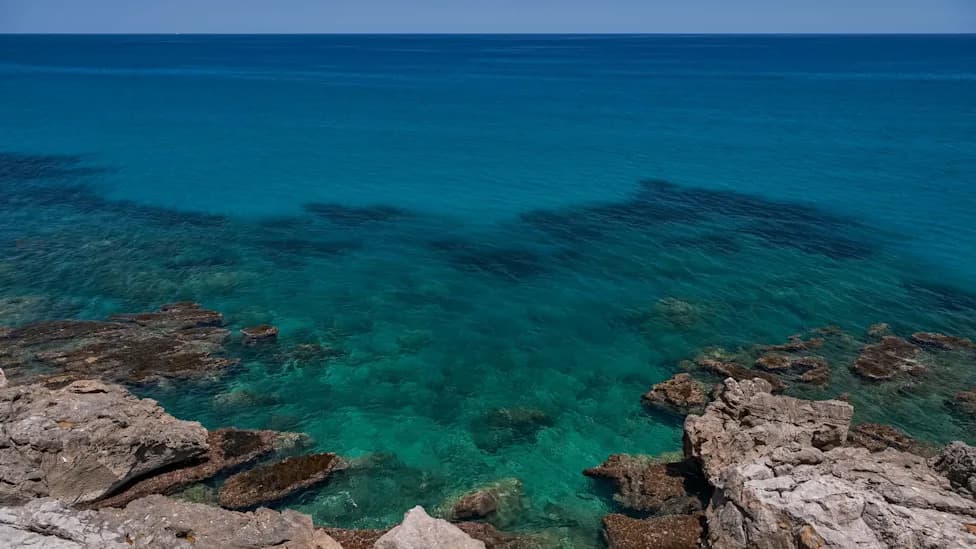
Each late spring the Black Sea — historically named for its dark waters — undergoes a dramatic makeover: vast swaths of deep navy flip to milky, swimming-pool turquoise. This seasonal spectacle was captured twice in 2026: on June 22 by NASA's PACE satellite Ocean Color Instrument, and about a month earlier, on May 27, by an Expedition 74 crew member aboard the International Space Station using a Nikon Z9 with a 50mm lens. NASA later cropped and contrast-enhanced the ISS frame for clarity, but the vivid turquoise needed no digital trickery.
The transformation is driven by microscopic life that is visible from roughly 400 kilometers above Earth.
What’s Painting the Sea?
The color comes from coccolithophores — tiny phytoplankton covered in calcium carbonate plates called coccoliths. When billions of these organisms bloom in late spring and early summer, their reflective plates scatter sunlight across the sea surface, producing a bright, milky-turquoise sheen. In cooler seasons, diatoms (phytoplankton with silica shells) tend to dominate and the surface darkens again, which is why the basin earned the name "Black Sea."
"Phytoplankton paint the water with color so brilliant it becomes visible from space," notes NASA's Earth Observatory.
Why Scientists Care
Beyond the striking visuals, coccolithophore blooms play a measurable role in the ocean carbon cycle. As these organisms grow, they take up carbon. When they die, their calcite plates can sink into seafloor sediments, effectively sequestering carbon over long timescales. Tracking the timing, extent, and composition of these blooms is therefore important for understanding regional carbon fluxes and ecosystem health.
Satellites are the only practical way to monitor these processes across entire seas. NASA has observed similar turquoise swirls in the Black Sea for more than two decades: MODIS-era sensors captured blooms near Sinop and Samsun in 2008 and again in 2022 off Romania, Bulgaria, and Turkey. The newer PACE mission improves on earlier sensors by detecting subtler variations in ocean color with higher spectral fidelity and more frequent revisits, giving scientists better, near-real-time data to detect shifts in bloom timing and species composition linked to warming waters and changing nutrient inputs.
Seeing Is Believing
It’s natural to be skeptical when satellite images look exceptionally vivid, but these coccolithophore blooms are real and carry live information about the ocean's role in the planet’s carbon budget—data that only missions like PACE can gather at basin scale. As the climate and nutrient conditions change, continued monitoring will help provide early-warning signals of ecosystem disruption long before effects are obvious from shore.
PACE will keep watching.
Help us improve.