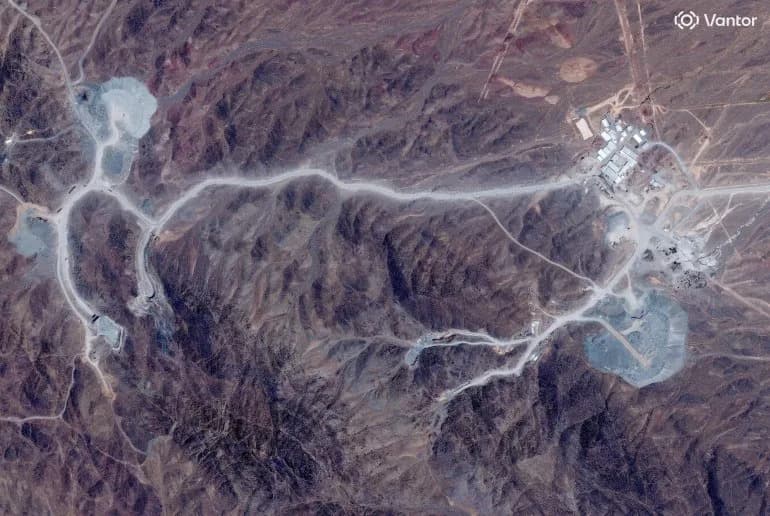
Pickaxe Mountain (Kuh-e Kolang Gaz La), near Iran's Natanz nuclear complex, sits atop hard andesite formed by ancient subduction that gives deep tunnels natural protection. Iran reportedly excavated tunnels more than 300 feet below the peak after 2020 damage, and analysts say conventional bunker-buster munitions are unlikely to penetrate very thick hard rock. As a result, any effective strike would most likely target surface access points such as ventilation shafts or portals. Since the June 2025 attacks, Iran has limited IAEA inspections, though most analysts believe Iran has not built a nuclear weapon.
How Ancient Geology Could Shield Iran’s Underground Centrifuges at Pickaxe Mountain
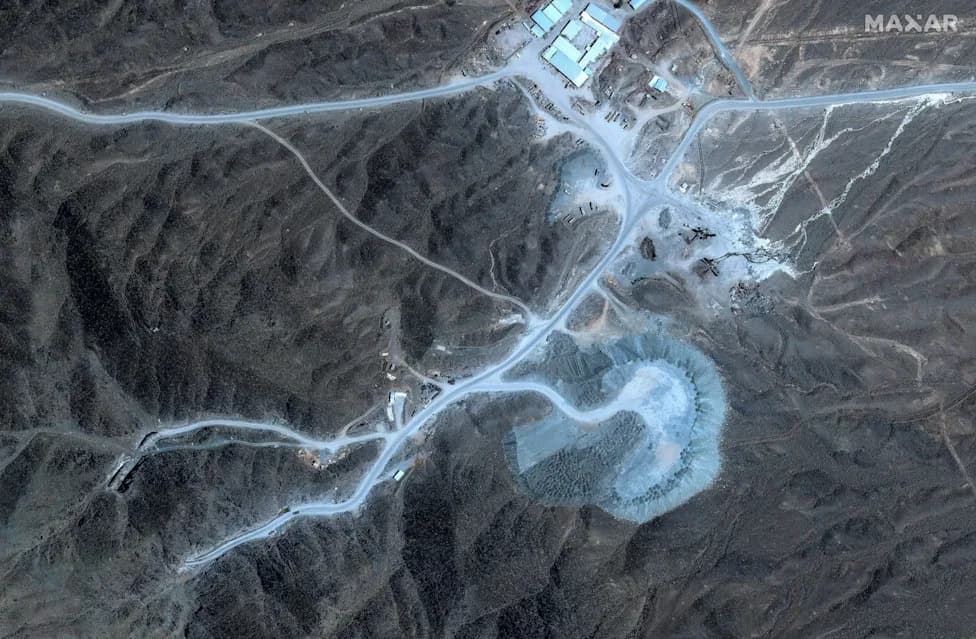
Ancient geology could insulate Iran's nuclear centrifuges under Pickaxe Mountain from bombing
President Donald Trump has renewed threats to strike Pickaxe Mountain, a rocky ridge near Iran's Natanz nuclear complex where centrifuges are believed to be housed in deep subterranean tunnels. Geology and engineering combine to make the site unusually hard to damage from the air.
Geologic Origin
Pickaxe Mountain, locally known as Kuh-e Kolang Gaz La, lies roughly 77 miles north of Isfahan. It sits inland from the Zagros Fold-Thrust Belt and forms part of the Urumieh-Dokhtar Magmatic Arc, a chain of ancient volcanic rocks created as the Neo-Tethys Ocean subducted beneath the Eurasian Plate while the Arabian Plate advanced.
Why the Rock Matters
The mountain is composed primarily of andesite, a hard volcanic rock interbedded with remnants of limestone deposited along the Neo-Tethys margins. Andesite is durable (around a 7 on the Mohs hardness scale), far more resistant to penetration than soft soils or clay, and so provides substantial natural armor for tunnels excavated beneath it.
Depth and Engineering
After damage at Natanz in 2020, Iran reportedly began excavating new underground tunnels more than 300 feet below Pickaxe Mountain to house centrifuge assembly areas, according to the Institute for Science and International Security. The institute characterizes the overlying rock as offering the equivalent of thousands of feet of protection in practical terms for munitions designed to penetrate softer materials.
Military Implications
The U.S. GBU-57 Massive Ordnance Penetrator (MOP) is designed to pierce deeply into soils, rock, or engineered structures, but its effectiveness falls dramatically against very hard, thick igneous rock such as andesite. Analysts conclude that direct penetration through thousands of feet of hard volcanic rock is unlikely; successful strikes would more likely target vulnerable, human-made access points — ventilation shafts, portals, or surface facilities — rather than expecting a bomb to blast through the whole mountain.
"It's basically a volcanic arc above a subduction zone,"
said Richard Walker, a professor of tectonics at the University of Oxford, summing up the mountain's origin.
Recent Attacks and Inspections
Natanz suffered a major explosion in July 2020 and another attack in 2021; analysts have attributed at least some of these to covert operations. Reports indicate the June 2025 bombings at Natanz and the nearby Fordow site targeted equipment and access points, and that Iran's inventories of enriched uranium and related equipment may now be stored in—or under—rubble-filled tunnels. Since those attacks, Iran has not fully cooperated with International Atomic Energy Agency (IAEA) inspections of some sites, though most outside analysts continue to assess that Iran has not yet built a nuclear weapon.
What This Means
Geology is not an absolute shield, but it shapes both defensive strategy and offensive options. Hardened natural rock forces any attacker to focus on surface vulnerabilities and human-made openings, increases the complexity and cost of any strike, and gives defenders additional time and concealment options for critical equipment.
Bottom line: Pickaxe Mountain's andesite and depth make direct penetration by conventional bunker-busting munitions unlikely; attacks are more likely to try to exploit shafts, portals, or other engineered weak points.
Help us improve.