The larvae of lake flies (Chaoborus edulis) in Lake Malawi spend daytime near 656 ft (200 m) and use two pairs of air-filled sacs to control buoyancy. Those sacs contain resilin, a pH-responsive protein that swells or shrinks to change sac volume. Pressure-chamber tests show the sacs tolerate pressures equivalent to over 1,213 ft (400 m), suggesting deep pressure alone does not explain why insects avoid the open ocean. The resilin-based mechanism may inspire novel adaptive materials.
Lake Fly Larvae Withstand Pressure Equivalent To 1,213 Ft Underwater, Challenging Why Insects Avoid the Open Ocean
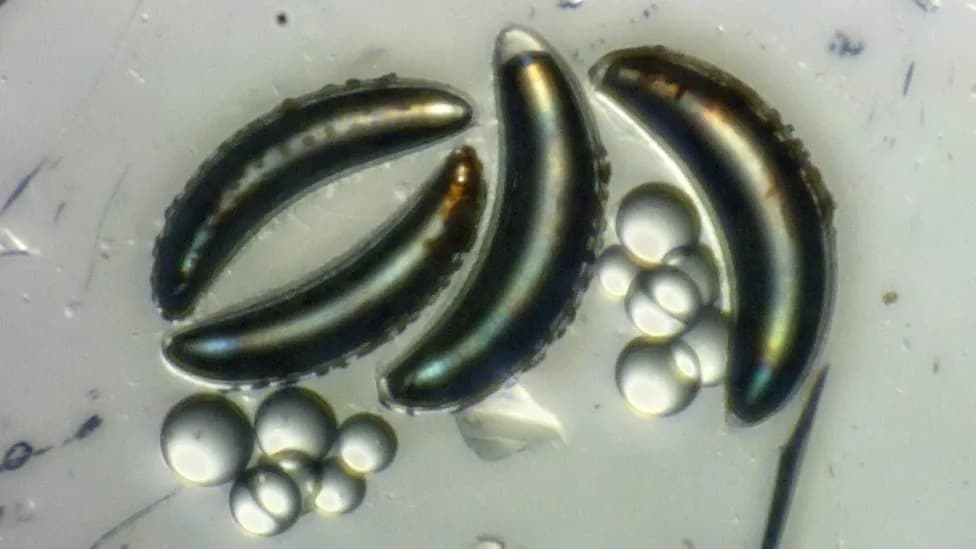
Removed 'Chaoborus edulis' airsacs.
Billions of lake fly larvae (Chaoborus edulis) in East Africa's Lake Malawi routinely spend daylight hours hundreds of feet below the surface and return to feed at night. A new study in Science shows these larvae use air-filled sacs containing a pH-responsive protein called resilin to control buoyancy — and those sacs tolerate far more pressure than researchers expected.
How These Larvae Dive Deep
Chaoborus edulis larvae migrate daily, spending daytime at depths around 656 feet (200 meters) before rising at night. Unlike many insects, these larvae have two pairs of air-filled sacs that act as buoyancy organs. The gas inside those sacs is at roughly surface atmospheric pressure, which led researchers to ask: how deep can an unpressurized sac hold out against the surrounding water pressure?
Chemo-Mechanical Buoyancy Control
The study's authors found the sac walls include resilin, a protein that swells or contracts in response to changes in pH. By actively changing the pH of the sac walls, the larvae cause resilin to expand or shrink, which alters sac volume and thus buoyancy — a "chemo-mechanical" control system that lets the insects fine-tune their depth.
"By regulating the pH of the air sacs' walls, they cause them to expand or contract via a distinct 'chemo-mechanical' system," — Philip Matthews, co-author and insect respiratory researcher, University of British Columbia.
Testing Limits With Pressure Chambers
To determine how much external pressure the sacs could tolerate, researchers tracked larval movements with sonar and then placed specimens in pressure chambers. The sacs endured pressures equivalent to more than 1,213 feet (400 meters) of water before failing — substantially deeper than the larvae normally dive.
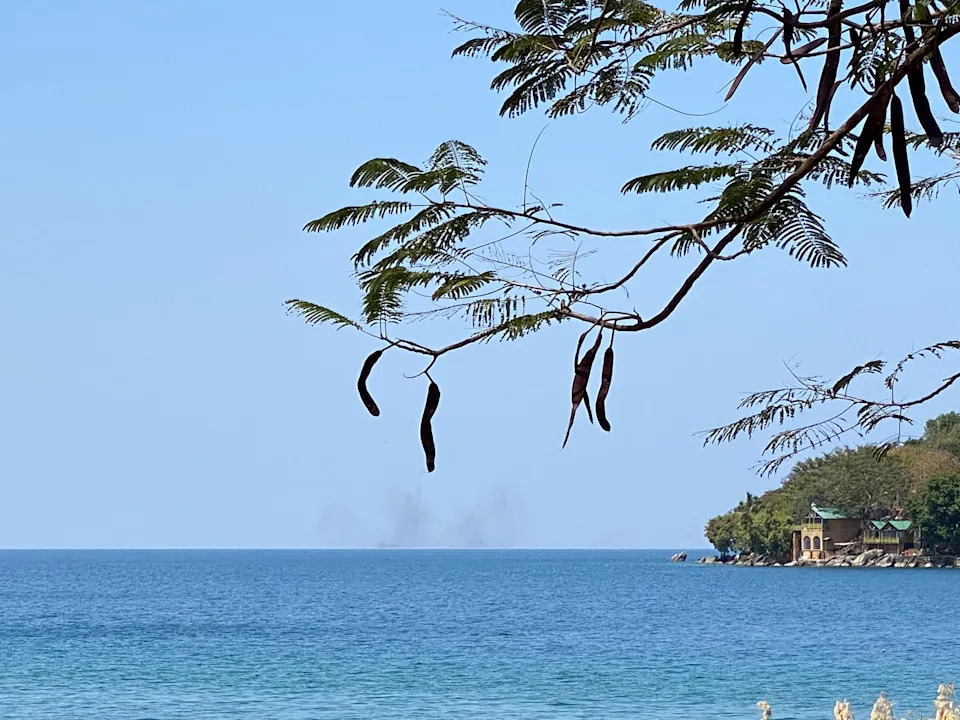
A swarm of the lake fly larvae over Lake Malawi.Image: Philip Matthews.
The results suggest that external hydrostatic pressure alone is unlikely to be the primary reason insects are absent from the open ocean. Instead, other ecological, physiological, or evolutionary factors may play larger roles.
Material Science Implications
Resilin was previously considered a passive, elastic component of insect anatomy. In Chaoborus it behaves dynamically, generating force as it swells or shrinks with pH changes. Co-author Evan McKenzie suggests this property could inspire new adaptive materials that morph in response to chemical signals.
Study: Published in Science. Fieldwork and experiments were led by researchers including Philip Matthews and Evan McKenzie from the University of British Columbia.
Image caption: A swarm of lake fly larvae drifts over Lake Malawi (photo credit: Philip Matthews).
Help us improve.