Researchers report that giant deep‑sea isopods likely incorporated a bacterial gene called ND1 into their genomes more than 16 million years ago. Multiple copies of this bacterial‑like gene, together with a large stomach, appear to let these isopods gorge on rare meals and sharply reduce metabolism to survive multi‑year starvation. Lab experiments inserting ND1 into zebrafish, nematodes and human cells also lowered metabolic rates, suggesting the gene has a conserved effect on energy use.
Bacterial Gene Enables Giant Deep‑Sea Isopods To Survive Years Without Food
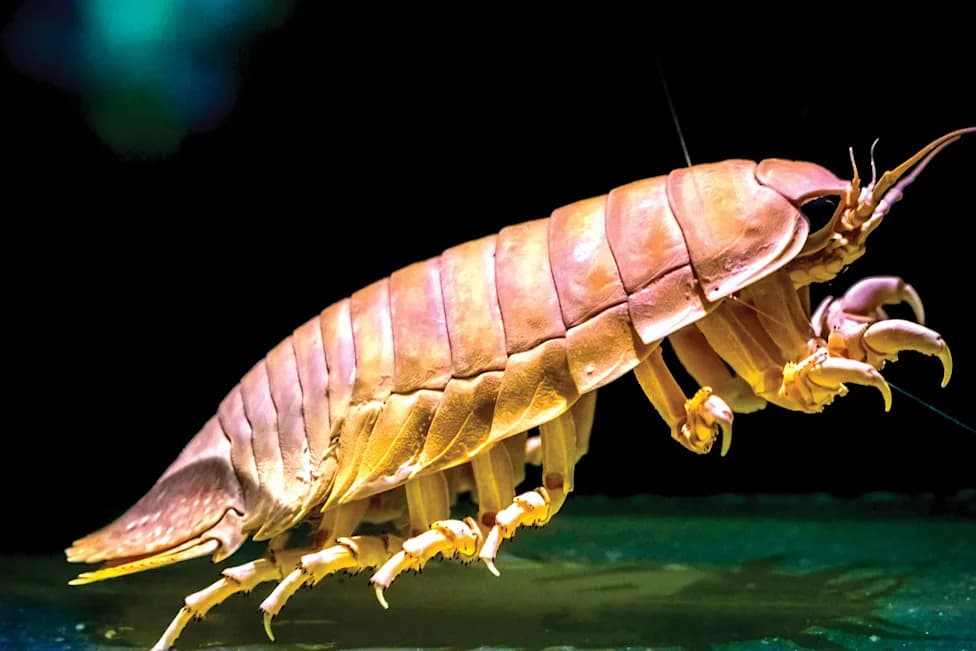
A supergiant deep-sea isopod can go for five years without eating.
The deep sea is often called Earth's most alien environment, and its fauna live by strange rules. Among them are giant, armor-plated isopods with triangular compound eyes and long antennae — relatives of the garden pill bug that can reach up to half a metre in length and endure years without eating.
Borrowed Gene, Extreme Survival
New research published in Cell suggests that these deep‑sea isopods acquired a bacterial gene, dubbed ND1, more than 16 million years ago. Paired with an unusually large stomach, multiple copies of this bacterial‑like gene appear to let the animals gorge on rare meals and then sharply reduce metabolic activity so they can survive long stretches of starvation.
Evidence for Horizontal Gene Transfer
The ND1 sequences in deep‑sea isopods show hallmarks of bacterial origin: they lack introns and encode unusually small proteins relative to typical animal genes. The authors propose that bacteria living in an ancestor's gut donated the gene, which became integrated into the isopod genome and was inherited by subsequent generations.
Functional Tests and Broader Effects
The researchers sequenced full genomes from specimens collected at about 300 and 800 metres and measured differences in energy demand, enzyme activity and oxygen consumption. They report that multiple copies of the bacterial‑like ND1 are highly expressed in deep‑dwelling isopods and seem to dampen cellular energy production at cold temperatures. When the team inserted ND1 into zebrafish, nematode worms and cultured human cells, those organisms also showed reduced metabolic rates, consistent with a conserved effect on energy metabolism.
“This is surprising because bacteria and animals are very different, and such [gene] transfers are rare,” said Jianbo Yuan of the Chinese Academy of Sciences, a co‑author of the study.
Why It Matters
Deep‑sea ecosystems cover more than half of Earth's surface and host unique adaptations to scarce food and cold conditions. The discovery links horizontal gene transfer and the microbiome to a dramatic physiological trait — prolonged starvation tolerance — and may shed light on the evolution of deep‑sea gigantism.
“This finding opens a completely new window to study the evolution of deep‑sea gigantism and the role of microbiome in deep‑sea adaptation,” said Torben Riehl of the Senckenberg Ocean Species Alliance, who was not involved in the study.
Key facts: Giant marine isopods live from roughly 170 to 2,100 metres depth; some deep‑sea species can survive more than five years without food. The ND1 finding remains observational and experimental work in the lab demonstrates an association between the gene and lowered metabolic rates, but further study will clarify mechanism and ecological impact.
Help us improve.