Tametara mirim, a well-preserved Cretaceous snake fossil from southeastern Brazil, reveals brain anatomy consistent with a burrowing lifestyle. With about 60% of the skull and 70% of the vertebral column preserved, researchers reconstructed its brain and found evidence of reduced visual centers typical of fossorial animals. The find suggests early snakes displayed wide neuroanatomical diversity and underwent multiple independent ecological shifts rather than a single rapid specialization.
Dinosaur-Era Snake Fossil Reveals Brain Anatomy and a Burrowing Lifestyle
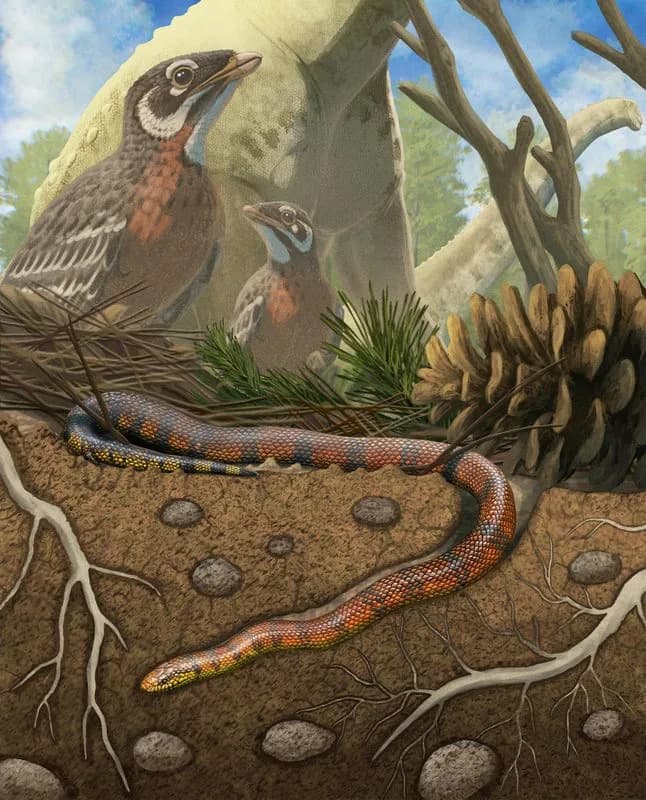
Life reconstruction of the Cretaceous Period burrowing snake Tametara mirim, shown against a background of long-necked sauropod dinosaurs and the bird Navaornis from the same locality in Brazil. The image was released on July 22, 2026. Gabriel Ugueto/Handout via REUTERS.
A remarkably complete Cretaceous snake fossil from southeastern Brazil is giving scientists an unprecedented look at early snake neuroanatomy and behavior. The specimen, identified as Tametara mirim, lived about 75–85 million years ago and measured roughly 17 inches (42 cm) in length. It was discovered in Presidente Prudente, São Paulo state, and published this week in the journal Nature.
Exceptional Preservation Enables Brain Reconstruction
Although not all bones survived, the fossil preserves approximately 60% of the skull and about 70% of the vertebral column. Much of the preserved cranial material includes the braincase and skull roof, with the rear portion of the lower jaw in life position. These elements were sufficiently intact for researchers to reconstruct the shape of the brain and study skull bone microstructure.
Evidence for a Fossorial (Burrowing) Lifestyle
Both the reconstructed brain shape and microanatomy of the skull point to a burrowing, or fossorial, lifestyle—similar to that seen in some modern snakes. The brain reconstruction shows comparatively smaller cerebral hemispheres and a reduced optic tectum, consistent with species that spend much of their time below ground and rely less on vision.
What This Means for Early Snake Evolution
Snakes evolved from lizard ancestors, with molecular and fossil evidence suggesting an origin near the Jurassic (around 170 million years ago). However, well-preserved fossils from the Jurassic and early Cretaceous are scarce. Tametara joins a very small group of exceptionally preserved Cretaceous snakes (only four species with similar preservation), providing rare data on early snake brains and sensory systems.
"The fossil reveals a more complex history of early snake evolution, with a larger diversity of neurosensory adaptations and multiple independent moves into different environments," said Tiago Simões, lead author and evolutionary biology professor at Princeton University.
The study also reconstructed the brain of the much larger Cretaceous ambush predator Dinilysia patagonica (about 2 meters long). The two species display substantially different brain shapes from each other and from most modern lizards and snakes, indicating significant neuroanatomical diversity early in snake history.
Diet, Limbs and Lineage
There is no direct stomach-content evidence for diet, but the researchers infer Tametara likely fed on insects. The specimen does not preserve teeth, so its venom status cannot be determined. While modern snakes are limbless, early snakes retained hindlimbs; the hip region of Tametara was not preserved, but the authors argue it likely had robust hindlimbs similar to its sister Cretaceous species Najash rionegrina. Tametara appears to have no direct descendants among living snakes.
Broader Implications
Rather than a single rapid shift into a single habitat, the new data support a model in which early snakes experimented with multiple lifestyles—burrowing, ground-dwelling and marine—over a long evolutionary history. The researchers propose the ancestral snake condition was probably transitional, existing at the interface between fossorial and ground-dwelling environments.
Study Citation: Tiago Simões et al., Nature (2026). Reporting by Will Dunham; editing by Daniel Wallis.
Help us improve.