ASEAN foreign ministers in Manila pressed for protection of navigation and overflight rights in international straits as their summit was overshadowed by the US‑Iran war and regional energy shocks. The joint communique introduced explicit wording on straits and urged "unimpeded" passage through the Strait of Hormuz amid disruptions tied to strikes on Iran. Tensions also flared between China and the Philippines in the South China Sea, though both sides said they aim to finalise a Code of Conduct by year‑end.
ASEAN Demands Open Straits as US‑Iran War Deepens Regional Energy Strain
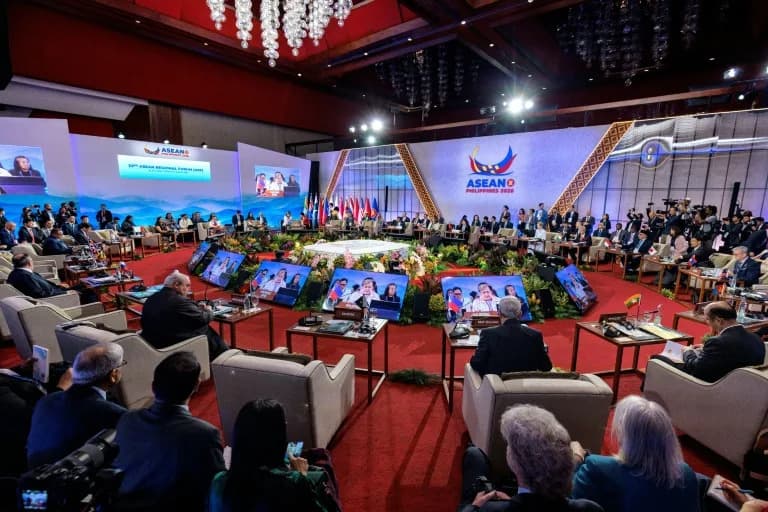
Foreign ministers attend the 33rd ASEAN Regional Forum (ARF), part of the ASEAN Foreign Ministers' Meeting, in Pasay, Metro Manila on July 23, 2026 (Ezra Acayan)
Foreign ministers from energy‑dependent Southeast Asian countries urged protection of freedom of navigation and overflight in international straits on Thursday, as their week‑long meeting in Manila was overshadowed by the fallout from the US‑Iran war.
A joint communique issued at the Association of Southeast Asian Nations (ASEAN) summit reiterated calls for self‑restraint in the Middle East conflict and introduced explicit language on "freedom of navigation in and overflight above straits," while also urging "unimpeded" passage through the Strait of Hormuz.
"There is a fundamental principle about freedom of navigation that is threatened," said US Senator Marco Rubio, who spoke to ASEAN envoys while visiting Manila.
Delegates warned that disruptions to the Strait of Hormuz following strikes on Iran have already triggered energy shortages and price spikes across the region, prompting the import‑reliant Philippines to declare a national emergency. Although the communique mentioned energy cooperation, officials disclosed no concrete progress on previously proposed projects such as a regional power grid or a coordinated fuel‑sharing mechanism.
South China Sea Tensions
The meeting opened amid fresh clashes between Chinese and Philippine vessels in the disputed South China Sea. Philippine Foreign Minister Theresa Lazaro told a closing press conference she remained hopeful both sides would finalise a long‑pending Code of Conduct by year‑end.
"This is now part of the political will, that we intend to finish this code of conduct at the end of the year," Lazaro said. China’s ambassador to Manila, Jing Quan, echoed the aim to conclude talks, adding the pact would focus on "rules of engagement" for the waterway rather than resolving bilateral territorial disputes.
Analysts cautioned that any compromise text acceptable to both Beijing and ASEAN capitals could be limited in scope and enforcement. Hours before the summit closed, the Philippine Coast Guard accused Chinese vessels of firing water cannon and using a "dangerous manoeuvre" to block boats carrying aid to Filipino fishermen near a contested reef; China said it had taken "necessary measures" to expel the Philippine vessels from what it described as its territorial waters.
What To Watch
Officials and observers will be monitoring whether ASEAN moves beyond diplomatic language to concrete energy arrangements or practical measures to safeguard key sea lanes — including contingency plans for fuel supplies and coordinated maritime incident responses.
Help us improve.