Untreated sewage and industrial residue from Hebron flow about 43 km south into Israeli areas, carrying domestic waste, stone dust and industrial contaminants that damage downstream treatment systems. A 2024 Green Now report estimates about 90 million m3 of sewage are produced annually in the region, with roughly 38 million m3 from Palestinian towns untreated. Environmental groups have petitioned Israel's High Court to enforce permits in Area C, but funding, pretreatment at the factory gate and coordinated cross‑border governance remain unresolved.
Hebron’s Polluted Stream Flows 43 km South — Threatening Negev Communities and the Mountain Aquifer
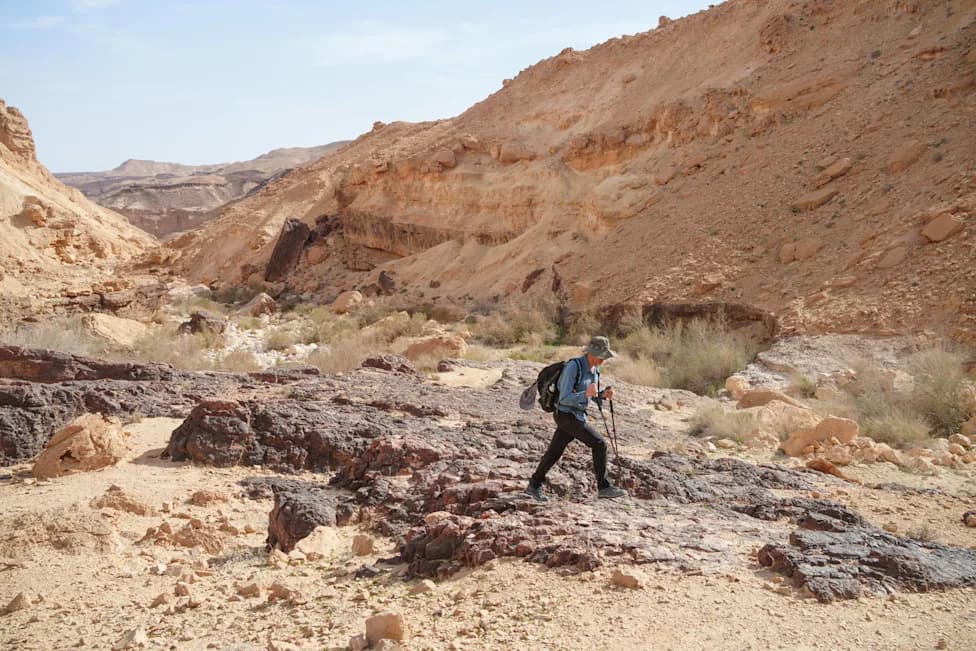
Israelis hike at Nahal Hava in the Negev, southern Israel, January 30, 2026; Illustrative. (photo credit: YANIV NADAV/FLASH90)
The water running through the arid hills south of Hebron is visibly contaminated: in places it is thick and pale, and the odor often arrives before the stream itself. Along parts of the dry arroyo the smell is the first sign that effluent is moving downhill.
From Hebron the polluted current continues roughly 43 kilometers south, crossing roads, open land and Israeli communities before joining the Beersheba Stream system. The flow carries untreated domestic sewage and industrial waste from the stone‑processing and tanning industries across Areas A, B and C and then into Israeli territory.
Sources, Industry and Treatment Challenges
Most of the wastewater originates in Palestinian towns around Hebron, where the Palestinian Authority is nominally responsible for civilian services. As the flow reaches Area C — where Israel retains planning and security control — and crosses the Green Line, it traverses land governed by different authorities, but the pollution has not been stopped at its source.
Eliram Azulay, head of the Har Hebron Regional Council, says local Israeli communities ultimately pay to collect and treat the pollution once it reaches Israeli territory. "You can make kayaks in this sewage," Azulay said after inspecting the stream, adding bluntly, "and you know, it smells." He also described how sediment from stone‑processing plants settles along the route, blocks channels and reduces the usability of nearby land.
Domestic sewage is only part of the problem. Hebron is a major center for stone cutting and processing, producing wastewater loaded with very fine mineral particles. Barak Werker, CEO of Green Now, says those mineral fines enter municipal sewers without industrial pretreatment systems required of regulated factories in Israel. "The biggest problem in the Hebron Stream is the stone industry in Hebron itself," Werker told The Media Line.
Biological wastewater plants are designed to break down organic material; stone powder and mineral sludge instead settle, clog pumps and damage treatment basins. Green Now's 2024 Cross‑Border Pollution report also identifies chromium from Hebron's tanning sector among the industrial contaminants entering the stream.
Scale, Risks and Institutional Gaps
Green Now estimates that communities across the West Bank and Israel generate about 90 million cubic meters of sewage annually, roughly 80% of it from the Palestinian population. The report estimates that about 38 million cubic meters from Palestinian towns receive no treatment and enter streams, soil or absorption pits; it also estimates roughly 5 million cubic meters of inadequately treated effluent from Israeli communities reaches the environment. These figures are regional estimates and are not limited to the Hebron Stream alone.
The longer‑term concern is that sewage and industrial contaminants could percolate through the limestone terrain into the Western Mountain Aquifer, a major groundwater reserve with average annual renewable resources of about 360 million cubic meters, which supplies both Israeli and Palestinian communities.
Green Now and others point to decades of population and industrial growth in Hebron as drivers of the pollution. Werker cautioned against blaming the problem solely on the Oslo Accords or on Palestinian neglect, noting that environmental infrastructure in the region was limited before the 1990s and that responsibility for many Palestinian communities shifted during the Oslo period.
At the same time, Green Now documents systemic barriers on the Palestinian side: limited budgets for environmental services, weak enforcement capacity, plans lacking formal approval or skilled personnel, and the high cost of connecting scattered communities to regional treatment plants. The organization also cites the Joint Water Committee as largely paralyzed since 2012, contributing to coordination failures.
Legal Fight and Responsibility
The legal dispute now focuses on stone‑processing plants. Regavim and Green Now petitioned Israel's High Court of Justice asking the state to enforce laws against facilities they say operate without permits and discharge sludge into the Hebron Stream. The petitioners assert some plants are in or have expanded into Area C, putting them under Israeli jurisdiction. In a June 29 statement the petitioners said Supreme Court Justice Alex Stein ordered the state to respond within 60 days and warned of a "serious and irreversible danger to nature." The Media Line did not independently review the full petition.
Petitioners also fault Israeli enforcement where facilities fall under Israel's jurisdiction. Naomi Kahn, director of Regavim's international division, urged that if Israel has authority in Area C it must exercise it to prevent environmental, political and security fallout. "For now, you're in charge, you're responsible for protecting that resource, and you have to do it," she said.
Green Now's report cites criticism from Israel's State Comptroller that the government lacks a unified system for managing cross‑border pollution and has not designated a coordinating body to align ministries and agencies — a fragmentation that has delayed decisions on waterways including the Hebron Stream.
Possible Engineering Fixes and Limits
Experts argue the most effective technical remedy is pretreatment at the factory gate. Werker recommended separating stone waste at source, installing pretreatment in the Hebron area, and routing pretreated effluent to regional Palestinian treatment plants such as the facility near Yatta for reuse in irrigation. He warns that plants funded for Hebron cannot operate efficiently while large volumes of stone residue enter the system.
But even if the courts clarify enforcement in Area C, that will not by itself answer who will fund, build and operate the cross‑border infrastructure needed to stop pollution upstream.
Local Impact
For residents beside the stream, the issue is immediate and tangible. Ayala Bar On of the Har Hebron Regional Council communications team says the odor keeps people away from open areas near their homes. "There are some places where you cannot even breathe because the air stinks," she said. Azulay reports frequent complaints: "They ask a very simple question: How can we live with that smell?"
The Palestinian Authority, Hebron and Yatta municipalities and representatives of the stone industry did not respond for this article.
Help us improve.