The Israeli Civil Administration's Blue Line team, set up in 1999, redraws West Bank land boundaries and has been used to reclassify Palestinian land as "state land," opening it to settlement activity. Families in al-Mughayyir say bulldozers uprooted thousands of olive trees and that re-demarcation left them unable to access most of their 0.4 sq km (100 acres). Reports and researchers warn the practice has accelerated in 2026 and is part of a broader system—including military orders and outposts—that restricts Palestinian access to land and damages local livelihoods.
How Israel’s 'Blue Line' Team Reclassifies West Bank Land, Leaving Families Bereft
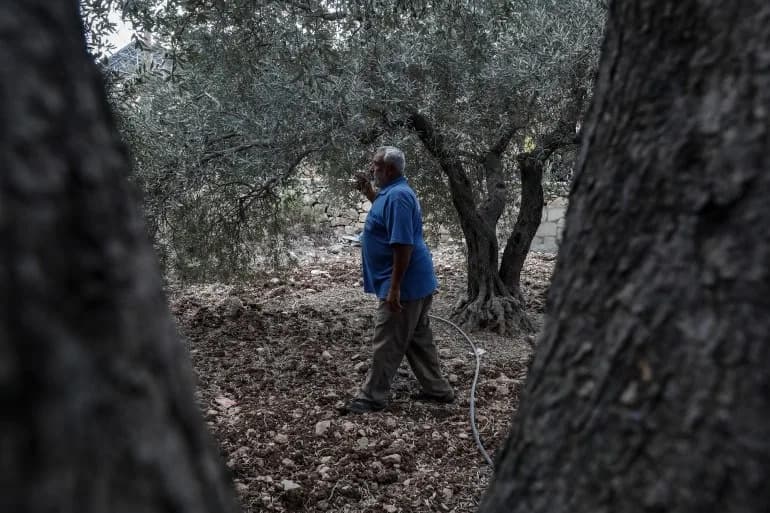
Adnan Kmail says Israeli forces confiscated his land and uprooted his olive trees [File: Mohamad Atiq/Al Jazeera]
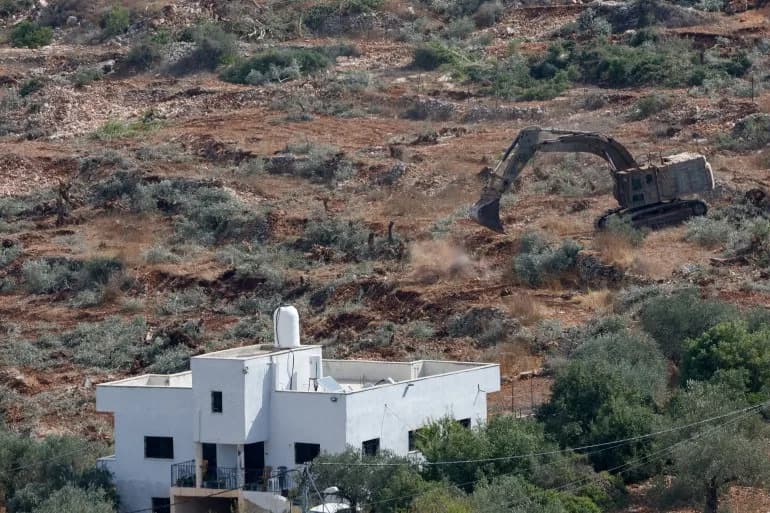
Al-Mughayyir, occupied West Bank — As the October olive harvest approaches, Bilal Abu Alia stands outside his home and looks over land his family says Israeli authorities have taken from them in the Palestinian village of al-Mughayyir, northeast of Ramallah. Once part of a 0.4 sq km (100-acre) holding, the family now has access to only a small plot containing their house and a few olive trees.
How the Blue Line Team Operates
The Israeli Civil Administration's so-called Blue Line team was formally established in 1999. According to a mid-September report by the National Bureau for Defending Land and Resisting Settlements (affiliated with the PLO), the team—composed of surveyors, cartographers and legal specialists—uses modern surveying tools and geographic information systems to review and redraw boundaries on official maps.
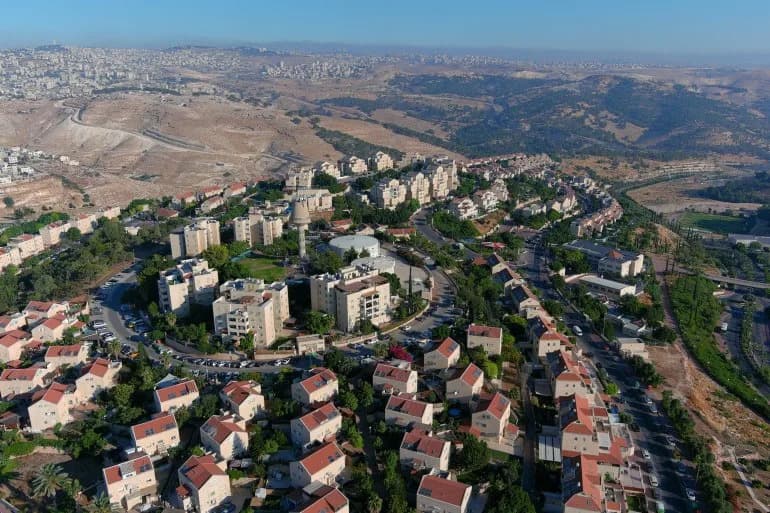
The practical effect of these technical exercises is that land newly recognised as "state land" can later be allocated to settlement projects. Israeli authorities describe the changes as technical corrections to historic surveying errors; the United Nations and Palestinian groups warn that the revisions have effectively expanded the area Israel declares as state property.
Stages Of Land Reclassification
The process often unfolds in stages: land is surveyed and boundaries are redrawn; it is then designated by Israeli authorities as "state land"; and finally it can be earmarked for settlement activity or other state uses. The bureau's report says recent exercises re-demarcated nearly 0.2 sq km (49 acres) in the northern and central West Bank, reclassifying parcels belonging to villages such as Jalud, Qaryut, Turmusayya and al-Mughayyir.
Local Impact: Al-Mughayyir
"We were told we could no longer access the land, that it had become a military zone and then state land," Bilal told Al Jazeera. "We watched the olive trees planted by my great-grandfather a century ago being bulldozed and we were powerless to stop it."
In August 2025, after an incident in which an Israeli settler was shot while encroaching on Palestinian land, Israeli forces carried out a four-day operation in al-Mughayyir. Bulldozers uprooted thousands of olive trees across much of the village, including the plot the Abu Alia family says was taken from them. In December 2025, when family members tried to salvage wood from the uprooted trees, they say they were arrested and held for three days.
The family says they were given only three days to submit a formal objection to the confiscation while bulldozers were already working on the site—leaving little realistic opportunity to challenge the move. They also report seeing settlers using the land under the protection of the Israeli army after the area was declared a closed military zone.
Wider Patterns Across the West Bank
The Blue Line team's activity is part of a broader system of measures affecting Palestinian land: military seizure orders, settler expansion, outposts, access-restricting roads, the separation barrier, and training zones. The National Bureau's report and local researchers say these instruments collectively encircle villages and limit residents' access to their farmland.
The bureau highlights recent military orders near Qabatiya, in the Jenin area, which it says have confiscated nearly 14 sq km (5.4 sq miles or almost 3,500 acres) in total. Raed Moqadi of the Land Research Center told Al Jazeera that work by the Blue Line team accelerated in 2026. The Palestinian Authority has filed objections with international institutions, but those actions have not, so far, stopped measures on the ground.
Livelihoods and Legal Remedies
For affected families the consequences are immediate and enduring: loss of income, destruction of century-old olive groves and restricted movement. Adnan Kmail, 62, says his family lost about 0.1 sq km (25 acres) and the olive trees that produced roughly 5,000 kg (11,000 lbs) of olives a season—income that sustained more than 70 relatives.
Palestinian officials and rights groups argue that legal avenues increasingly fail to protect owners' rights. They say many land disputes and commission decisions are resolved in favour of settlers, and that Israeli Supreme Court rulings no longer provide reliable redress for Palestinians disputing land claims.
International And Israeli Responses
Al Jazeera contacted Israeli authorities for comment but had not received a response at the time of reporting. International bodies including the UN have expressed concern about reclassification practices, calling for greater scrutiny of measures that change land status and enable settlement expansion.
Bottom line: What may begin as technical mapping and surveying can translate into permanent loss of land, livelihoods and access for Palestinian communities—especially where rapid reclassification precedes settlement activity.
Help us improve.