Outrage erupted in China after a video showed four boys beating puppies and setting their mother, Wang Wang, on fire. Authorities limited online discussion to protect the minors, but censorship fuelled broader public anger. Activists pushed the campaign offline and overseas — including billboards in Times Square and Taipei — and renewed calls for specific laws against animal cruelty in China.
After Censorship, Chinese Animal Advocates Take Protest Offline and Overseas Over Brutal Dog Killing

From Taiwan to the US, activists are lobbying for China to pass laws against animal cruelty [Supplied]
When disturbing footage surfaced in late June showing four boys beating puppies and setting their mother dog alight in Jieyang, Guangdong province, public outrage in China was immediate. Authorities quickly moved to restrict discussion online, citing concerns for the children involved, but the controls appear to have intensified the backlash — pushing activists to voice their protest offline and around the world.
What Happened
Video clips circulated online showing four boys, reportedly all under 14, striking three puppies with sticks and setting their mother, known as Wang Wang, on fire. The recordings captured the boys laughing as the dog burned, prompting widespread shock and grief.
Official Response and Censorship
Jieyang authorities said the boys would not face criminal charges because of their ages and that they would be sent to a 'specialised school', without providing further detail. Platforms were urged to remove related posts, with an official notice asking the public not to disseminate information, to reject cyberbullying and to protect minors' growth environment. Users report some posts being deleted or sharing restricted; at the same time, search terms like Wang Wang and animal protection continued to trend at times.

Animal cruelty is not punishable by law in China [Getty Images]
Why Discussion Was Limited
Many countries restrict the publication of identifying information about juvenile offenders to minimise psychological harm and avoid misidentification. Chinese censors said protecting the boys' identities was the reason for some removals, but partial clips and unverified close-up images purporting to show the boys' faces have continued to circulate, increasing the risk that other children could be wrongly identified.
Public Reaction: From Online Outcry to Global Campaigns
Rather than silencing the debate, the restrictions appear to have galvanized animal advocates. Inside China, thousands of comments continued to pour in on social platforms, and people organised offline displays — from stadium screens to shopping-mall ads. Several brands ran campaigns calling for an end to cruelty, and sellers listed stickers and decals depicting Wang Wang on major e-commerce sites.
Campaigners overseas amplified the story. In New York City, large digital screens in Times Square display photographs of Wang Wang roughly every 35 minutes with captions such as: 'She was loved. She wanted to live. She should still be here.' Near Taipei 101, a billboard shows Wang Wang nursing her puppies and carries the message: 'This planet is their home too. Justice for Wang Wang.' A Taiwanese donor reportedly paid NT$30,000 to rent one of the Taipei billboards.
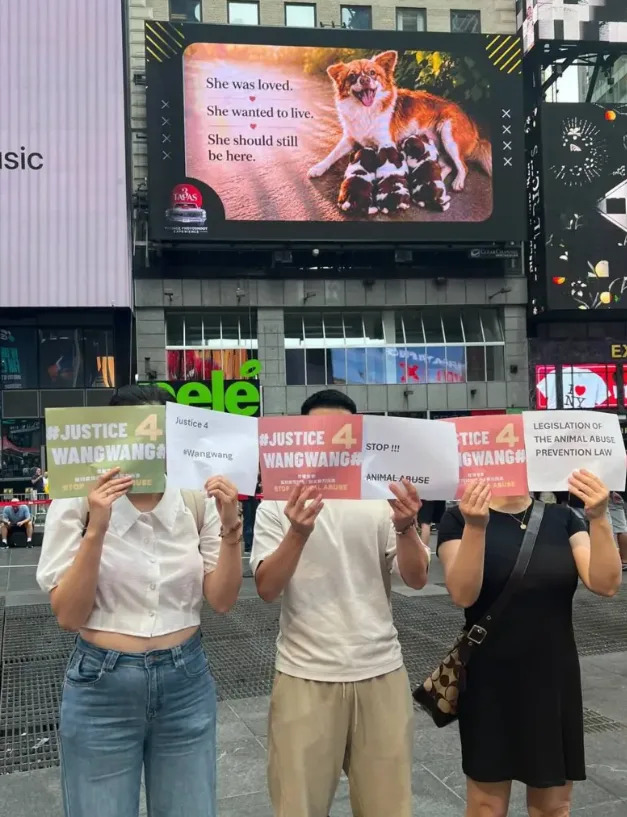
China's animal lovers have taken their fight global, with some putting up billboards in places as far away as New York [Supplied]
Activists have also translated summaries of the incident into more than 10 languages, raised funds for posters on public transit in Hong Kong and Macau, and sought support from international organisations. The International Organisation for Animal Protection in Italy said it received over 100 reports about the case and has requested more information from Chinese authorities.
Calls For Legal Reform
The episode has renewed domestic calls for explicit laws against animal cruelty in China. Activists and ordinary citizens alike are urging lawmakers to introduce clearer legal protections for animals and stronger enforcement mechanisms to deter abuse.
Ongoing Debate And Risks
While the case has mobilised many, it also raises concerns about vigilantism and misidentification when partial footage and unverified images spread online. Observers say balancing protection for minors with accountability and transparency will be a sensitive challenge for authorities, campaigners and the public.
Key takeaway: A brutal animal-abuse case sparked national anger and international activism, highlighting both China s censorship practices around juvenile suspects and a growing movement pushing for animal-protection laws.
Help us improve.