The Houthi‑declared naval blockade and the reversal of two Saudi crude tankers have put the Bab al‑Mandeb export corridor at risk, threatening Saudi Arabia's Yanbu workaround to bypass the Strait of Hormuz. Asian refiners are exploring a longer reroute via the Suez Canal, but that would add weeks to voyages, increase freight and fuel costs, and face logistical limits because many Saudi barrels ship on VLCCs that cannot transit Suez. Analysts warn limited substitution options and higher shipping costs could tighten supplies and push up oil prices.
Can the Suez Canal Avert an Asian Oil Shortage After Houthi Blockade of Bab al‑Mandeb?
A ship transits the Suez Canal towards the Red Sea [File: Sayed Hassan/Getty Images]
Two tankers carrying a combined 2.8 million barrels of Saudi crude reversed course in the Red Sea after Yemen's Houthi movement declared a naval blockade of Saudi ports, raising the prospect that the Bab al‑Mandeb strait — a key gateway to Asia — may be unsafe for commercial shipping, according to shipping analytics firm Kpler.
The vessels, the Rodos and the Xin Long Yang, had loaded at Yanbu on Saudi Arabia's Red Sea coast and turned north instead of transiting the strait that separates Yemen from the Horn of Africa. Their movements are the first clear, visible sign that Houthi threats are beginning to affect Saudi crude routing and underscore a growing vulnerability in Riyadh's efforts to protect energy exports amid wider regional tensions.
Why This Matters
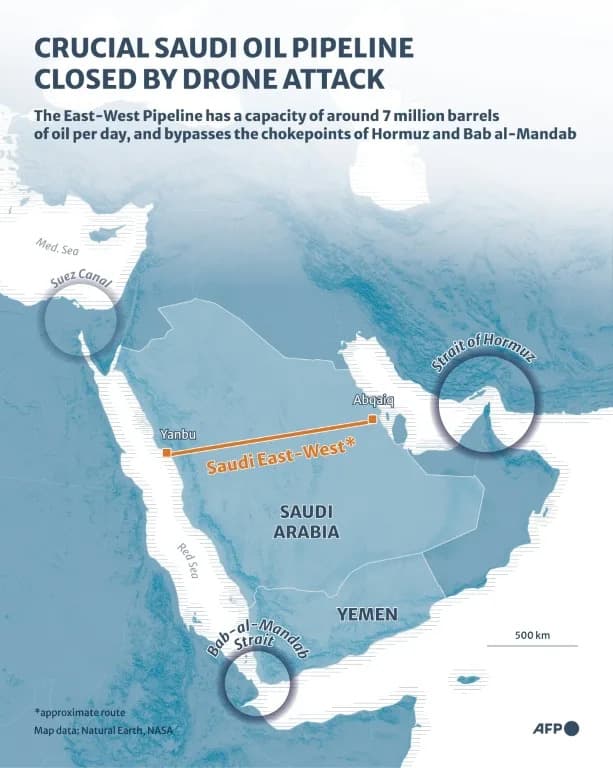
Before recent disruptions, Saudi Arabia had reduced its dependence on the Strait of Hormuz by pumping crude through pipelines to Yanbu and exporting via the Red Sea. That workaround helped offset the sharp fall in traffic through Hormuz amid heightened tensions involving Iran and restrictions on vessels calling at Iranian ports.
With shipping through Bab al‑Mandeb now under threat, the alternative corridor that helped lower Saudi reliance on Hormuz faces its own security risks. About 6 million barrels per day of crude currently pass through Bab al‑Mandeb to Asia, roughly two‑thirds of which originates in Saudi Arabia, Kpler estimates. In June, Yanbu exported about 4.1 million barrels per day — roughly 64% of the Saudi volume that otherwise would have transited Hormuz.
The Suez Option: Possible, But Costly
Asian refiners are considering a far longer diversion: routing oil northwest from Yanbu through the Suez Canal into the Mediterranean and then around Africa via the Cape of Good Hope to reach Asia. That route would avoid both Hormuz and Bab al‑Mandeb but would add weeks to voyages, materially raise freight and fuel costs, and introduce logistical bottlenecks.
Kpler calculates that a voyage from Yanbu to South Korea via the Suez route would increase transit time from about 24 days to roughly 54 days. Exact figures depend on the final destination, but most Asia‑bound voyages would be several weeks longer than the direct route across the Arabian Sea.
Logistics And Tanker Constraints
Most Saudi crude shipments from Yanbu load onto very large crude carriers (VLCCs). Fully laden VLCCs typically cannot transit the Suez Canal because of their deep drafts. Operators would therefore need to either:
- Transfer part of cargo (lightering) before the canal or use Egypt's SUMED pipeline, or
- Shift to smaller Suezmax tankers that can transit the canal — reducing per‑voyage volumes.
Both options add time and cost and may reduce overall export throughput unless terminal productivity is substantially increased.
"Redirecting cargoes through Suez would require a material shift towards Suezmax liftings or additional lightering operations," said Homayoun Falakshahi, head of crude oil analysis at Kpler. "Maintaining current export rates would require materially higher terminal productivity, making logistics the key bottleneck."
Market Impacts And Substitution Limits
Longer voyages would raise fuel consumption, insurance premiums and freight rates, shrinking effective tanker availability and supporting higher freight markets more broadly, Kpler analysts warn. If both Hormuz and Bab al‑Mandeb remain constrained, impacts would go beyond shipping — increasing import costs and tightening crude availability on international markets.
Alternatives such as boosting Russian, U.S. or Venezuelan supplies exist but come with limits: many Russian barrels to Asia also transit the Red Sea; U.S. and Venezuelan shipments imply much longer sailings and higher transport costs; and some suppliers face refining or capacity constraints. Marc Ayoub, an energy policy researcher, notes that refinery damage and near‑full utilisation in some regions reduce the ease of substitution.
Regional Exposure
Asia would likely feel the most acute impact. India is particularly exposed: more than half of its crude imports currently transit Bab al‑Mandeb, and it relies on the Strait of Hormuz for almost half of Gulf‑sourced oil. Other Asian importers with notable exposure include Pakistan (36%), the Philippines (37%), South Korea (31%), Japan (28%), Taiwan (22%) and China (19%), per Kpler estimates.
Security Context
This is not the first Red Sea campaign involving the Houthis. During previous operations between 2023 and 2025, the movement attacked commercial shipping with missiles, drones and small boats, causing several ships to be damaged or sunk and prompting a sharp drop in traffic through Bab al‑Mandeb. Independent monitors such as the Yemen Data Project have also documented civilian casualties from subsequent strikes in Yemen; one report records at least 238 civilian deaths from March 15 to May 6, 2025.
What To Watch Next
- Ship movements from Yanbu and vessel AIS transmissions for signs of further rerouting or lightering operations.
- Insurance and freight‑rate movements that reflect changing tanker availability and risk premia.
- Policy responses by Saudi Arabia, Egypt (SUMED and Suez operations) and regional naval escorts or ceasefire developments that might restore safe passage.
In short, the Suez Canal could help keep some barrels flowing to Asia, but it cannot fully replace the speed, scale and cost advantages of the direct routes through Hormuz and Bab al‑Mandeb. Prolonged pressure on both chokepoints would raise costs for Asian importers, tighten global freight markets and sustain upward pressure on oil prices.
Help us improve.