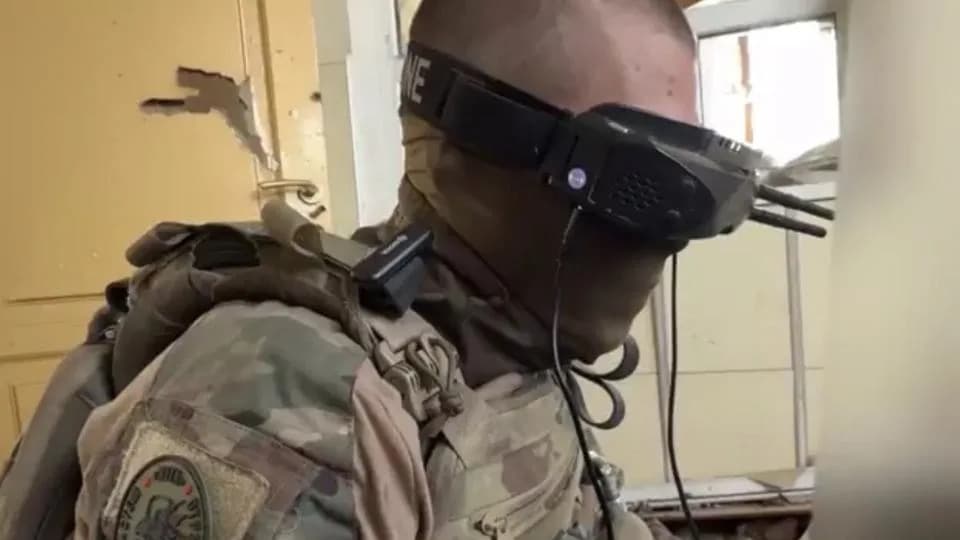
Leaked images show frontline units mounting $2 magnetic compasses under Molniya drone FPV cameras. The compasses give pilots a quick visual heading when GPS or radio links are jammed. Molniya drones commonly use ExpressLRS for ranges up to ~62 miles (100 km) or a fibre-optic tether for jamming resistance but limited range (~18 miles/30 km). The field-installed compasses are crude but effective in contested airspace.
Russian Units Screw $2 Magnetic Compasses Onto Molniya Drones to Bypass GPS and Radio Jamming

Credit: Lamp of Knowledge/YouTube
Frontline Russian units have reportedly begun attaching inexpensive magnetic compasses to Molniya drones as a low-tech countermeasure against GPS and radio jamming, according to The Defence Blog and leaked images.
How the modification works
Crews mount small mechanical compasses just beneath the drone's FPV (first-person-view) camera, typically fastening them with five Phillips screws to a nearby panel. Pilots can glance at the compass during flight to confirm heading; when combined with telemetry and other onboard data, the instrument helps estimate position if satellite navigation or radio links are disrupted.
Why crews are doing it
GPS disruption and electronic warfare are common over parts of Ukraine, and losing satellite navigation or control links can cause drones to stray from their intended routes. The Molniya is a relatively cheap, medium-range UAV that commonly uses the open-source ExpressLRS radio-control system—capable of theoretical ranges up to about 62 miles (100 km)—but operators also adopt other measures to reduce vulnerability.
Some operators use a fibre-optic tether to eliminate electronic interference entirely; this makes the drone virtually immune to jamming but limits range to roughly 18 miles (30 km). Others have experimented with routing control through Starlink, although reports say Ukraine’s requirement to register Starlink terminals inside the country has complicated that option.
Field improvisation and effectiveness
The five-screw mounting and plainly visible wiring in the leaked photograph suggest the compass is a field-installed modification rather than a factory upgrade. Observers have mocked the crude appearance as a backward step for a military that touts advanced capabilities, but the reality is pragmatic: when high-tech systems fail or are degraded, a <$2 mechanical compass can provide a simple, robust means to maintain bearings and complete missions.
Implications
This adaptation highlights how modern conflicts mix high-end electronic warfare with everyday improvisation. Low-cost, reliable tools—no matter how unsophisticated—can materially increase the survivability and mission success of unmanned systems operating in contested airspace.
Help us improve.