The Michael Center for Spiritual Liberation and Exorcism in Metro Manila operates as Asia’s only dedicated exorcism centre and training school for clergy, combining ritual practice with mandatory clinical assessments. The two-storey centre hosts priests from across the region and pairs spiritual rites with psychologists, psychiatrists and neurologists. Mental-health experts warn that supernatural explanations can delay diagnosis in a country with limited psychiatric resources, but doctors and clergy stress culturally sensitive cooperation.
Faith vs. Therapy: Inside Asia’s Only Exorcism School in Manila
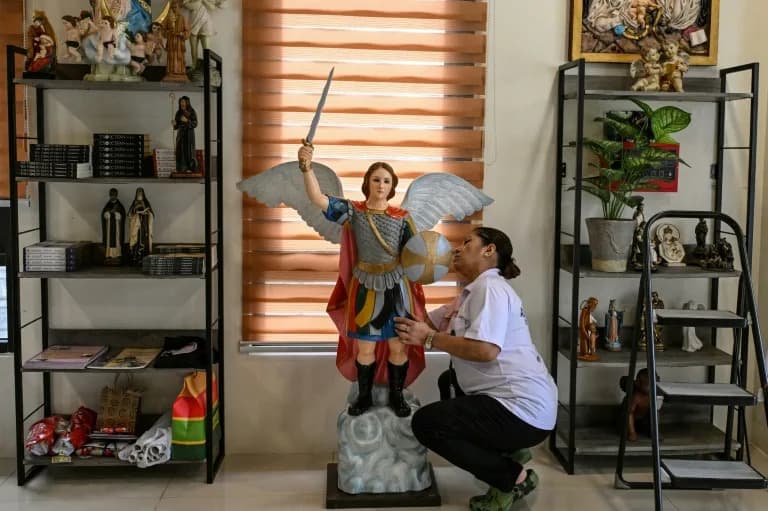
An exorcism centre in the Philippines says demands is steady for both the ritual and training of exorcists (Jam STA ROSA)
The Michael Center for Spiritual Liberation and Exorcism, located just off a busy thoroughfare in Metro Manila, bills itself as Asia’s only dedicated facility that both performs exorcisms and trains clergy from across the region. Open for roughly five months, the two-storey centre combines ritual practice with clinical assessment as it seeks to differentiate spiritual concerns from medical or psychological conditions.
A Purpose-Built Facility
Visitors stay in neatly arranged rooms that open onto warmly lit corridors leading to a chapel where a ritual with roots stretching back about 400 years is performed. One wall displays holy relics used in the rites, while another features a one-way mirror so family members and trainee exorcists can observe without interrupting the proceedings.
Training Clergy, Regionally
Father Jose Francisco Syquia, who helped establish the Michael Center, told AFP the centre was created because "cases were piling up." Financed largely by donations from families of those previously treated there, the facility has drawn interest from priests across Southeast Asia, including Singapore, Malaysia, Cambodia and India. A central element of training is learning to distinguish problems with psychological or neurological causes from those clergy consider spiritual.
Clinical Oversight and Church Practice
Although the centre is not under tight Vatican supervision, it follows long-standing Church guidelines on exorcism, including mandatory vetting by mental health professionals. "We have clinical psychologists. We have a psychiatrist... There are also neurologists, so they work hand in hand with us," Syquia said during a tour. He also said he can recognise signs of demonic possession: "You will see a change in behaviour... a different consciousness. Something else takes over a person."
"When it comes to the spiritual world, we need something beyond science."
— Father Jose Francisco Syquia
Concerns From Mental Health Experts
Mental health professionals warn that attributing unexplained behaviour to supernatural causes can delay or prevent appropriate clinical care. Christopher French, a psychologist and emeritus professor at the University of London, told AFP that failing to recognise medical conditions can be dangerous: historically, illnesses such as schizophrenia and Tourette’s were misinterpreted as spirit possession.
Dr Kathryn Tan, a Manila-based psychiatrist, noted that the Philippines has limited psychiatric resources—roughly one psychiatrist per 200,000 people according to the World Health Organization—and that stigma often drives families to seek spiritual remedies first. "It's a lot of stigma when somebody is brought to a psychiatrist," she said, adding that many patients consult indigenous healers before seeking psychiatric help and that alleged possessions often present with symptoms consistent with psychosis.
Finding Common Ground
Both clinicians and clergy interviewed emphasised the importance of cultural sensitivity. French suggested clinicians can adapt treatment to patients' belief systems without explicitly endorsing supernatural explanations, and acknowledged that rituals such as exorcism might produce a placebo or therapeutic effect in some cases. Syquia voiced a similar willingness to cooperate: "We're... focusing on the spiritual dimension. But of course, the body is always part of that." He also conceded that wider investment in mental health services could reduce the number of cases referred to the centre.
"Science is a gift from God." he said, reflecting the centre's stated aim to integrate pastoral care with clinical assessment.
Reporting credited to AFP. The centre is five months old at the time of reporting; details reflect statements made by clergy and clinicians during that period.
Help us improve.