AI deepfakes are being used in romance scams that impersonate Dubai's crown prince to build trust and extract money. A Filipino woman known as Maria lost 100,000 pesos after video calls with a lifelike fake and later discovered links to Nigeria. Scammers exploit the prince’s large online profile and manipulate images and poems to deceive victims; investigators warn that real-time face-swapping and international payment routes make these frauds harder to trace.
AI Deepfake Romance Scam: 'Fake Dubai Prince' Steals Victim's Savings
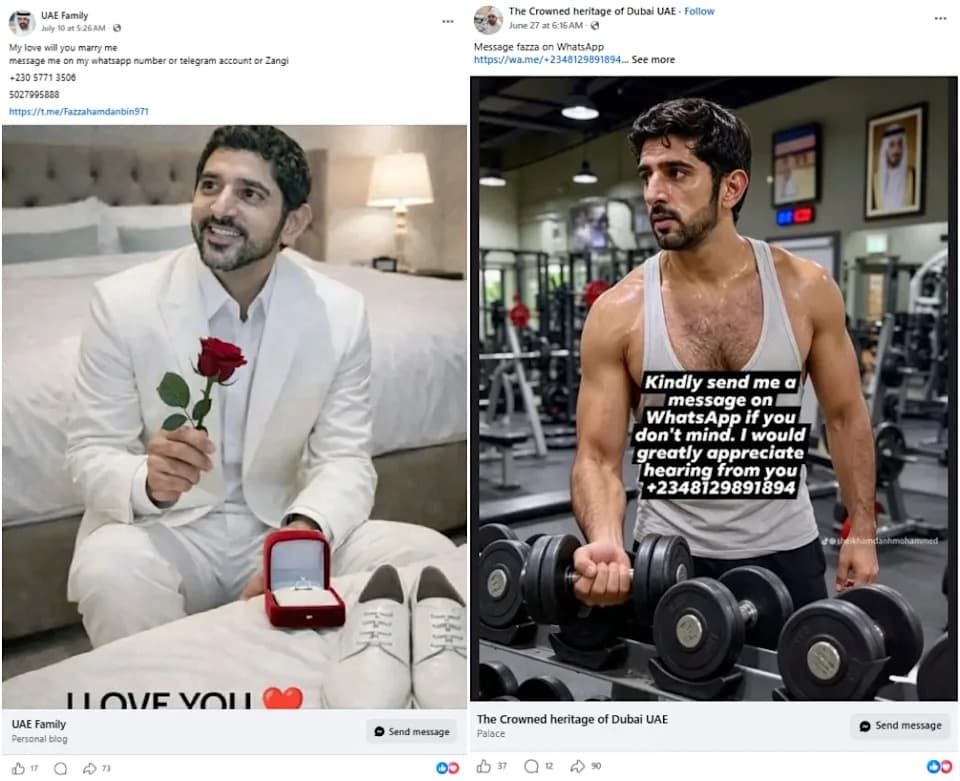
Screenshots of posts from Facebook groups that shared AI-generated images of Prince Hamdan bin Mohammed, taken on July 13, 2026
A Filipino domestic worker, identified in reports only as Maria, believed she was in a relationship with Prince Hamdan bin Mohammed of Dubai after a series of lifelike video calls. The suitor, however, was an AI-powered deepfake used by fraudsters to build trust and extract money.
How the Scam Unfolded
Maria first encountered the impostor on a dating site. The conversation quickly moved to a messaging app, where she received constant affectionate messages and frequent video calls. In a WhatsApp recording reviewed by AFP, the figure on screen looked convincingly like the crown prince, with lip movements synchronized to the speech — though the voice did not match the real prince.
"He kept on messaging me even when I was sleeping," Maria told AFP. "It felt like there was a love spell that connected our minds."
Convinced by the ruse, Maria was persuaded to pay roughly 100,000 Philippine pesos (about $1,625) for what the scammer described as a marriage certificate and a "royal membership card" — documents he claimed would help her obtain work in Dubai. Her suspicions were raised when the impostor proposed meeting in a hotel and then demanded an additional 60,000 pesos (about $974) to cover the booking. A closer look at the fake profile — since removed — showed links to Nigeria, prompting her to cut off contact and send one final message: "Go to hell, scammer."
Wider Pattern And Methods
This incident is part of a broader pattern of "fake Dubai prince" romance scams. Scammers exploit the real crown prince's large online presence — he has more than 17 million Instagram followers — and sometimes reuse his genuine poems and images to add credibility to their profiles. AFP found Facebook groups impersonating the royal that steered followers to private chats on WhatsApp and Telegram.
Scam pages post manipulated images — for example, the prince on one knee with a ring or offering a rose with a flirtatious caption — and mix convincing visuals with emotional messaging. While some users warn others in the comments, many react with hearts and kiss emojis, which helps the scams appear legitimate to new victims.
Technology And Financial Channels
Investigations have traced some operations to organized crime syndicates in Nigeria. Perpetrators often request payments through banks in countries other than the victim’s own or via cryptocurrencies, complicating efforts to trace and recover funds. The Global Anti-Scam Alliance estimates consumers worldwide lost about $442 billion to scams, including romance fraud, last year.
Experts warn the growing availability of AI face‑swapping and motion‑control tools is making real-time deepfakes more realistic and harder to detect. "The technology is improving rapidly, and it is likely that soon real-time video deepfakes will become better and better," Cornell University’s David Rand told AFP. "Once this happens, it becomes fundamentally impossible to tell whether any not‑in‑person conversation is real."
Protection Tips
- Verify profiles using reverse image searches and check for inconsistencies (location, language, mutual contacts).
- Be cautious of anyone who asks for money, especially through unfamiliar banks or cryptocurrency channels.
- Ask to conduct video calls in ways that make spoofing harder (ask for real-time, specific actions or gestures).
- Report suspicious accounts to the platform and local authorities; consider contacting your embassy if the scam involves promises of overseas work.
Dubai authorities did not respond to AFP’s request for comment in the reports. Awareness campaigns and community groups — such as Instagram accounts and petitions urging the prince’s team to warn the public — have sprung up to alert potential victims.
Help us improve.