Archaeologists are studying a bronze sword found standing upright in a forest near Gdańsk, dating to about 900–700 BC. The discoverer, metal detectorist Marcin Wiśniewski, left the sword in place and reported it, enabling professionals to excavate and document it in situ. Measuring 60 cm and covered in green patina, the high‑value blade may have been deposited as a ritual offering. Specialists will use X‑rays, alloy analysis and microscopic wear studies to determine how it was made and whether it saw combat or was ceremonial.
2,700‑Year‑Old Bronze Sword Found Standing in Polish Forest — Possible Ritual Offering
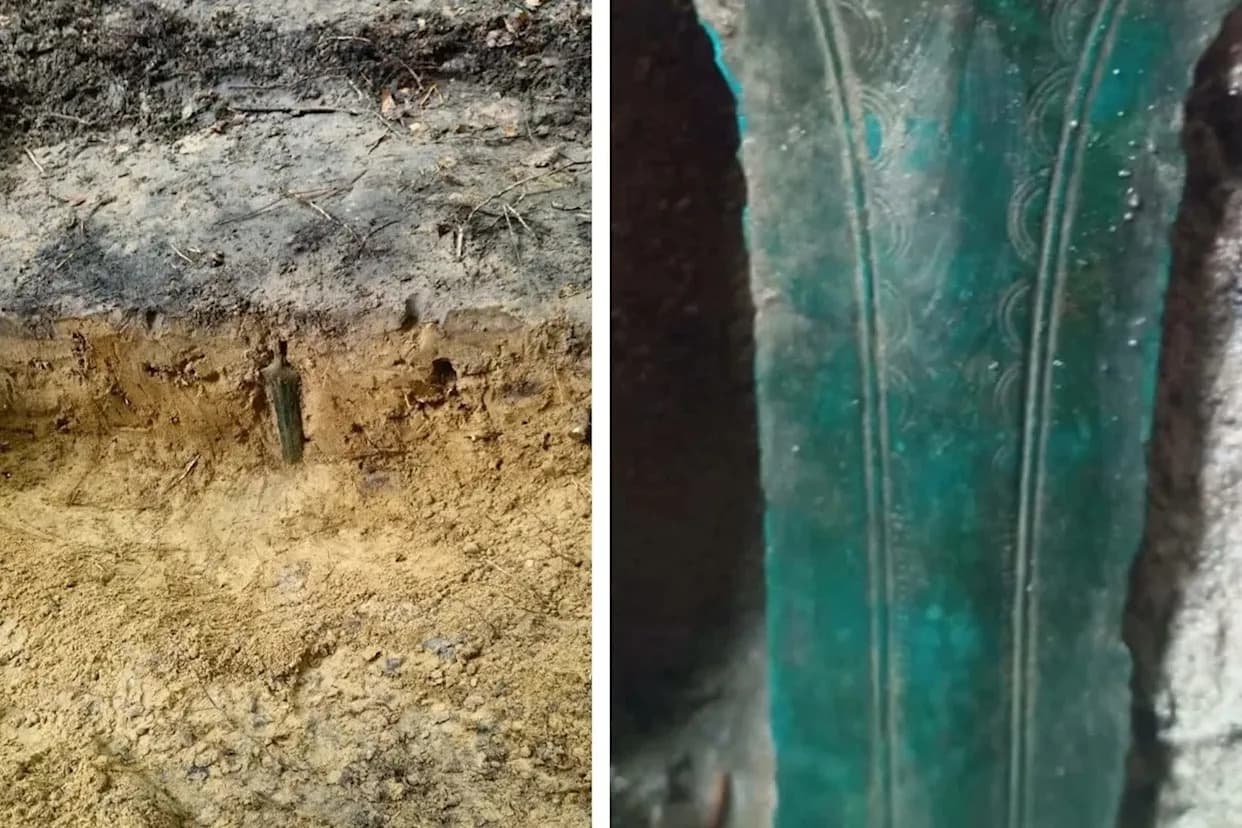
Photo Credit: Pomeranian Voivodeship Conservator of Monuments
Archaeologists are examining a bronze sword estimated to be about 2,700 years old after it was discovered standing vertically in sandy soil in a forest near Gdańsk, northern Poland. Its unusual upright position has prompted experts to consider that the weapon may have been deliberately deposited rather than simply lost.
The find attracted extra attention because the discoverer, experienced metal detectorist Marcin Wiśniewski, chose not to remove the sword. He alerted authorities and left the object in place, allowing professional archaeologists to excavate and document the weapon exactly as it was found.
Images released by heritage officials show a striking blade coated in a green patina. Decorative grooves, engraved arcs and short transverse lines remain visible despite centuries underground. Measuring 23.6 inches (60 centimetres), the sword dates to roughly 900–700 BC. Its narrow tang indicates it once supported a grip of wood, bone or antler.
No additional objects were recovered immediately nearby, but specialists stress that the context and position of an artifact can be as informative as the object itself. The sword’s vertical placement makes accidental loss less likely and strengthens the case for a ritual or symbolic deposition.
Poland’s State Forests told Heritage Daily the sword may have been worth "the equivalent of an entire herd of cattle," highlighting its value as a prestige object in the late Bronze Age.
Because the sword remained undisturbed, researchers can now apply non‑destructive and microscopic techniques to learn more: X‑ray imaging to view internal features, alloy and metallurgical testing to identify composition and manufacturing methods, microscopic wear analysis to detect combat use or symbolic manufacture, and careful study of soil layers and positioning to reconstruct depositional circumstances.
Similar intentional weapon deposits have been recorded elsewhere in Europe, but they are relatively rare. If confirmed as a deliberate offering, this blade could shed light on how communities in northern Europe expressed status, belief or remembrance nearly three millennia ago.
Officials praised Wiśniewski’s handling of the find: the Provincial Office for the Protection of Monuments described his cooperation with archaeologists as "excellent" and called his decision to report and leave the sword "commendable." Researchers continue analysis to determine whether the weapon was made for combat, ceremony or both.
Help us improve.