The League has plunged to about 6% from 34% in 2019, eroding Matteo Salvini's influence and threatening the strength of Prime Minister Giorgia Meloni's right‑wing coalition ahead of the 2027 general election. A February breakaway group, Futuro Nazionale, and rising internal divisions have accelerated the slump. Transport failures and stalled projects have damaged Salvini's standing, and proposed tactical moves — including a return to the interior ministry — have met a cool reception.
Salvini's Slide Threatens Meloni's Re-Election as League Slumps to 6%
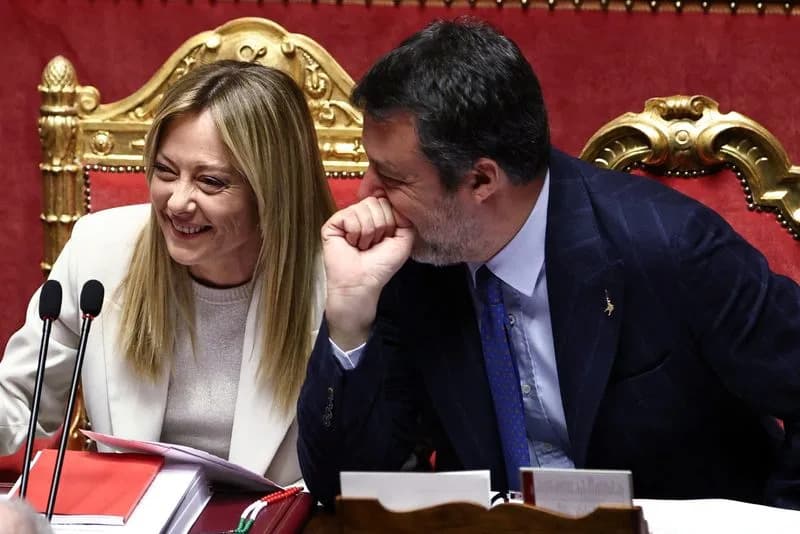
Italy's Prime Minister Giorgia Meloni laughs as she listens to Deputy Prime Minister Matteo Salvini during a session at Italy's Senate in Rome, Italy, March 11, 2026. REUTERS/Matteo Minnella
Matteo Salvini, once hailed as "the captain" for driving the League from a regional northern movement to a dominant national force, is facing a sharp drop in support that could imperil Prime Minister Giorgia Meloni's coalition ahead of the next general election, due in 2027.
Polling Collapse and New Rivals
Polls from YouTrend put the League at roughly 6% — a steep decline from the 34% the party won in the 2019 European Parliament elections. That fall accelerated after a former Salvini ally launched Futuro Nazionale in February, a breakaway grouping that has drawn voters further to the right.
Why Salvini Is Losing Ground
Observers say Salvini's long tenure and repeated spells in government have dulled the League's anti-establishment appeal. "There are no leaders for all seasons," Lorenzo Pregliasco of YouTrend said, characterising the shift as a natural leadership cycle after more than a decade in the spotlight.
Internally, the party has become increasingly fractious. Meetings that were once routine have grown tense, with members openly criticising Salvini and debating whether to return the party's focus to local northern issues or to pursue a broader national strategy.
Leadership Options and Regional Stakes
Media speculation has named possible successors from the north, including Luca Zaia, former governor of Veneto, and Massimiliano Fedriga, president of Friuli-Venezia Giulia. Fedriga has urged the party to prioritise a long-delayed push for greater regional autonomy rather than rely on slogan-driven promises.
Riccardo Molinari, the League's leader in the lower house, defended the party's record in government but acknowledged that Meloni's popularity has overshadowed Salvini. "The League has done a good job, but it is not always recognised, as it is overshadowed by the dominance of the prime minister," he said.
Damaged Record and Last-Ditch Moves
Since Meloni became prime minister in 2022, Salvini has served as transport minister. Recurrent rail delays and the stalled Sicily-Calabria bridge project have dented his reputation. Some allies floated a return to the interior ministry — a post Salvini held in 2018–19 — hoping his hardline migration stance might revive support, but the proposal drew a cool response within the coalition.
Polls suggest migration is no longer the top voter concern; inflation and economic pressures linked to global events now rank higher. As senior League figure Stefano Candiani put it: "That was fine when the country was in good shape, not with the fuel prices rising." A planned rally near Treviso was cancelled to allow time to rework the party's relaunch strategy, a sign of growing unease.
Outlook
Salvini's decline is reshaping the Italian right. Unless the League can quickly stabilise and reconsolidate support — either behind Salvini or a new leader — Meloni's coalition may head into the 2027 vote with a weakened partner, complicating efforts to hold together a right-wing majority.
Reporting note: This summary synthesises reporting and quotes from party officials and pollsters to clarify current dynamics within the League and their implications for Italy's broader political landscape.
Help us improve.