The planned sale of the Wilbur J. Cohen Federal Building — home to a premier collection of New Deal murals, including Ben Shahn frescoes — may be paused after federal testimony revealed practical complications. A GSA analyst told the Public Buildings Reform Board that the Cohen shares underground heating and electrical systems with the adjacent Mary E. Switzer Building, making separation costly. Coupled with recent below-market property sales in Southwest D.C., the revelation has prompted officials to reconsider disposal and raises the likelihood the Cohen will be retained and rehabilitated rather than sold.
‘Sistine Chapel of the New Deal’ May Be Saved: Sale Of Wilbur J. Cohen Building Likely Paused
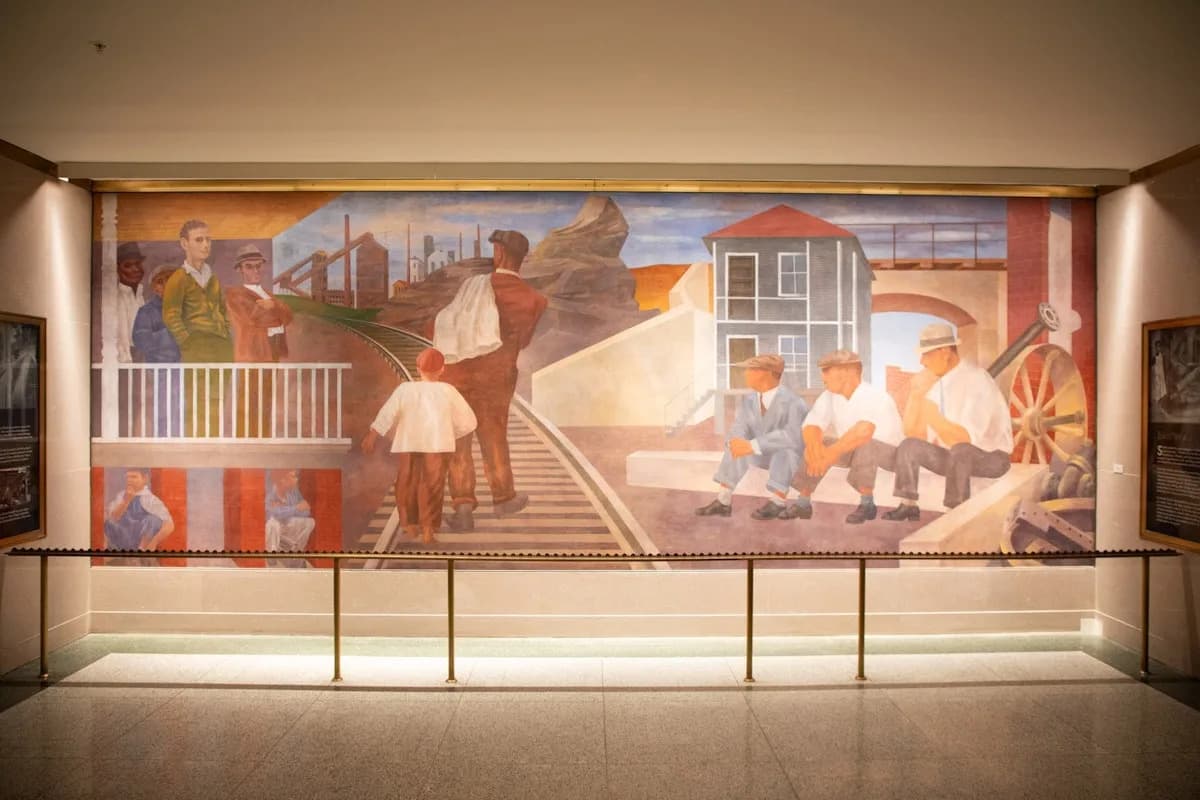
After nine months of warnings from preservation advocates, a planned sale of the Wilbur J. Cohen Federal Building — home to one of Washington, D.C.’s richest collections of New Deal murals — appears to be on hold. The building houses a celebrated series of Ben Shahn frescoes running along a 70-foot lobby corridor, which Shahn called “the best work I’ve done,” alongside important works by Philip Guston, Seymour Fogel and others. Those works would be difficult and costly to remove and conserve.
New Turn at a Public Hearing
This week the Public Buildings Reform Board (PBRB) signaled it may slow or pause efforts to dispose of the 1.2 million–square–foot Cohen building at 330 Independence Ave. SW. That shift followed testimony by Rich Butterworth, a senior analyst in the General Services Administration (GSA)’s Office of Real Property Utilization and Disposal, revealing a practical complication: the Cohen shares key underground mechanical systems with its twin across C Street, the Mary E. Switzer Memorial Federal Building, which is not slated for sale.
Butterworth (paraphrased): “Infrastructure complications with the Cohen Building are prompting officials to consider pulling it from a disposal list and instead reinvesting in the property for continued government use.”
Why Shared Utilities Matter
Both buildings were designed at the same time by architect Charles Z. Klauder in an Egyptian-Revival–meets–Art-Deco idiom. To save money, Klauder routed heating, electrical and other mechanical systems so the two structures share underground ducts and equipment beneath C Street. Separating the buildings would require replicating or severing those utilities — a process Butterworth warned would be “extremely expensive” and could cost the government more money, not less.
That engineering reality gives Congress a clear, nonpartisan fiscal rationale to reconsider the sale. It also provides preservationists with a practical argument that complements cultural and historical concerns about the murals.
Context: Fire Sales and Bipartisan Signals
Late last year the administration moved aggressively to divest several properties in Southwest D.C., even soliciting demolition bids that critics say prioritized land value over the buildings themselves. Two properties later sold this spring at roughly one-tenth and one-fifth of market value amid a weak local commercial market; a third high-profile sale, the Old Post Office, also closed below expectations and has been the subject of broader controversy.
Earlier this month an appropriations amendment from Rep. Chellie Pingree (D-ME) that would have forced public release of a GSA feasibility study received two Republican votes in the House — a small, bipartisan sign of interest in preserving the Cohen. Still, the building remains on the accelerated disposal list, and Senator Joni Ernst previously inserted language into a water resources bill pushing for its sale.
Reactions From Advocates
Mary Okin of the nonprofit Living New Deal said she welcomes any public signal that the Cohen’s sale may be halted, but she remains cautious while the building remains listed for accelerated disposal. Preservationists and members of the public who have spent months drawing attention to the murals say the shared-utilities revelation is an unexpected but welcome development.
As the PBRB and GSA reassess the costs and logistics, the most plausible near-term outcome is retention and reinvestment: repairing and repurposing the Cohen to raise its utilization rate, rather than attempting a costly separation and sale that could jeopardize the art and cost taxpayers more.
What Happens Next
The PBRB must weigh the financial analysis, market conditions in Southwest D.C., and coordination with the District government on any master redevelopment plan. If officials conclude that separating the two buildings is impractical or uneconomic, Congress and the GSA will have a stronger basis to remove the Cohen from disposal lists and fund its rehabilitation.
For advocates of public art, the murals’ future may hinge less on rhetoric and more on pipes, ducts and the engineering work beneath a city street — an odd but powerful lever in the fight to protect these New Deal treasures.
Help us improve.