ASIO Director‑General Mike Burgess warned that Australia’s security environment is deteriorating amid overlapping threats from hostile states, cyber actors and antisemitic extremists. He said the official terrorism threat level of “probable” understates the concurrent and compounding risks, citing rapid online radicalisation, state‑backed cyber operations, arson attacks on Jewish businesses and the Bondi mass shooting. Burgess also warned foreign spies are targeting AUKUS‑related secrets and urged continued vigilance and resourcing for security agencies.
Spy Chief Warns Australia’s Security Environment Is Deteriorating as Multiple Threats Multiply
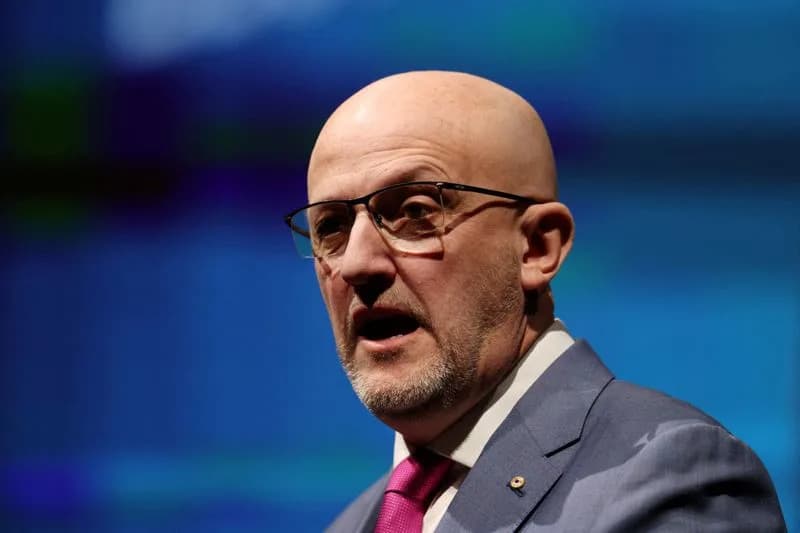
Mike Burgess, Australian Security Intelligence Organisation (ASIO) Director-General of Security, delivers the 2025 Lowy Lecture in Sydney, Australia, November 4, 2025. REUTERS/Hollie Adams
Australia is facing a widening and increasingly complex set of national security threats — from hostile state actors and state-sponsored cyber operations to rapidly spreading online radicalisation and antisemitic violence — that together are degrading the country’s security environment, the head of the Australian Security Intelligence Organisation (ASIO) warned.
Concurrent, Cascading Threats
ASIO Director‑General Mike Burgess told an audience that while the national terrorism threat level remains at “probable,” that label does not reflect the “concurrent, cascading and compounding threats” authorities are monitoring. He cautioned that the overall environment is worsening and politically motivated violence is becoming more likely than the current shorthand suggests.
Domestic Incidents and Online Radicalisation
Burgess highlighted several recent, high‑profile incidents that illustrate the risk landscape: rapid radicalisation on encrypted chat platforms, state‑sponsored cyberattacks, arson attacks targeting Jewish businesses and a deadly mass shooting at a Hanukkah event in Bondi that killed 15 people. He warned encrypted messaging apps can radicalise individuals, including minors, within weeks, while mainstream social media accelerates grievance narratives, erodes trust in institutions and amplifies polarising rhetoric.
Foreign Espionage and AUKUS Risks
Foreign intelligence services are actively seeking classified information related to Australia’s AUKUS nuclear submarine partnership with the United States and Britain, Burgess said. He described attempts to target security‑cleared officials, including contact from people posing as legitimate consultants to gain access to sensitive material.
Allegations of Iran‑Linked Attacks
ASIO has linked a series of arson attacks on Jewish businesses since the Gaza conflict began to Iranian direction, saying investigators believe at least one Sydney attack was coordinated by an Australian citizen acting as an agent of Iran’s Islamic Revolutionary Guard Corps. The Iranian embassy did not immediately respond to requests for comment.
“Thankfully, no‑one died as a result of the arson attacks... but I do worry that one day an Australian will be killed at the hands of a foreign government here in Australia,” Burgess warned.
ASIO’s Response and Limits
Burgess emphasised that ASIO and partner agencies continue to work around the clock to keep Australians safe: the agency says it has disrupted 31 major terror plots since 2014 and has managed more than a dozen significant terror‑related investigations since the Bondi attack. He acknowledged, however, that intelligence agencies cannot prevent every attack or uncover every spy, and resources must be balanced across competing threats.
What This Means: The combination of domestic radicalisation, foreign espionage and state‑linked malign activity creates a more volatile and unpredictable security environment. Authorities are urging vigilance, investment in counter‑radicalisation and cyber defences, and improved information‑sharing across government and industry.
Help us improve.