China announced sanctions blocking exports of certain dual-use items to 10 U.S. defense-linked companies and barred government agencies from buying products from 46 American firms. The Commerce Ministry said the measures protect national security and respond to what it called the U.S. expansion of a list of Chinese military-linked companies. Beijing also barred third parties from routing dual-use items from China to the sanctioned firms, while allowing export approvals for genuinely necessary goods. Analysts described the actions as largely symbolic but significant politically, reflecting an escalation in U.S.-China tech and trade tensions.
China Retaliates: Blocks Dual-Use Exports To 10 U.S. Defense-Linked Firms
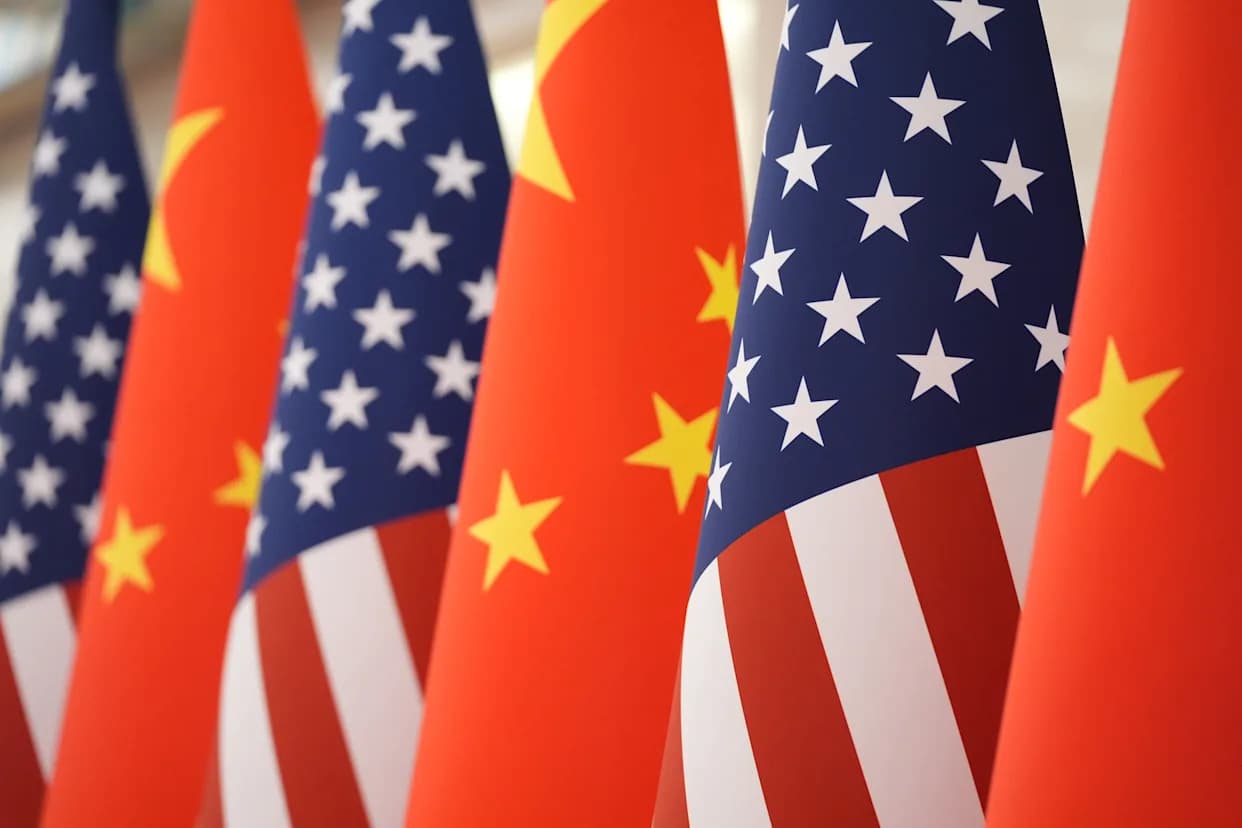
FILE - The U.S. and Chinese flag at the Great Hall of the People prior to the state dinner of President Donald Trump and Chinese President Xi Jinping on May 14, 2026, in Beijing. (AP Photo/Mark Schiefelbein, File)(AP Photo/Mark Schiefelbein)
BEIJING — China on Monday announced targeted sanctions on 10 U.S. companies tied to the defense sector, barring exports of certain "dual-use" items in response to recent U.S. measures that restrict several major Chinese tech firms from receiving U.S. defense contracts.
What Beijing announced
The Ministry of Commerce said Chinese exporters will be prohibited from shipping dual-use goods—items that can serve both civilian and military purposes—to the 10 named American companies. It framed the move as both a protection of national security and a response to what it called the U.S. government's "wrongful expansion" of its list of Chinese military-linked firms.
The Commerce Ministry also said that companies or individuals in third countries are barred from transferring dual-use items from China to the sanctioned U.S. firms. The ministry added that Chinese companies can still apply for export approvals when goods are judged to be "genuinely necessary."
Separate Finance Ministry action
China's Ministry of Finance announced a separate restriction barring government entities from buying products from 46 U.S. companies. The short statement named multiple units tied to Lockheed Martin, Raytheon and General Dynamics but did not give further explanation.
Context and reactions
Earlier this month, the U.S. Department of Defense added several Chinese tech companies, including Alibaba and Baidu, to a list of firms it says have ties to the Chinese military. Baidu has publicly denied the characterization, calling it "totally baseless."
"Most of them are U.S. defense industry players or they have close connections with the U.S. government for contracts and other reasons," said George Chen, partner for Greater China at advisory firm The Asia Group. "Those companies are not going to do business in China, so the impact will be quite symbolic."
The Commerce Ministry also noted the U.S. action ran counter to the understandings reached by Chinese leader Xi Jinping and U.S. President Donald Trump during the latter's visit to China in May.
Companies named by Beijing
- AVEOX (Simi Valley, California)
- Red Cat Holdings (South Salt Lake, Utah)
- Teal Drones (South Salt Lake, Utah)
- IMSAR (Springville, Utah)
- Jaia Robotics (Bristol, Rhode Island)
- Ball Aerospace & Technologies (Broomfield, Colorado)
- Oshkosh Defense (Oshkosh, Wisconsin)
- L3Harris Maritime Services (Norfolk, Virginia)
- MP Materials (Las Vegas, Nevada)
- USA Rare Earth (Stillwater, Oklahoma)
Several of the companies are involved in drone manufacturing, defense systems or critical supply chains such as rare-earth mining—areas that have become focal points in U.S.-China technology and trade tensions.
Implications
Beijing's package of measures represents a direct, calculated tit-for-tat response designed to signal displeasure and raise costs for U.S. restrictions on Chinese tech firms. While analysts caution that the immediate economic impact on the named companies may be limited—some already have limited business exposure to China—the moves underscore growing strategic competition over technologies and supply chains between the world's two largest economies.
Help us improve.