The FDA has told uniQure it may pursue accelerated approval for AMT‑130, an investigational gene therapy that has shown signs of slowing Huntington’s disease. UniQure plans to base its Biologics License Application on a three‑year trial analysis and aims to file in Q3 2026. Patient groups welcomed the decision, which removes the need for a new trial with a controversial sham‑surgery control, but confirmatory post‑approval studies will still be required.
FDA Reverses Course — UniQure Can Seek Accelerated Approval For AMT‑130, A Potential Huntington’s Therapy
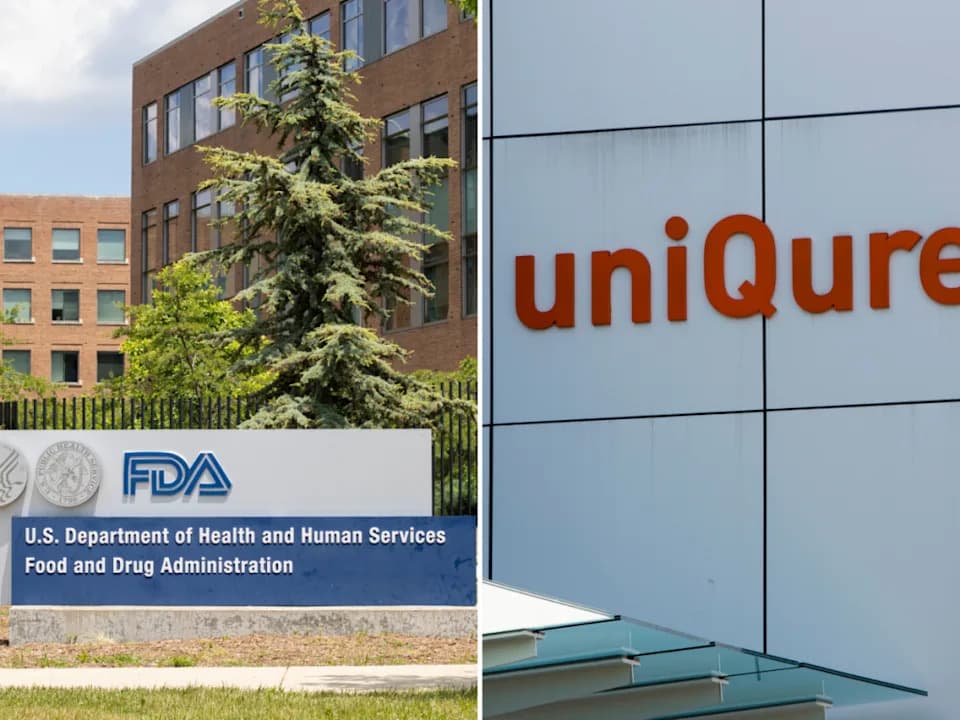
Left, a file photo of the FDA campus in Maryland. Right, an image of a uniQure facility in Lexington, Massachusetts in 2016.
The U.S. Food and Drug Administration (FDA) has reversed an earlier position and told Dutch biotech uniQure that it may pursue accelerated approval for AMT‑130, the company’s investigational gene therapy for Huntington’s disease. The decision clears a major regulatory hurdle after agency officials earlier this year expressed skepticism about the program’s data.
What Changed
UniQure announced this week that the FDA will accept a Biologics License Application (BLA) that relies primarily on a three‑year analysis from an earlier-stage clinical trial as the basis for accelerated approval. The company said it plans to submit the BLA in the third quarter of 2026.
About AMT‑130
AMT‑130 is an experimental, one-time gene therapy delivered surgically into the brain. It is designed to reduce production of the mutant huntingtin protein that drives Huntington’s disease. Early clinical data indicate that patients treated with higher doses experienced a slower clinical decline than expected for the disease.
Regulatory Designations and Next Steps
The therapy has received multiple expedited designations from the FDA: Regenerative Medicine Advanced Therapy (RMAT) — the first RMAT for Huntington’s disease — along with Breakthrough Therapy and Fast Track status. Those designations facilitate more frequent engagement with regulators and can shorten development timelines, but accelerated approval is contingent on the company completing post‑approval confirmatory trials to verify clinical benefit.
HHS / FDA: "The FDA remains committed to working with uniQure to identify a regulatory pathway that serves patients with Huntington’s disease and their families, while upholding the agency’s commitment to gold‑standard science."
Why This Matters
If approved, AMT‑130 could become the first therapy demonstrated to meaningfully slow Huntington’s disease progression — a major milestone for patients, families and the broader gene‑therapy field. Patient groups hailed the announcement: the Huntington’s Disease Society of America (HDSA) said the move “offers renewed hope to thousands of families.”
Advocates have been vocal. HDSA said it submitted a petition with more than 47,000 signatures and sent over 11,000 messages to Congress pressing for accelerated access to treatments.
Controversy and Caution
Earlier this year, regulators reportedly asked uniQure to run a new trial with a controversial "sham surgery" control, a proposal that drew criticism from patients and researchers. Under the new agreement, the FDA has accepted the existing clinical dataset as the basis for an accelerated approval submission while retaining the requirement for post‑approval confirmatory studies.
Experts caution that an accelerated approval does not guarantee final marketing authorization. The FDA’s accelerated pathway allows earlier approval for serious conditions with unmet needs, but companies must complete confirmatory trials to demonstrate long‑term, meaningful clinical benefit. If follow‑up studies fail to confirm benefit, the agency can withdraw approval.
Market And Industry Response
UniQure’s U.S.-listed shares jumped more than 75% on the announcement, reaching a seven‑month high. Observers say the decision underscores tensions in how regulators set evidentiary standards for emerging modalities such as gene therapies and mRNA products; the FDA has reversed course on other high‑profile reviews in recent years, fueling debate about regulatory consistency.
For patients and families affected by Huntington’s disease, the FDA’s reversal renews hope — but it also signals the start of a regulatory process that will require rigorous confirmatory research and oversight.
Key Dates
UniQure aims to file the BLA in Q3 2026. If accelerated approval is granted, the FDA will require confirmatory trials to verify clinical benefit over time.
Help us improve.