Germany and Poland marked the 35th anniversary of their 1991 friendship treaty at a Berlin forum attended by about 700 delegates. Several cultural items looted during World War II — including a 16th-century gold ring believed to have belonged to King Sigismund I and parts of a medieval anthem manuscript — were announced for return to Poland. Leaders used the occasion to push for deeper cross-border economic and defence cooperation while acknowledging the enduring impact of wartime history; the Bundestag has also backed a permanent memorial to Polish WWII victims.
Germany and Poland Mark 35 Years Since 1991 Friendship Treaty as Wartime Artifacts Are Returned
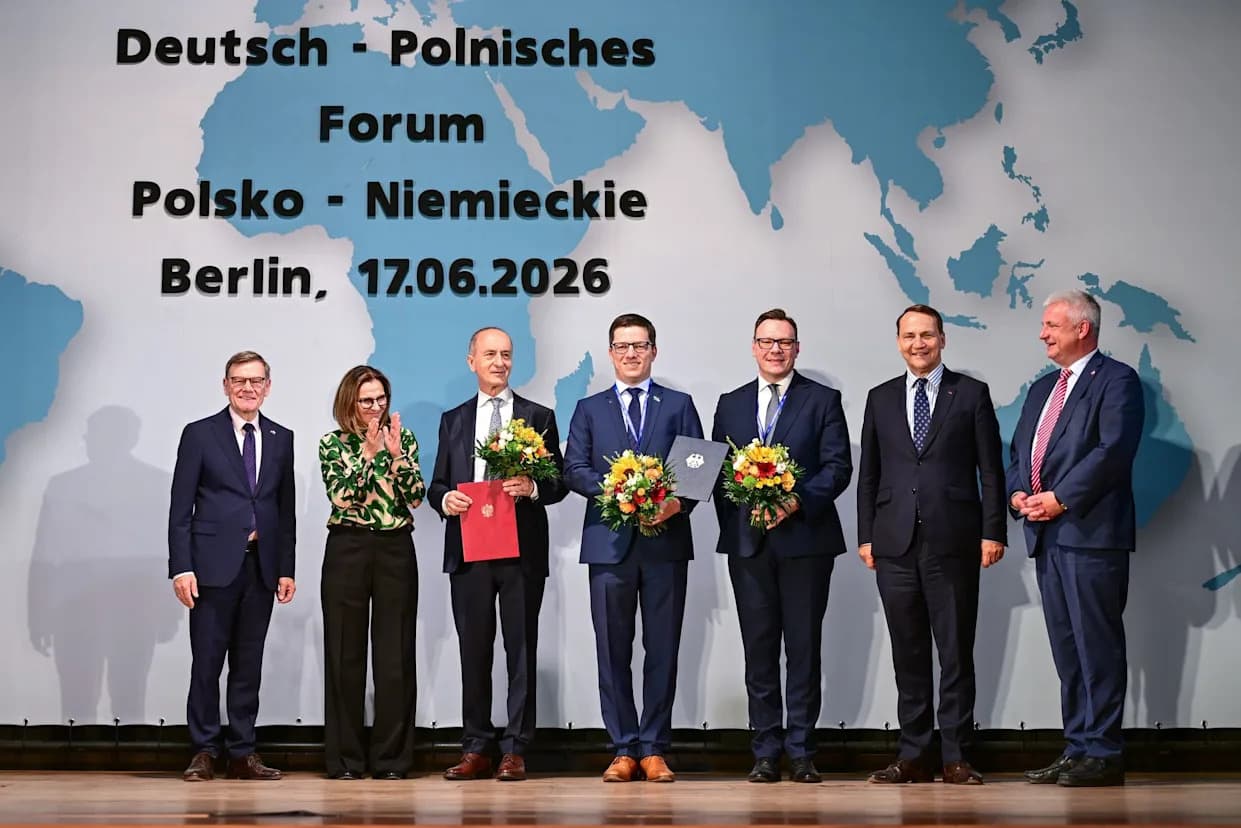
Germany's Foreign Minister Johann Wadephul (L) and Poland's Foreign Minister Radoslaw Sikorski (2nd R) present the German-Polish Prize to the Frankfurt-Slubice Cooperation Center during the German-Polish Forum at the Federal Foreign Office in Berlin. The event marks the 35th anniversary of the German-Polish Treaty on Good Neighbourly Relations and Friendly Cooperation. (is associated with: «Germany, Poland mark 35 years of post-Cold War ties at Berlin forum») Sebastian Gollnow/dpa
Germany and Poland commemorated the 35th anniversary of their 1991 Treaty of Good Neighbourship and Friendly Cooperation at a Berlin forum on Wednesday, where the return of several World War II–looted cultural items to Warsaw was announced ahead of a bilateral defence accord in Poland’s capital.
High-Level Gathering in Berlin
The German-Polish Forum brought roughly 700 participants to Berlin, including German Foreign Minister Johann Wadephul and his Polish counterpart, Radosław Sikorski. The event preceded German Defence Minister Boris Pistorius’s trip to Warsaw to sign a defence agreement between the two NATO allies.
Calls for Closer Links
Wadephul stressed that, "mindful of the tragic history of the 20th century, we bear a special responsibility for our region and our continent as allies in NATO and partners in the European Union." He urged expanded cross-border infrastructure and travel connections to strengthen personal ties, the economy and — if needed — defence cooperation.
"Together, Germany and Poland form the backbone of European defence and NATO’s deterrence against the Russian threat," Wadephul said. "Whoever invests in German-Polish railway tracks is also investing in friendship and defence."
Restitution of Cultural Property
In a symbolic restitution gesture, Germany handed over a 16th-century gold ring set with a 3.5-carat diamond that is believed to have belonged to King Sigismund I of the Jagiellonian dynasty. Polish Culture Minister Marta Cienkowska was on hand to receive the item.
The ring was removed from Warsaw to the village of Sienawa shortly before the German invasion of 1939 and later looted by German troops. It surfaced in 1963 as a donation to a museum in Pforzheim, near Stuttgart. Pforzheim Mayor Peter Boch described the return as "an act of historical responsibility" and "a sign of respect and friendship towards our Polish neighbours."
Other restitutions announced include a medieval manuscript containing part of the old Polish anthem "Gaude Mater Polonia," returning from the Prussian Cultural Heritage Foundation in Berlin, and model trains and accessories originally from the Warsaw Transport Museum that were traced to the German Technology Museum.
Defence Deal and Security Cooperation
The defence agreement to be signed in Warsaw emphasizes the two countries’ integration within NATO and the European Union and reaffirms mutual-assistance commitments. It sets out plans for closer cooperation on military capabilities, the defence industry and joint exercises. Knut Abraham, the German government official responsible for ties with Poland, described the deal as "a very important sign of increasingly close cooperation in the military sphere, but also in security policy more broadly."
Historical Context and Ongoing Tensions
German-Polish relations have improved significantly since the end of the Cold War, yet the legacy of World War II — including disputes over reparations — continues to shape dialogue. An estimated five million Polish citizens were killed by Nazi Germany during the war, including roughly three million Polish Jews who perished in the Holocaust.
In December, Germany’s Bundestag approved a motion to establish a permanent memorial in Berlin to honour Poland’s World War II victims, following the unveiling of a provisional commemorative stone near the German Chancellery last June. The site saw controversy days earlier when Polish far-right activist Robert Bakiewicz tried to erect a cross there without police permission; six people were reportedly detained in connection with that incident.
Honours and Cross-Border Cooperation
Janusz Reiter, the first post-communist Polish ambassador to Berlin, was honoured at the forum for his role in fostering understanding between the two nations. The Frankfurt-Słubice Cooperation Centre was also recognised for its educational work on both sides of the Oder River — a long-standing symbol of cross-border cooperation.
The 35th anniversary events highlighted a mix of reconciliation, practical cooperation and unresolved historical questions — underscoring that while ties have deepened, history continues to inform the trajectory of German-Polish relations.
Help us improve.