Erdogan’s political maneuvers have blunted rivals, but constitutional limits and public pushback are tightening his room to maneuver. A May 21 court ruling removed Ozgur Ozel as CHP leader and reinstated Kemal Kilicdaroglu, sparking protests and market losses. High-profile arrests — including Istanbul Mayor Ekrem Imamoglu — and judicial interventions have weakened the opposition, but Turkey’s constitution bars more than two five-year presidential terms, leaving Erdogan with only difficult options that require parliamentary supermajorities.
Erdogan’s Toolkit Is Shrinking — Can He Secure Another Term?
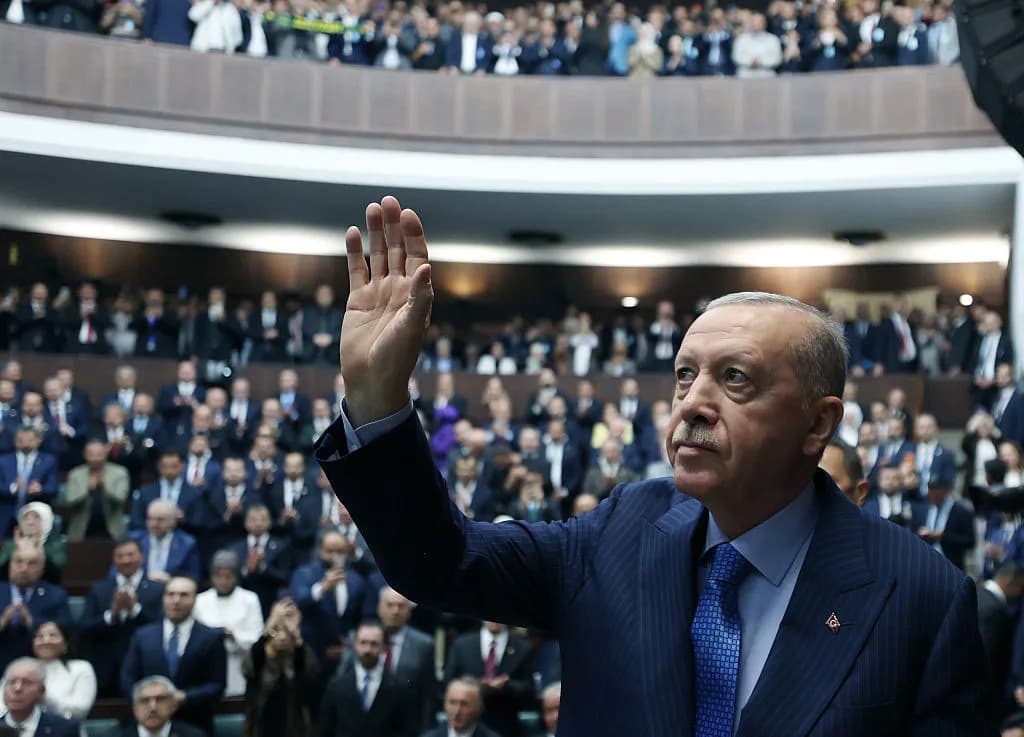
Turkish President and Chairman of the Justice and Development Party Recep Tayyip Erdogan attends his party's parliamentary group meeting at the Grand National Assembly in Ankara, Turkey on June 10, 2026. —TUR Presidency-Murat Cetinmuhurdar-Handout-Anadolu via Getty Images
President Recep Tayyip Erdogan has stretched his political durability for more than two decades, using legal, institutional and political levers to weaken rivals and consolidate power. But recent setbacks — and constitutional limits — are narrowing his options.
Judicial Intervention and Political Maneuvers
On May 21, an appeals court overturned the results of an internal leadership vote in the Republican People’s Party (CHP), removing the party’s newly elected leader, Ozgur Ozel, and reinstating his predecessor, Kemal Kilicdaroglu. The decision immediately triggered street protests across Turkish cities and sent the stock market sharply lower, underscoring the high political and economic stakes.
For years Erdogan and his Justice and Development Party (AKP) have reshaped Turkey’s political landscape. After entering government in 2002, the AKP broadened its support beyond Turkey’s major secular cities into the Anatolian heartland. Erdogan served as prime minister for 11 years and became Turkey’s first directly elected president in 2014. A 2017 constitutional referendum expanded presidential powers, enabling the president to appoint senior officials, influence legislation and exert greater control over state institutions.
Crackdown on Opponents
Political pressure and criminal investigations have targeted hundreds of opposition figures, charges critics say are politically motivated. One prominent example is Ekrem Imamoglu, the charismatic mayor of Istanbul and a potential presidential challenger, who was arrested in 2025 on corruption charges that carry a combined maximum sentence in excess of 2,300 years and has been detained awaiting trial for more than a year.
The reinstatement of Kilicdaroglu — a politician noted for leading the CHP through a string of defeats before recent local-election gains — is widely seen as a tactic that fragments the opposition and weakens a potential unified challenge to Erdogan.
Constitutional Limits and the Road Ahead
Despite repeated re-elections and deep institutional influence, Erdogan faces a key legal constraint: the current constitution bars a president from serving more than two five-year terms. That makes him ineligible to run in 2028 unless he pursues extraordinary options. Two theoretical routes remain: a constitutional amendment or calling an early election that would reset term calculations. Both require parliamentary supermajorities that Erdogan and the AKP do not currently control.
Those limits do not, however, eliminate shorter-term tactics: strategic arrests, courtroom interventions and political realignments can still shape the field. For now, the opposition’s best path is to regroup quickly, close internal divisions, and consolidate around a single credible candidate while monitoring Erdogan’s next moves.
Bottom line: Erdogan has powerful tools, but legal constraints and growing political pushback are shrinking his options. The political balance in Turkey will depend on whether the opposition unites and how Erdogan attempts to navigate constitutional limits.
Help us improve.