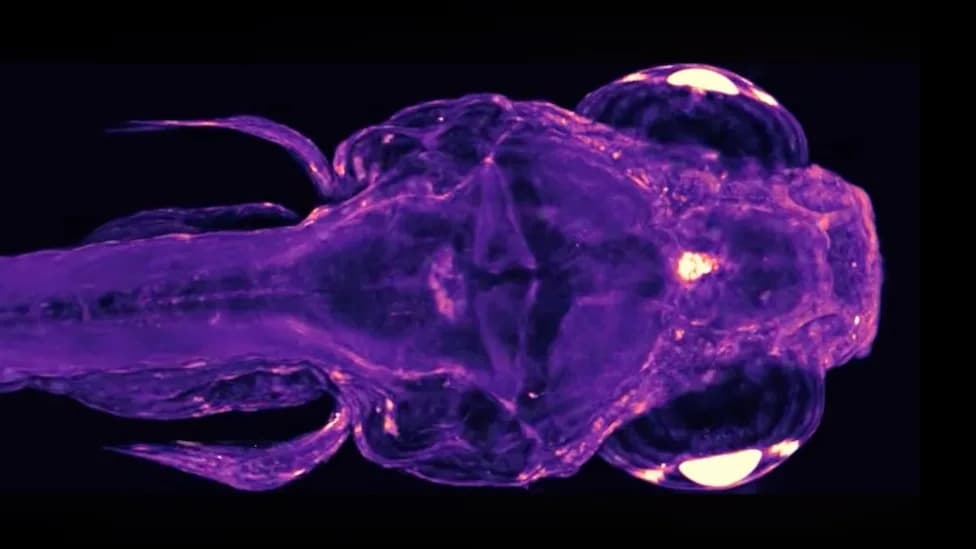
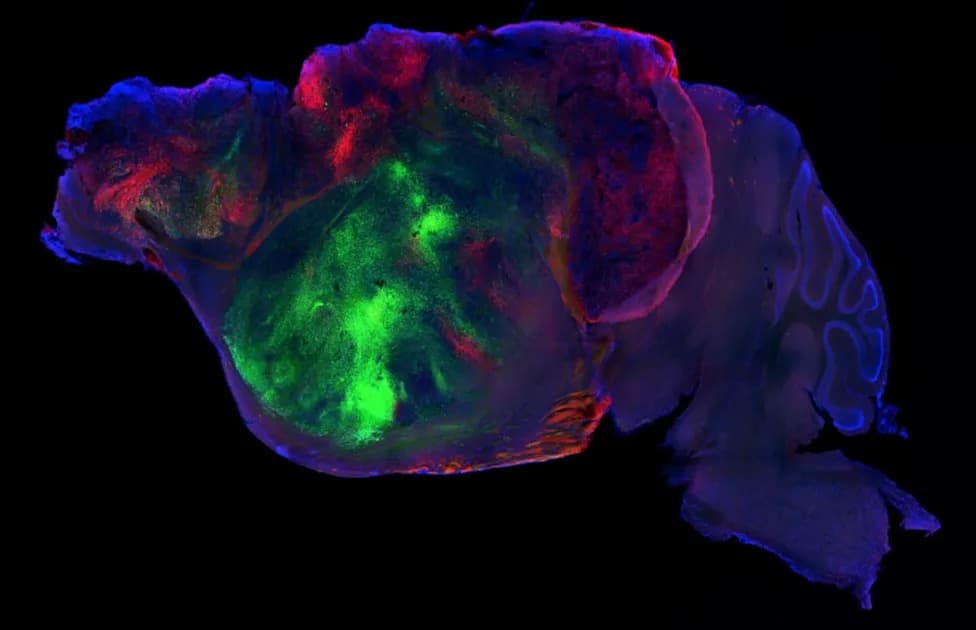
Researchers recorded whole-brain activity in zebrafish and found a distinct burst of pallial neuron activity that reliably appears seconds before social approach movements. The neural signature is specific to interactions with other fish (not inanimate targets) and is stronger in more social individuals. Laser ablation of the implicated pallial neurons reduced social approaches, suggesting a causal role, though the authors caution that further work is needed to test relevance to mammals and humans.
Brain Activity Predicts Social Approach: Zebrafish Show Neural ‘Rehearsal’ Seconds Before Moving
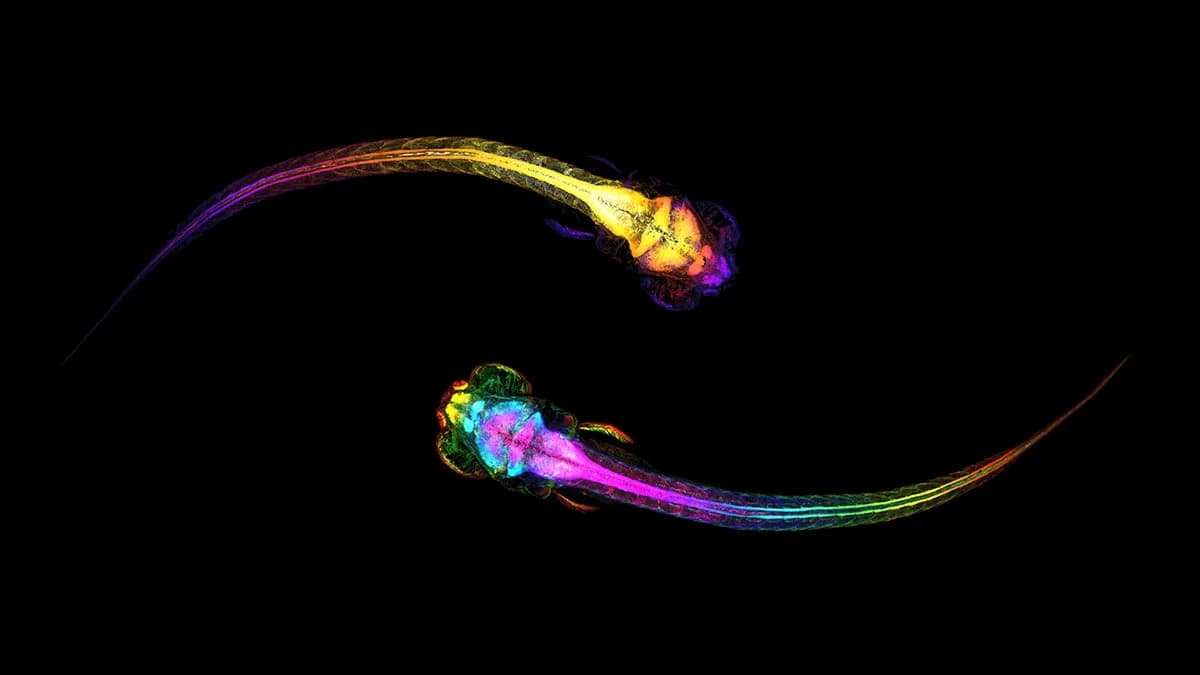
Two socializing zebrafish. (Luke A. Hammond & Jeremy Ullmann)
Imagine spotting someone across a crowded room and, for a moment before you move, your brain rehearses the approach. New research in zebrafish suggests a similar neural “build-up” happens in some animals: a burst of coordinated brain activity appears seconds before a fish initiates a social approach.
Researchers at the Hebrew University of Jerusalem recorded whole-brain activity in zebrafish while other fish swam nearby to investigate how the brain prepares for social engagement. They identified a reliable, distributed neural signature that predicts whether an imminent movement will be social.
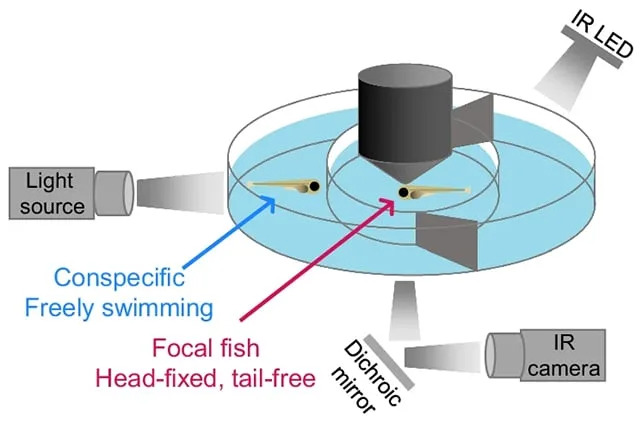
The experimental setup: One fish had its head fixed in place so it could be monitored as it interacted with free-swimming fish around it. (Lifshitz et al.,Nat. Comm., 2026)
The predictive activity was centered in the pallium, a brain region in zebrafish associated with higher-level processing. In mammals, analogous functions are carried out by structures such as the amygdala and hippocampus, which process emotion, memory and contextual social cues. The team observed increased activity in pallial neurons together with reduced activity in certain midbrain and hindbrain populations seconds before social approach movements.
"Distinct distributed neural activity emerges seconds before approach movements, characterized by increased activity in pallial neurons and reduced activity in midbrain and hindbrain populations," the researchers write. "These coordinated dynamics reliably predict upcoming approach movements across regions and account for individual differences in social behavior."
Crucially, the neural signature was specific to social decisions: the same pattern did not occur when fish chased an inanimate moving dot. The coordinated dynamics were strongest in individuals that displayed higher social drive, indicating the signal’s strength tracks sociability.
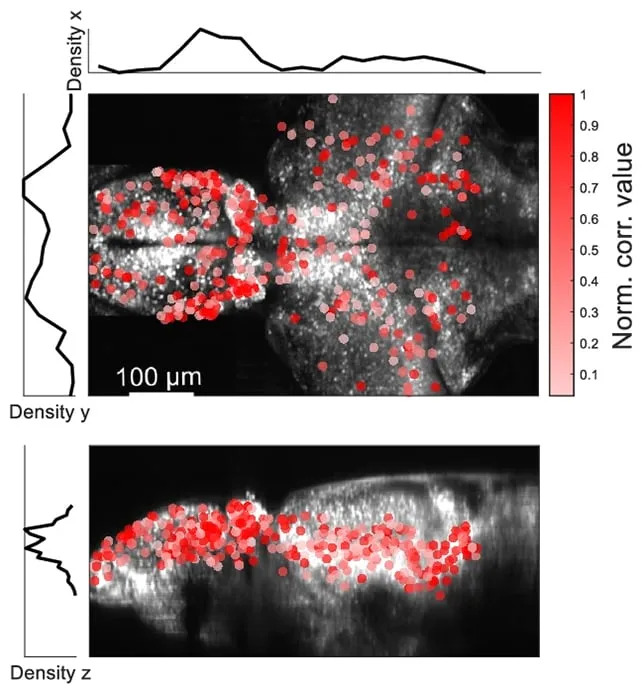
The researchers identified neuron activity that preceded social interactions. (Lifshitz et al.,Nat. Comm., 2026)
To test causality, the team used targeted laser ablation to remove the subset of pallial neurons associated with the social-approach signature. After this intervention, the fish showed reduced social approach behaviors, supporting a functional role for these neurons in initiating social contact.
The study also found that social interactions were more likely when pairs of fish moved in synchrony, suggesting that movement coordination and social motivation are linked. The authors note, however, substantial individual variability: some fish rarely initiated social approaches, demonstrating natural differences in sociability within the population.

Subscribe to ScienceAlert's free fact-checked newsletter
Because the experiments were conducted in zebrafish, the authors are cautious about directly extrapolating findings to humans. Still, given conserved aspects of vertebrate brain organization and the high-resolution neural recordings, the results raise the possibility that predictive neural dynamics for social approach may exist in other species, including mammals.
The work advances understanding of brain mechanisms that prepare animals for social behavior and provides a framework to dissect how development, experience, genetics and internal states shape social decision-making. The study is published in Nature Communications.
Help us improve.