WHOLISTIC is a new whole-organism imaging platform that records calcium-dependent cellular signaling across an intact living animal in real time. Demonstrated in transparent larval zebrafish and adult-transparent Danionella cerebrum, the method revealed surprising whole-body responses — including cartilage cells reacting to cold and meninges responding to ketamine — and uncovered new muscle–organ coordination and brainstem-driven blood-flow redistribution. The authors hope WHOLISTIC will be widely adopted to connect physiology, neuroscience and cell biology at organismal scale.
For The First Time, Scientists Watch Cells Send Signals Across an Entire Living Body
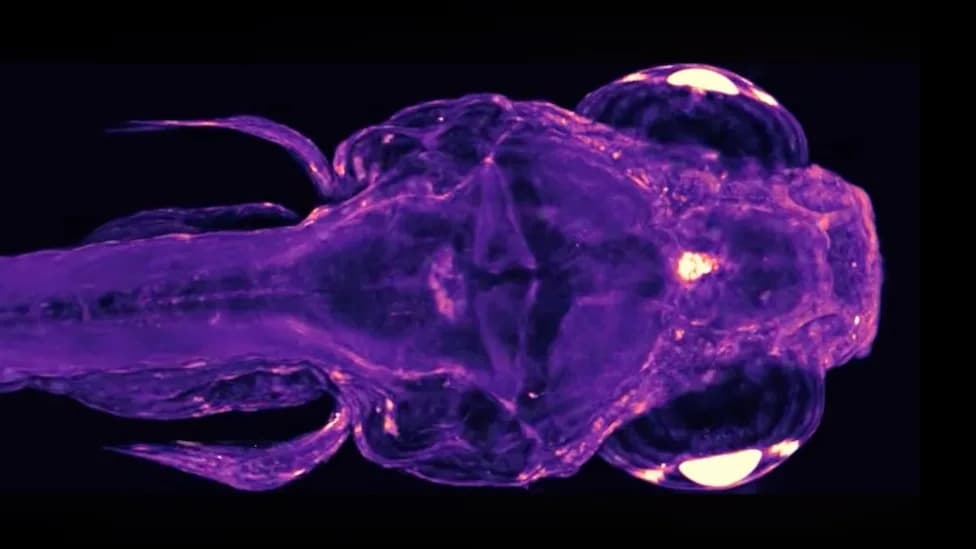
New techniques reveal previously unseen communication between living systems in the body of a zebrafish. And yes, that glowing node between its eyes is the pineal gland. (Ruetten et al., Nature, 2026)
Researchers have developed a new imaging platform that lets scientists observe cellular signaling across an intact, living animal in real time. Published in Nature (Ruetten et al., 2026), the method — called WHOLISTIC — fills an important gap between single-cell biology and whole-organism physiology by capturing second-by-second activity across every visible tissue.
YouTube Thumbnail
What Is WHOLISTIC?
WHOLISTIC (WHole-Organism Live-Imaging System for recording Tissue and IntraCellular activity) is a whole-body fluorescence imaging system. It uses genetic tools to express fluorescent calcium sensors broadly across the animal so that cellular calcium signals — a near-universal messenger in biology — can be visualized simultaneously throughout the body.
YouTube Thumbnail
How The Technique Works
The team genetically engineered model fish to express calcium-sensitive fluorescent indicators in nearly every cell. When intracellular calcium levels change during signaling events, the sensors brighten; a single fluorescence channel was sufficient to differentiate organs and tissues by their unique visual textures. Brighter, yellowish regions indicate stronger calcium-related fluorescence in the published images (Ruetten et al., Nature, 2026).
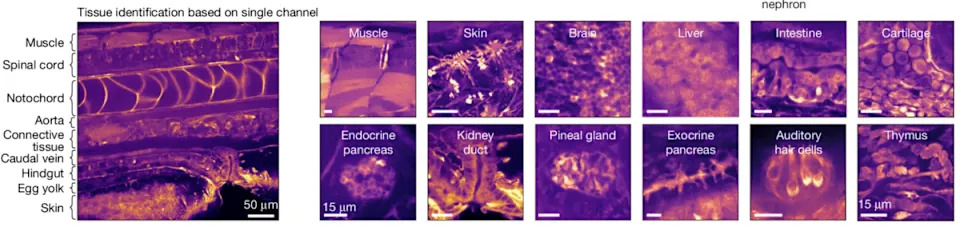
A single fluorescence channel enables identification of organs and tissues via distinct visual textures. The areas with a yellow 'glow' show stronger fluorescence from the calcium sensor. (Ruetten et al.,Nature, 2026)
Model Organisms Used
The researchers demonstrated WHOLISTIC in naturally transparent larval zebrafish and in Danionella cerebrum, a small freshwater fish that remains transparent into adulthood. Both species are established laboratory models, making the technique immediately useful for many labs.

Subscribe to ScienceAlert's free fact-checked newsletter
Key Discoveries
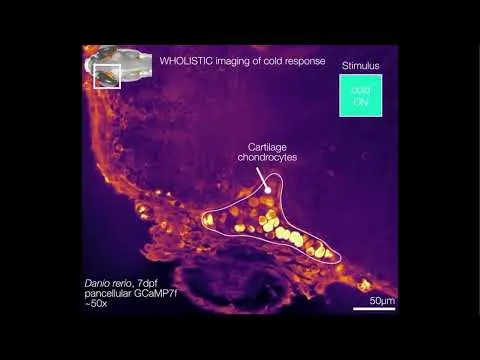
- Cold exposure triggered pronounced calcium signals in chondrocytes (cartilage-forming cells), an unexpected peripheral response.
- Ketamine produced activity not only in neurons but also in the meninges, the brain's protective tissue layers.
- Whole-body recordings revealed previously unrecognized muscle synergies and muscle–organ interactions at the multi-organ scale.
- At the organism level, WHOLISTIC captured brainstem-controlled redistribution of blood flow across the body.
Why This Matters
Because calcium signaling participates in processes ranging from muscle contraction and synaptic activity to fertilization and programmed cell death, being able to observe these signals across an intact animal provides a powerful window into how cells coordinate physiology and behavior. The method creates a common experimental platform for physiology, neuroscience, behavior and cell biology to be studied together in the same animal.
Limitations and Outlook
WHOLISTIC is currently demonstrated in transparent fish models, which allows optical access at body scale. Translating the approach to opaque animals will require new optical strategies or tissue-clearing approaches. The authors hope other labs will adopt and extend the platform to study whole-body signaling in health, disease and response to drugs.
Authors and Affiliation: The technique was developed by Virginie Ruetten and colleagues in a team based at the Howard Hughes Medical Institute and reported in Nature. Misha Ahrens' lab hosted the work.
Help us improve.