The study finds that many Ediacaran organisms likely reproduced asexually via stolons, forming locally connected clonal networks that limited dispersal and reduced intraspecific competition. High‑resolution scans, spatial analyses and AI applied to fossils from Mistaken Point and Charnwood Forest show round clusters and weak competition consistent with clonal growth. Mechanistic modeling (10,000 simulations) indicates a later shift toward wider, likely sexual dispersal increased competition and drove diversification, setting the stage for the Cambrian.
Asexual Reproduction in 574‑Million‑Year‑Old Fossils May Have Slowed Early Animal Evolution
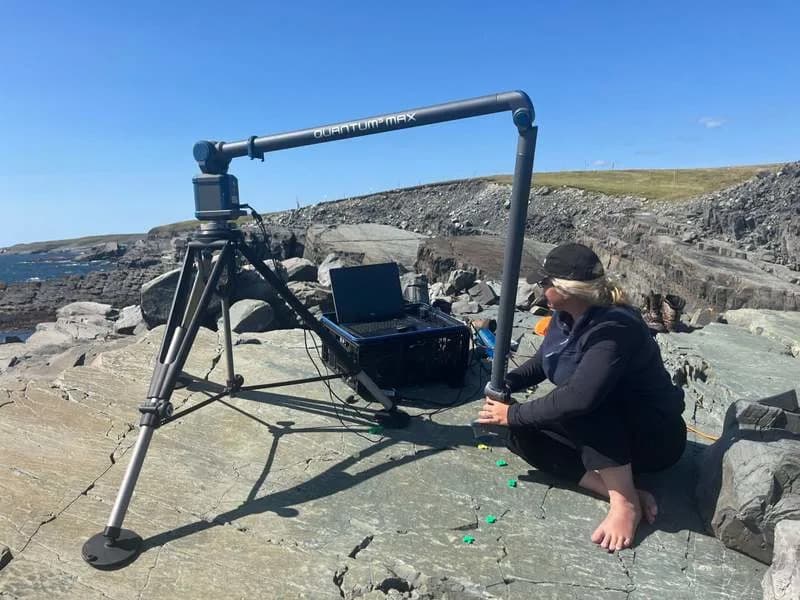
Dr. Emily Mitchell at Mistaken Point, Newfoundland, Canada. Her research suggests clone-based reproduction kept early animals stable until sexual reproduction boosted diversity. (CREDIT: Emily Mitchell)
Fern‑like organisms carpeted ancient seabeds during the Ediacaran Period, some reaching heights comparable to a person. Yet for millions of years after large multicellular life first appeared, animal evolution advanced only slowly. A new study from researchers at the University of Cambridge argues that a dominant asexual reproductive strategy among these early animals helped explain that prolonged lull.
Clonal Growth, Limited Dispersal
The team focused on exquisitely preserved fossil communities — particularly beds at Mistaken Point in Newfoundland — that date to about 574 million years ago, within the Ediacaran interval (≈635–539 Ma). Many of these taxa look unlike most modern animals: they lacked obvious mouths, organs or locomotion and likely absorbed nutrients from seawater. Previous work suggested that several species reproduced asexually by producing connected clones via runner‑like extensions called stolons.

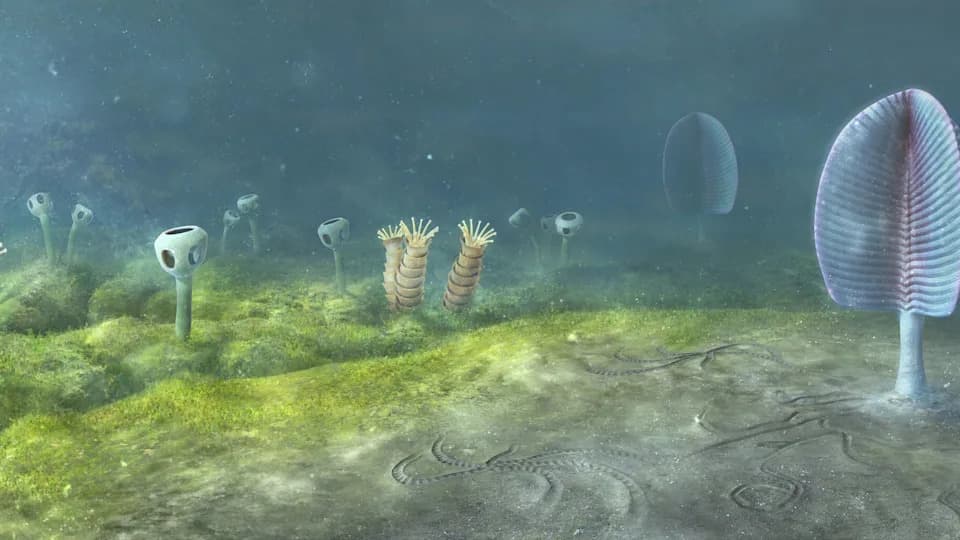
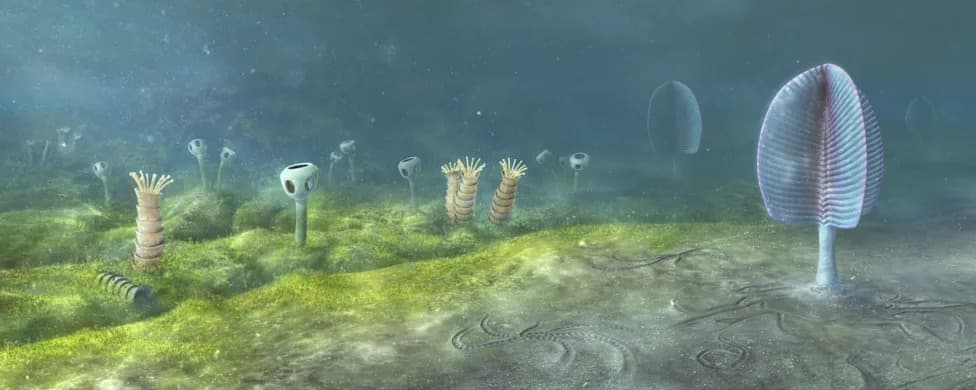
Artist’s impression of a Ediacaran animal community. (CREDIT: Hugo Salais)
Unlike offspring dispersed widely by currents, stolon‑borne clones would remain local and often physically connected, potentially sharing resources across the network. The authors argue that this clonal connectivity limited dispersal, reduced direct competition among linked individuals and therefore softened selective pressures that normally drive rapid evolutionary change.
Methods: Scanning, Spatial Analysis and AI
To test these ideas, researchers combined high‑resolution laser scanning, spatial‑point analyses and artificial intelligence to study fossil spacing and cluster shapes from Mistaken Point and sites in Newfoundland and Charnwood Forest in the United Kingdom. They quantified whether fossil clusters were round (consistent with local stolon expansion) or elongated (consistent with waterborne dispersal) and used spatial point‑process methods to detect signatures of competition versus random placement.
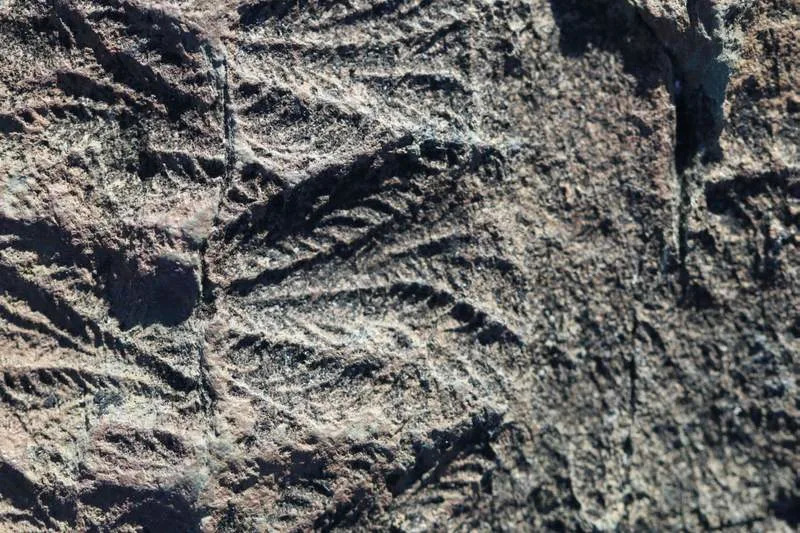
Fossils of Fractofusus, an animal from the Ediacaran period. (CREDIT: Emily Mitchell)
“Life was pretty nice during the Ediacaran, so the need for sex was rather limited,” said lead author Dr Emily Mitchell (Department of Zoology, University of Cambridge). “There was relatively little competition, so there was no real pressure to change anything.”
Findings: Clonal Networks and Weak Competition
Across 21 populations on eight bedding planes, the team found a consistent association: stronger evidence for stolon‑like clonal growth correlated with weaker intraspecific competition. This pattern helps explain a previously observed peculiarity called heteromyopia, where competition between species appears at smaller spatial scales than competition within a species. The authors conclude that linked clonal networks best account for this spatial arrangement.
Clonal connectivity could buffer individuals against local resource shortfalls: a clone occupying a poor patch could receive nutrients from a connected neighbor in a richer patch, reducing incentive for direct competition among members of the same clone.
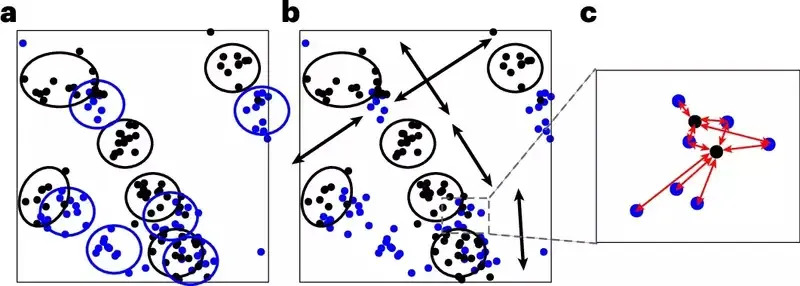
Schematic diagram demonstrating heteromyopia. (CREDIT: Nature Ecology & Evolution)
Alternatives Considered
The team evaluated other explanations — pathogens, chemical inhibition, predation, and strong niche segregation — but found them less consistent with the spatial signatures preserved in the fossils. Notably, evidence of macropredation is absent in these assemblages until later in the Ediacaran, and expected spatial patterns for disease or chemical effects were not observed.
Modeling Evolutionary Consequences
To probe long‑term consequences, the researchers built a mechanistic model spanning three major Ediacaran assemblages — Avalon, White Sea and Nama — and ran 10,000 simulations. Using approximate Bayesian computation combined with a simple neural network, they identified scenarios that best matched diversity trends in the fossil record. The model reproduced the established pattern of relatively low diversity in Avalon communities, a rapid rise in the White Sea assemblage, and a more modest decline in the Nama.
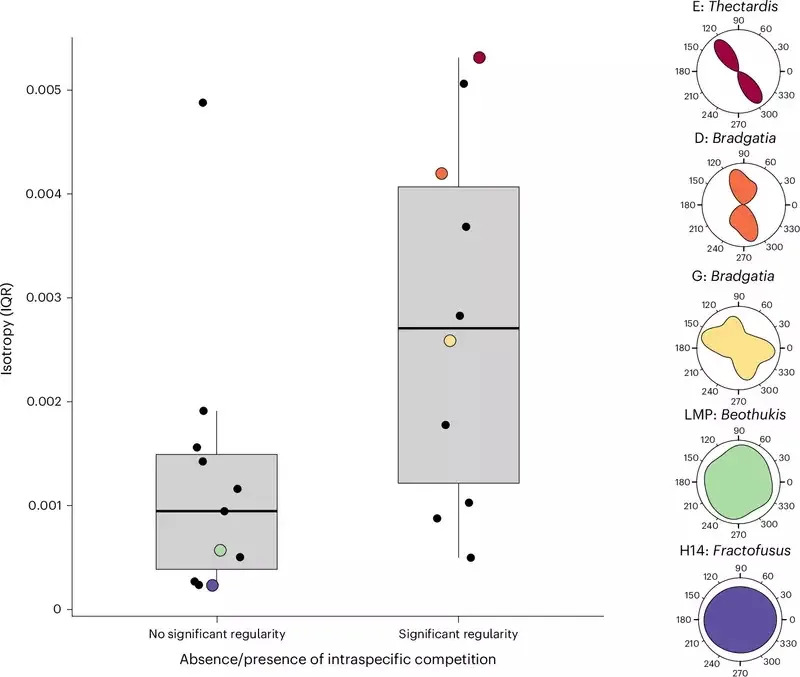
Relationship of isotropy to intra-specific segregatiom. Isotropy is measured by the IQR of point-to-point orientations grouped depending on whether they exhibit significant regularity: lower IQR indicates isotropy and higher IQR anisotropy. (CREDIT: Nature Ecology & Evolution)
Crucially, the inferred change in dispersal parameters aligns with this shift: a move away from localized, stolon‑dominated reproduction toward wider, likely sexual and waterborne dispersal increased competition and selection pressure, helping to accelerate diversification and paving the way for the Cambrian radiation.
Implications
By tying reproductive mode to dispersal, competition and selection, the study offers a fresh explanation for why complex life appeared early but diversified slowly for millions of years. It also highlights that fossil spacing — not only body form — can reveal how ancient ecosystems functioned and why major evolutionary transitions occurred when they did.
Publication: The work is published in Nature Ecology & Evolution and led by researchers at the University of Cambridge.
Help us improve.