New research published in Science Advances suggests animals could have originated between about 800 and 700 million years ago — up to 200 million years earlier than the oldest widely accepted fossils. The team studied exceptionally preserved microfossils from Mongolia's Kheseen Biota and found no identifiable animals, challenging assumptions about fossil visibility in well-preserved deposits. Molecular-clock analyses using older geological calibration points shifted possible animal origins back by ~200 million years. The finding would place animal origins deep in the Neoproterozoic and possibly before or during major Cryogenian glaciations, though body fossils from that time remain elusive.
New Study Suggests Animals Could Have Originated 700–800 Million Years Ago — Up To 200 Million Years Earlier
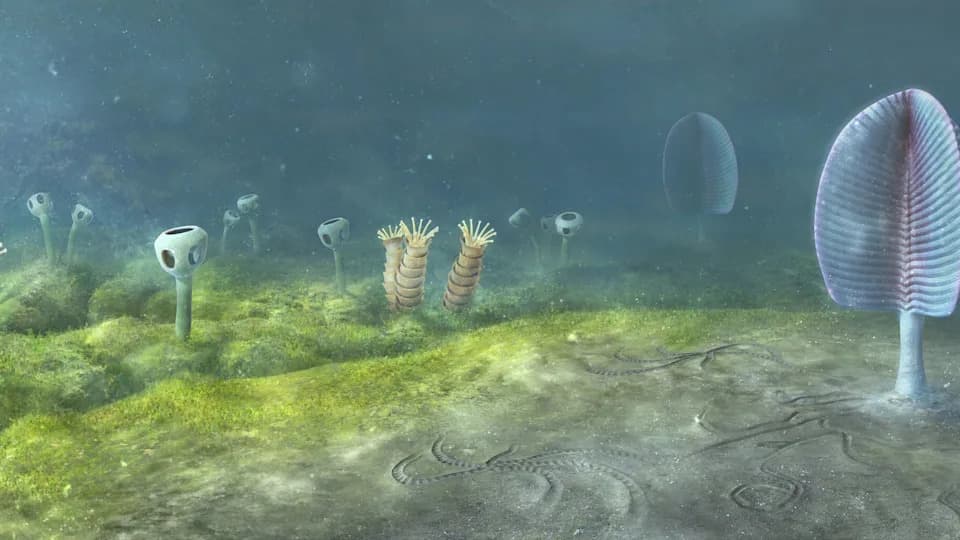
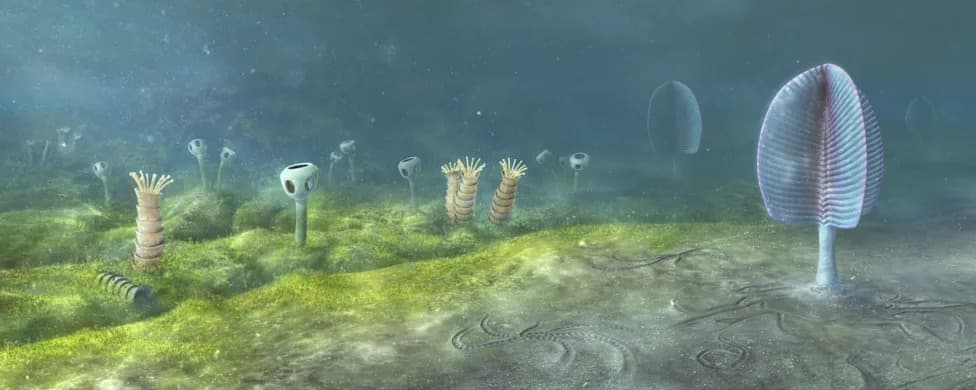
An artist's reconstruction of the seafloor in Namibia, West Africa, 543 million years ago. . | Credit: Museum of Natural History, University of Oxford / Mighty Fossils.
New modelling and fossil analyses suggest the first animals may have appeared far earlier than the oldest widely accepted fossils indicate. A team of researchers publishing in Science Advances argues that gaps in the fossil record and different molecular-clock calibrations could push the possible origin of animals back into the Neoproterozoic, roughly 800–700 million years ago.
Context. Until now, the earliest widely accepted animal fossils come from the Ediacaran period, with the oldest robust evidence dated at about 574 million years ago. Exceptional deposits such as the ~590-million-year-old Weng'an Biota in China preserve microscopic detail but contain no indisputable animal body fossils. Some scientists have therefore treated such deposits as practical upper limits for when animals first evolved.
What the researchers did
Study authors led by Ross Anderson and Orin Lole Durbin examined more than 140 microscopic samples from the Kheseen Biota in Mongolia, a deposit deposited more than 40 million years after Weng'an. Using high-resolution electron scanning microscopy, they documented exquisitely preserved microfossils — spherical forms and embryo-like structures with internal cells — but found none they could confidently identify as animals.
Finding no animal evidence in the well-preserved Kheseen material undermines the argument that exceptional preservation at sites like Weng'an would necessarily include early animals if those animals existed at that time. As Anderson states, the Kheseen Biota "breaks the argument that the exceptional microfossils of Weng'an mean we would have seen animal fossils in the assemblage had they existed at the time."
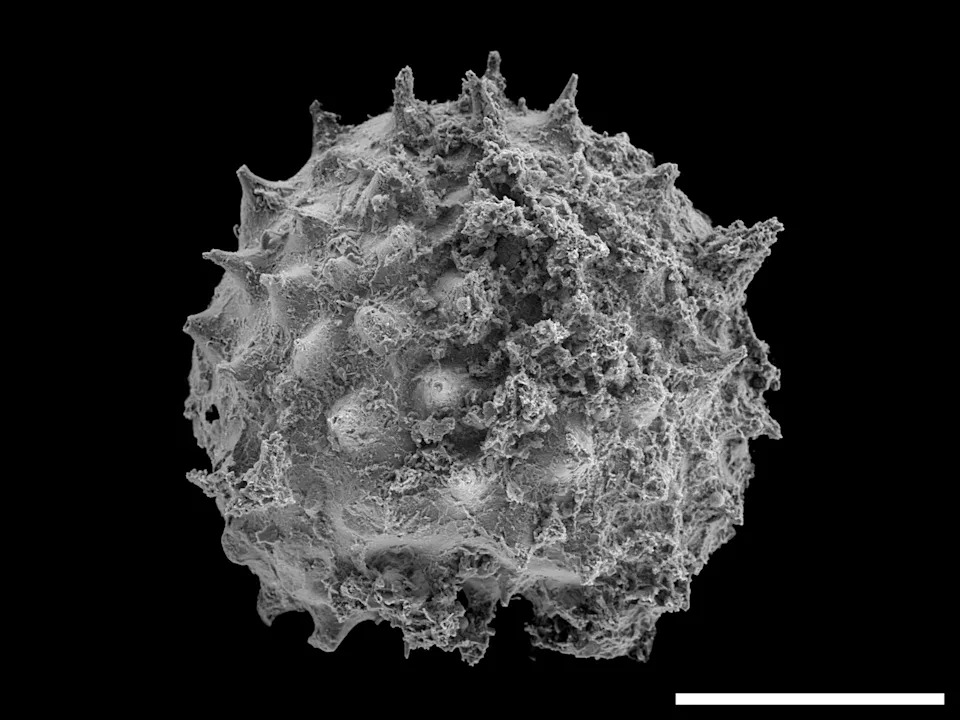
An electron microscope image ofAsterocapsoides wenganensis, a microscopic fossil from the Kheseen Biota in Mongolia. | Credit: Derek Briggs.
Molecular clocks and older calibrations
Because body fossils remain absent before the Ediacaran, the team turned to molecular-clock analyses. Molecular clocks estimate divergence times by comparing genetic differences among living species and applying rates of genomic change, calibrated against dated fossils or geological events. When the authors used older calibration points — from rock formations in Norway, Australia and Arizona deposited between ~850 and ~730 million years ago — the molecular-clock estimates shifted the possible origin of animal lineages back by roughly 200 million years, to about 800–700 million years ago.
"Pre-Ediacaran animal body fossils still elude us, and this analysis does not prove that animals existed 800 million years ago," said first author Orin Lole Durbin. "Meanwhile, our molecular-clock analyses show how much further back their evolutionary history could extend."
Independent clues and implications
Other lines of evidence are consistent with a deeper animal history. Chemical biomarkers interpreted by some researchers as sponge-like signatures date to at least ~650 million years ago, predating unambiguous animal body fossils by tens of millions of years. If animals did originate near 800 million years ago, their early history would overlap the Cryogenian period (beginning ~720 million years ago), when Earth experienced extreme global glaciations often referred to as "Snowball Earth." Whether animals survived, adapted to, or went extinct during these events remains an open question.
Limitations and next steps
The authors emphasize that molecular-clock results depend on calibration choices and that absence of fossils in particular deposits does not prove animals were absent globally. The team plans targeted fieldwork in additional Neoproterozoic rocks with diverse depositional environments and preservation pathways to seek further evidence. As external commentator Karma Nanglu notes, fossils are inherently incomplete, and much about early animal evolution remains hidden.
Credit: Artist's reconstruction image credited to the Museum of Natural History, University of Oxford / Mighty Fossils.
Help us improve.