India's total fertility rate has fallen to 1.9 children per woman, below the 2.1 replacement level. The decline is driven by higher education and career priorities, wider access to contraception and reproductive technologies, rising living costs and falling infant mortality. Regional disparities persist, with higher fertility in poorer states and much lower rates in well-educated urban and southern regions. Experts say policy should focus on underlying causes—fertility care, workplace support and financial pressures—rather than simply urging higher birthrates.
Why Indians Are Having Fewer Children: Costs, Careers and Changing Choices
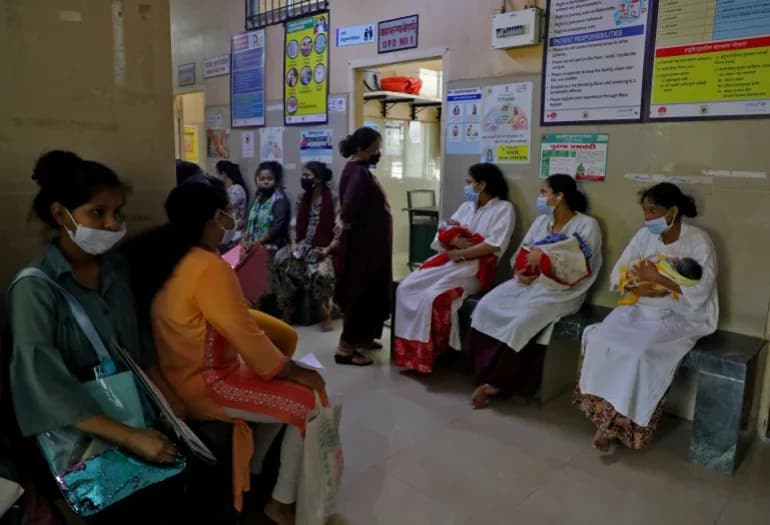
Mothers with their newborns wait their turn for an antenatal examination outside a doctor’s room at a maternity hospital in Mumbai, India [File: Niharika Kulkarni/Reuters]
Bengaluru — Across India, growing numbers of young people are choosing smaller families or no children at all. Recent government data show the country's total fertility rate (TFR) has fallen to 1.9 children per woman, below the 2.1 replacement level. That decline reflects a complex mix of education, career priorities, easier access to contraception, rising living costs and changing social expectations.
Personal Choices, New Priorities
Nidhi Agarwal, a 41-year-old PR entrepreneur in Bengaluru, and her partner decided soon after marriage that they would not have children. "Before marriage, we didn’t talk about kids; we discussed finances and career plans," she says. "We wanted to focus on careers and build companies that could have a broader social impact rather than raising children." Agarwal still faces social pressure, but she stresses that reproduction is a personal choice and asks for respect for those decisions.
Education, Careers and Reproductive Options
Experts point to expanding education and female labour-force participation as major factors behind falling birthrates. Dr. Jyotsna Mirlay, a consultant gynaecologist in Bengaluru, says better-educated women are less likely to accept traditional narratives that equate fulfilment with marriage and motherhood. Many couples now time or delay pregnancies to fit career milestones.
A couple whose baby was born using a surrogate pose for a photo in Anand, India [File: Allison Joyce/AP]
Technological options such as egg freezing — India has more than 2,000 fertility centres offering the procedure — give some women more flexibility to delay childbearing while they advance professionally.
Economic Pressures
Rising costs are a strong disincentive to early parenthood. India’s consumer price inflation rose to 3.48% in April from 3.40% in March, and analysts warn that broader geopolitical shocks could push prices higher. The International Monetary Fund reported India’s average annual income at about $2,878 in 2025 (roughly $240 per month), while Numbeo’s June 2026 estimate puts monthly living costs for a single person at 27,664.7 rupees (about $290), excluding rent. Many people say they prefer to secure financial stability before having children.
Health, Infant Mortality and Infertility
Improved child health has reduced infant mortality from 30 deaths per 1,000 live births in 2019 to 24 per 1,000 in 2024. Historically, falling infant mortality tends to lower the incentive for larger families. At the same time, reported infertility in India has risen — studies indicate rates climbed from 22.4% in 1992–93 to 30.7% in 2015–16 — with contributors including metabolic and hormonal health issues. Fertility treatments have expanded but remain expensive and out of reach for many.

A woman and her baby wait for a bus to take them to a railway station to board a train to their home state of Uttar Pradesh [File: Adnan Abidi/Reuters]
Regional Gaps And Policy Responses
Fertility rates vary widely across India. Poorer states with lower education levels and higher infant mortality, such as Bihar (TFR ~2.9) and Uttar Pradesh (TFR ~2.6), report higher birthrates. By contrast, New Delhi (TFR ~1.2) and southern states such as Tamil Nadu and Kerala (TFR ~1.3) record much lower rates.
Some states have introduced incentives: Andhra Pradesh offers cash payments for third and fourth children (30,000 and 40,000 rupees respectively), and states including Goa, Karnataka and Telangana have established state-funded IVF centres to support parenthood. Public-health experts argue that effective policy should probe underlying causes — access to fertility care, workplace support, rising costs and changing social norms — rather than simply exhorting couples to have more children.
Workplace Support And Social Norms
Workplace policies shape family decisions. In India, women are entitled to up to 26 weeks' paid maternity leave for their first two children and lesser leave for subsequent or adopted children; central government employees get 15 days' paid paternity leave, while no uniform private-sector paternity statute exists. Women report encountering workplace attitudes that can discourage having children and that improved parental leave and flexible work arrangements would make parenthood more feasible.
What Comes Next?
India's falling fertility rate is the outcome of both choice and constraint: more people are choosing different life paths, but rising infertility, high costs and patchy support also shape outcomes. Policymakers who want to address demographic shifts will likely need a balanced approach — stronger reproductive and fertility healthcare, affordable childcare options, fair workplace policies and targeted social supports — that responds to why people are choosing to delay or avoid parenthood rather than simply urging higher birthrates.
"When couples decide to have or not have children, it is an informed decision," Dr. Mirlay says. "Understanding why couples are finding it difficult to get pregnant or unwilling to have children is more useful than telling them to have more babies."
Help us improve.