
The United States has deployed layered security for the record 48‑team World Cup — including anti‑drone systems, boosted local policing and intelligence monitoring — while acknowledging that lone‑wolf attackers remain an unpredictable risk. Anti‑drone coverage will be active at all U.S. matches, supported by a $500 million federal grant for police training. Officials cite drone incidents at the 2024 Paris Olympics and crowd lessons from the 2024 Copa America as drivers of preparations; Philadelphia will host six games and require extra staffing during the event.
Drones, 'Lone Wolves' and Rowdy Fans: How the U.S. Is Securing the Record-Breaking World Cup
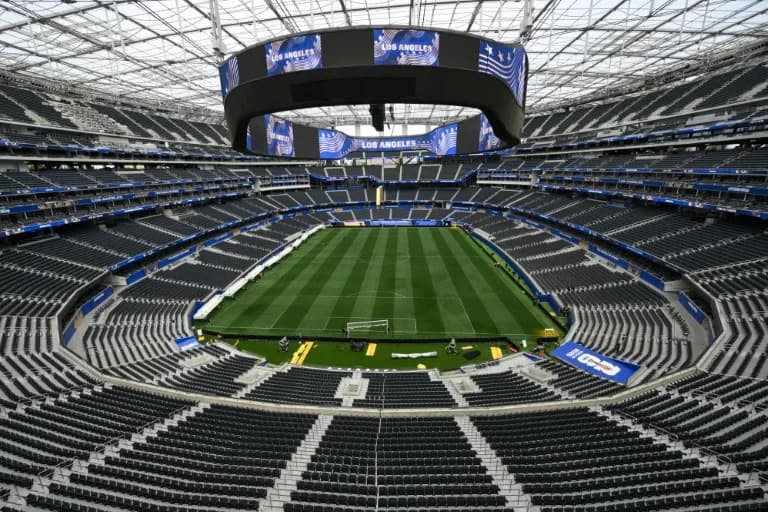
Los Angeles Stadium, normally known as SoFi Stadium, will host the first US World Cup match, between the United States and Paraguay, on June 12, 2026 (Patrick T. Fallon)(Patrick T. Fallon/AFP/AFP)
U.S. officials say they have layered extensive security measures — from crowd management to counter-drone systems — across 11 host cities for the expanded World Cup, while warning that unpredictable lone‑wolf attacks remain a primary concern.
Security Preparations Ahead of Kickoff
The 2026 World Cup, co-hosted by the United States, Mexico and Canada, is the largest in tournament history with 48 teams and 104 matches, 78 of which will be played on U.S. soil. Department of Homeland Security chief Markwayne Mullin told "Fox & Friends" that U.S. venues are "very secure," while cautioning that authorities cannot completely eliminate the risk posed by "the lone wolf."
"We feel like we're as safe as we can possibly be. But we can't control, you know, the lone wolf," Mullin said shortly before the nearly six-week tournament began. He also highlighted vulnerabilities in the so-called "soft areas" — public spaces fans pass through before entering secured perimeters — and said local and state agencies will "flex" resources in those zones.
Anti-Drone Measures and Intelligence Focus
Andrew Giuliani, head of the White House Task Force for the World Cup, said anti-drone coverage will be in place at every U.S. match. A $500 million federal grant funded training for local and state police to detect and counter unauthorized drone activity at large sporting events — a response to a growing security threat.
Officials point to recent events as justification: a French National Assembly report recorded 355 drone incursions and 81 related arrests during the 2024 Paris Olympics. "Right now there are no credible threats, so we continue to monitor," Giuliani told the Atlantic Council, adding that much of his day is spent in a SCIF (a secure facility for sensitive intelligence). "The intelligence community is tripled down looking at this World Cup," he said.
Local Policing, Crowd Culture and Lessons From Copa America
Much of the day-to-day security work will fall to local police departments, which must manage large crowds that may behave differently from typical domestic sporting audiences. At the 2024 Copa America, which served as a domestic warm‑up, some security forces appeared unprepared for rowdier fan behavior compared with the usually calmer crowds at NFL games.
"What may look like a riot to a local police officer, that may actually end up being something that's just standard practice for a soccer fan from that country," Giuliani told ESPN, underscoring the need for cultural awareness in crowd response.
The Philadelphia Police Department said officers working World Cup events will wear body cameras with live translation capabilities to communicate with non‑English speakers. Philadelphia will host six matches — including a Round of 16 fixture on July 4 that coincides with the 250th anniversary of the signing of the U.S. Declaration of Independence — and will require mandatory overtime during the busiest days to ensure adequate staffing.
Roosevelt Poplar, president of the Fraternal Order of Police Lodge 5, said officers are being prepared for sustained operations over the tournament's 39‑day span. "We want to make sure our officers are mentally prepared to handle the long 39 days this is going to be," he told ESPN.
What Fans Should Know
- Expect visible security measures around stadiums and in public "soft" areas.
- Authorities have prioritized counter-drone capabilities and intelligence monitoring.
- Local police will adapt tactics learned from recent international events and domestic warm‑ups like Copa America.
As play progresses toward the final on July 19, officials say they will continue close monitoring and coordination across federal, state and local levels to keep fans safe while preserving the tournament atmosphere.
Help us improve.





















