
Peru holds a runoff Sunday between Keiko Fujimori and Roberto Sánchez to elect the country’s ninth president in 10 years. Polls show a statistical tie, making undecided and blank ballots potentially decisive and raising the risk of post-election disputes. Analysts say the vote underscores a broader crisis of representation, institutional weakness and public distrust; the winner faces urgent tasks including restoring governability, fighting corruption and stabilizing the economy.
Peru’s High-Stakes Runoff: Ninth President In A Decade As Tensions And Mistrust Loom
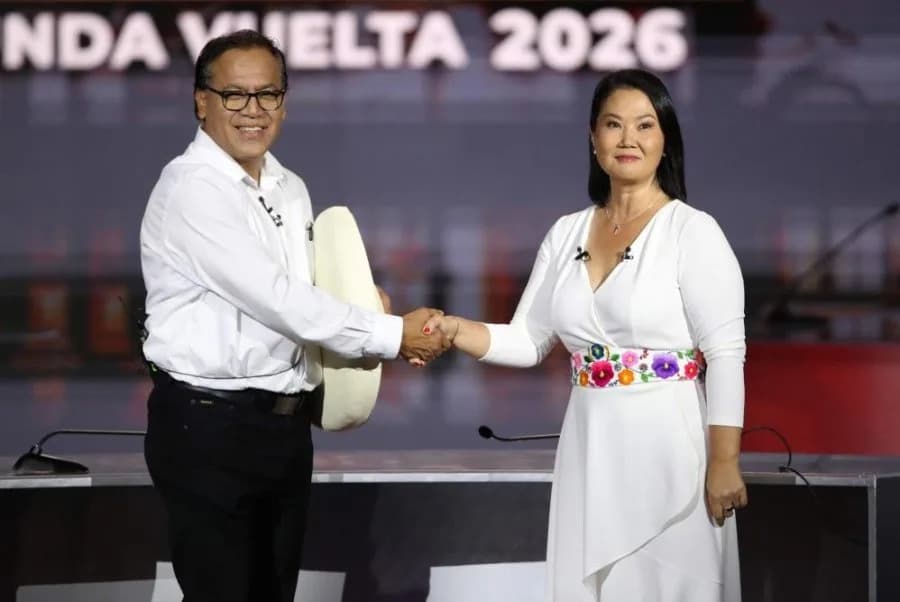
Lleft-wing candidate Roberto Sanchez and right-wing candidate Keiko Fujimori pose during a presidential debate in Lima, Peru, last weekend. This was the only debate between Fujimori and Sanchez before the decisive election scheduled for Sunday. Photo by Paolo Aguilar/EPA
Peru will hold a presidential runoff Sunday to choose its next leader in a contest between Keiko Fujimori, head of the right-wing Popular Force party, and Roberto Sánchez, the candidate of the leftist Together for Peru coalition. Nearly 28 million voters are eligible to decide what will be the country’s ninth president in just 10 years, a statistic that underlines Peru’s deep institutional strains.
A Tight Race That Could Turn On The Undecided
Recent polls show Fujimori and Sánchez in a statistical tie, meaning undecided voters and the number of blank ballots could determine the final outcome. The narrow margins raise the likelihood of legal challenges and contested narratives after the vote.
Candidates And Regional Divides
Fujimori, the daughter of former President Alberto Fujimori, remains a central and polarizing figure in Peruvian politics. Sunday's runoff is her fourth consecutive attempt to win the presidency in a second-round contest. She holds a solid advantage in Lima.
Sánchez is less well known outside Peru. His campaign shifted during the race to court supporters of expelled former President Pedro Castillo and performs strongly across much of the country’s interior, especially in Andean regions.
Deeper Crisis: Representation And Weak Parties
Many analysts say the election reflects more than a personality-driven split: it highlights a broader crisis of political representation. Parties have struggled to channel voter demands, and politics has grown increasingly personalized.
Peru has become 'a democracy without parties,' where organizations have lost their capacity to mediate between voters and the state, according to Luis Lira of the International Affairs Observatory at Finis Terrae University.
Raúl La Torre, a Peruvian academic, warns the country faces a representation crisis, with weak parties, low congressional approval and widening gaps between citizens and elites.
Structural Drivers Of Instability
Observers also point to institutional design and the fraught relationship between the executive and Congress. Juan Jiménez, a former prime minister, notes that Peru has had eight presidents in the last 10 years and said constitutional mechanisms and a fragmented party system have made sustained governance difficult.
Post-Election Risks: Acceptance And The Fraud Narrative
Tight polls increase the chances that the losing side will allege irregularities or mount legal challenges. Some analysts warn the 'fraud' narrative is being used preemptively as a political tool, while others say a narrow result could spark genuine disputes over legitimacy.
Carlos Escaffi cautions there is no evidence of systematic fraud but says the accusation has become a mobilization tactic for some sectors.
Immediate Challenges For The Next President
Regardless of who wins, the incoming president will confront entrenched problems: restoring governability amid congressional fragmentation, strengthening institutions, tackling corruption and improving public security. Analysts also warn that prolonged political uncertainty could erode economic stability and deter investment despite the cushioning role of institutions like the Central Reserve Bank.
Some experts propose institutional reforms—such as restoring a bicameral legislature—to reduce the likelihood of rapid presidential removals and foster deeper political deliberation, but few expect a quick fix.
Bottom line: The runoff is not just a contest between two candidates; it will test whether Peru can begin reversing a decade-long decline in political stability, representation and public trust.
Help us improve.





















