Verdict: The viral images claiming a ferry crew built a seat for a commuting cat called Marty are AI-generated. Multiple checks — reverse-image searches, visual analysis, and AI-detection tools (including a SynthID finding) — found no evidence the images are real. Identical posts placed the same scene in many different cities, consistent with mass-produced AI content intended to drive views and ad revenue.
Fact Check: Viral ‘Marty the Ferry Cat’ Images Are AI-Generated, Not Real
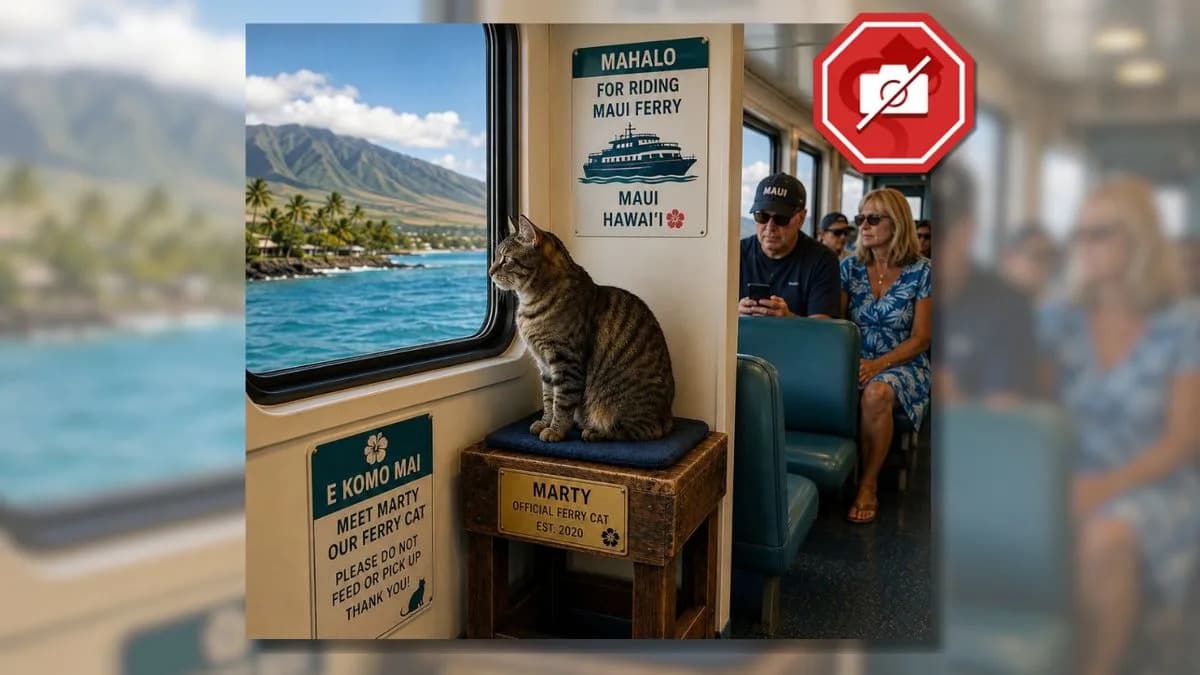
Facebook page Maui Hawaii Life, illustrated by Snopes
In June 2026, a set of images shared on social media purported to show a ferry crew building a special seat for a cat named Marty, who allegedly commuted on the same vessel every day for about four years. After a detailed review, the evidence indicates those images were created with artificial intelligence rather than photographed in the real world.
Verdict
Not authentic. The viral photos appear to be AI-generated. Reverse-image searches, visual inconsistencies across location-specific variants, metadata and watermark checks, and AI-detection tools all point to fabrication.
How We Checked
We examined the images and related posts using multiple methods: reverse-image searches (Google Lens), broad web searches (Google, DuckDuckGo, Yahoo) for independent local reporting, and automated screening tools that flag synthetic imagery. We also scanned for synthesized-image identifiers (SynthIDs) using Google and OpenAI tools.
Key Findings
- Reverse-image and news searches produced no credible independent reporting about a real ferry cat named Marty — only reposts of the same social-media claim.
- Nearly identical posts placed Marty in many different cities (Maui, Galveston, Savannah, Mobile, Mackinac Island, Boston and even Apache Junction), a geographic spread that strongly suggests mass-produced content rather than a true local story.
- Visual discrepancies were apparent: mismatched skylines, inconsistent focus and perspective through ferry windows, and conflicting dates on the stool signage (e.g., signs reading "Est. 2020" or "Est. 2021" vs. claims of nearly four years of commuting).
- Automated detectors (Sightengine, Hive Moderation) returned a very high probability (about 99%) that the Maui image was synthetic. OpenAI’s tools also detected a SynthID in that image — a marker commonly embedded in images generated with certain AI systems.
- Detection tools have limits: they can falsely flag real photos as synthetic and sometimes find markers in images that have only been processed by AI tools. We weighed these results alongside the broader pattern of reposts and visual inconsistencies.
Why This Likely Spread
The posts resemble previously documented campaigns in which operators publish large volumes of AI-generated images and brief local-style captions across many state-targeted Facebook pages (names such as "[State] Life" or "I Grew Up in [State]"). Slight variations help target different audiences while maximizing ad revenue or engagement.
What This Means
Heartwarming social posts about animals are widely shared, but social virality does not guarantee authenticity. When a charming image appears without independent local reporting, shows identical or nearly identical variants across unrelated locations, and triggers AI-detection tools, skepticism is warranted.
Sources
Relevant references include OpenAI’s documentation on C2PA and SynthID, Snopes reporting on AI-driven misinformation trends, and the AI-detection tools mentioned in the investigation.
Help us improve.