The retina has a physical blind spot with no photoreceptors, yet the brain fills the gap so we rarely notice it. Researchers from the University of Glasgow and York University are using this phenomenon in INTREPID experiments (published in January 2026 in PLOS One) to test integrated information theory versus predictive processing. IIT predicts perceptual compression around under-represented cortical areas, while predictive processing expects seamless reconstruction from internal models. The work probes how much of conscious experience is constructed and whether people may perceive the same world differently.
Your Brain's 'Black Hole' Reveals How Reality Is Constructed, Neuroscientists Say
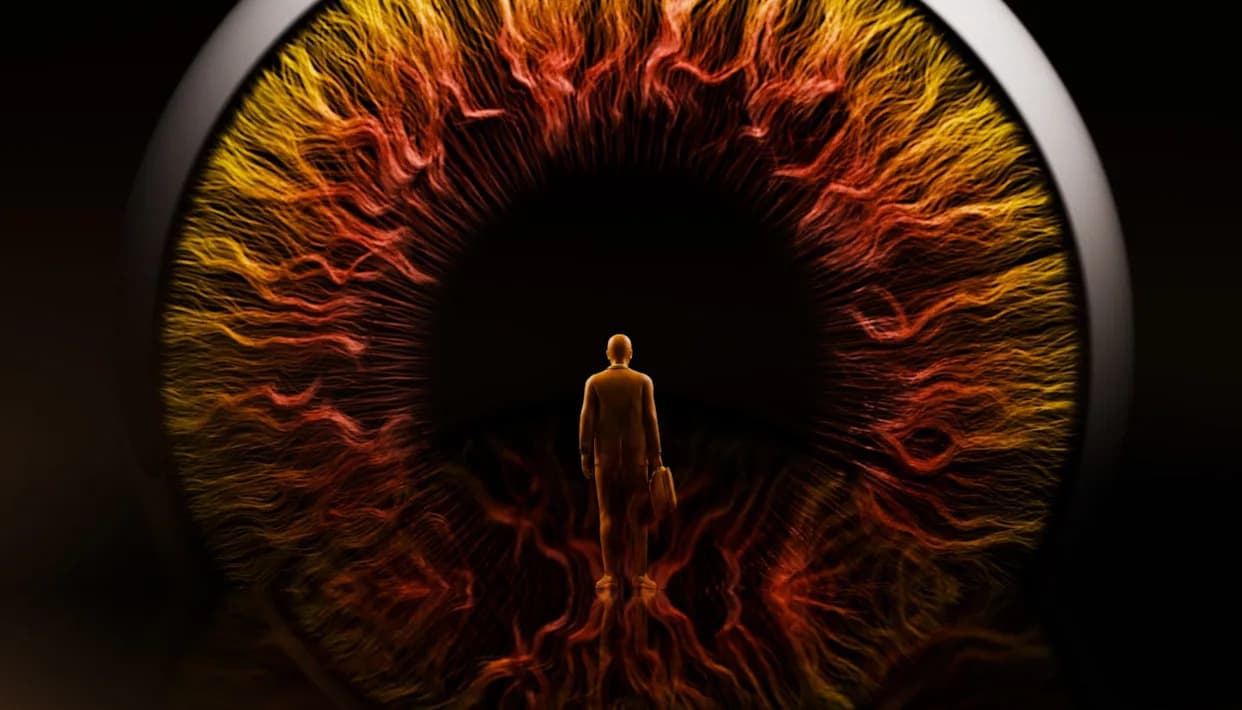
You Have a ‘Black Hole’ in Your ConsciousnessGetty Images
Most of us picture black holes as cosmic maelstroms swallowing light. Yet each of us carries a much smaller, literal gap in our inner cosmos: the retinal blind spot. Where the optic nerve leaves the eye, no photoreceptors exist, so visual information simply does not arrive at that patch of retina.
Remarkably, we rarely notice this absence. The brain "fills in" the missing information, producing a continuous scene. "In part, that is because our two eyes compensate for each other: the missing patch in one eye is usually visible to the other," says Lars Muckli, PhD, professor of visual and cognitive neurosciences at the University of Glasgow. Even when one eye is closed, cortical processes use surrounding patterns to reconstruct the absent region silently.
Turning a Perceptual Quirk Into a Test
Researchers at the University of Glasgow and York University, including Muckli, are using the blind spot as a controlled testbed for competing theories of consciousness. In a January 2026 study protocol published in PLOS One, their experiments—part of the INTREPID adversarial collaboration—ask whether conscious experience is driven more by the brain's anatomy or by its predictive models.
Integrated Information Theory (IIT) links consciousness to how much information the brain can integrate and to its physical architecture. Predictive processing frameworks argue that the brain is an active prediction engine that reconstructs incoming sensory data from internal models. Applied to the blind spot, IIT predicts that perceived space near the under-represented region will be subtly compressed or altered, while predictive processing predicts that the brain will stitch in plausible content so effectively that the blind spot is indistinguishable from fully represented visual areas.
Beyond the Blind Spot
The optic blind spot is only one place where perception is patched. Muckli points to "monocular crescents"—edge regions visible to only one eye—that are usually absorbed into binocular vision and do not trigger the same rapid filling-in when one eye closes. Conversely, the large blind area behind our heads is an absence we acknowledge consciously: our brain does not fabricate imagery there.
"The brain is not a passive receiver of sensory input. It is an active prediction machine that builds a model of the world and updates it as new information arrives," says Ramses Alcaide, PhD, neuroscientist and CEO/cofounder of Neurable.
Alcaide calls the retinal gap a "clean proof of concept": input never arrives, yet the brain presents a complete scene assembled from prior expectations and context. "When the input disappears, the simulation keeps running," he says. This suggests perception may be best understood as a continuously updated internal model that sensory input calibrates.
Why This Matters
If different brains rely on different histories, expectations, or weights on sensory evidence, people may perceive the same physical world in subtly different ways. The viral image known as "The Dress," which appeared blue-and-black to some viewers and white-and-gold to others, illustrates how differing assumptions about lighting and context can produce divergent conscious experiences.
By pitting IIT against predictive processing in carefully designed experiments, the INTREPID team aims to move the debate from elegant theory to testable prediction. If a literal blind spot can be smoothed into a seamless scene, neuroscientists must ask: how much of the rest of perceived reality has the brain quietly rewritten before it reaches awareness?
Bottom line: The retinal blind spot is more than a curiosity—it is a tractable window into how the brain constructs conscious experience and a promising battleground for competing theories of consciousness.
Help us improve.