The University of Virginia team ran a tightly blinded three-room experiment to test whether experienced out-of-body practitioners could perceive an image shown on a laptop in a distant, closed room. AI-driven matching found participants' descriptions did not identify the true images any better than chance. Unexpectedly, two participants independently described the positions and actions of researchers in the intermediate room — anecdotal observations that matched session records but were not part of the planned tests. The authors urge carefully designed follow-up studies to probe these anomalous reports under rigorous conditions.
Blind Lab Test Found No Evidence for Remote Perception — Yet Two Practitioners Report Unexplained Observations
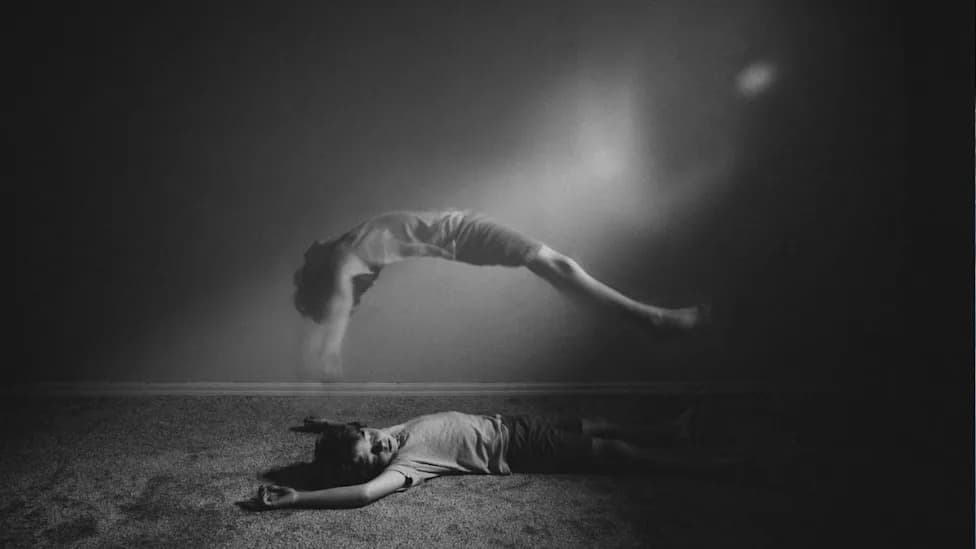
(Lindy Pfaff/Cavan Images/Getty Images)
Researchers at the University of Virginia re-examined claims of out-of-body experiences (OBEs) with a tightly controlled, double-blinded experiment. The team, led by neuroscientist Marina Weiler, recruited 21 experienced practitioners and used a three-room protocol to test whether participants could accurately describe a hidden visual target placed in a distant room.
Methods
Participants sat in Room 1 for 60–90 minutes while hooked to an EEG to record brain activity. The research team occupied Room 2 (door closed). Room 3 contained the target: a laptop displaying one image randomly selected from a set of 100. The laptop screen faced a wall so it could not be seen accidentally.
YouTube Thumbnail
To ensure full blinding, no experimenters who remained during a session knew which image had been selected; a separate team member ran the randomization, oriented the laptop away from view and left the experimental area before the image appeared. The selected image remained unknown to everyone until analysis months later.
Analysis
After each session participants described any impressions they believed were related to the hidden target. Instead of relying on subjective human raters, the team used an AI text-matching procedure to compare each participant’s description against metadata for all 100 images. If a participant had accurately perceived the hidden image, that image should have ranked near the top of the AI’s candidate list.
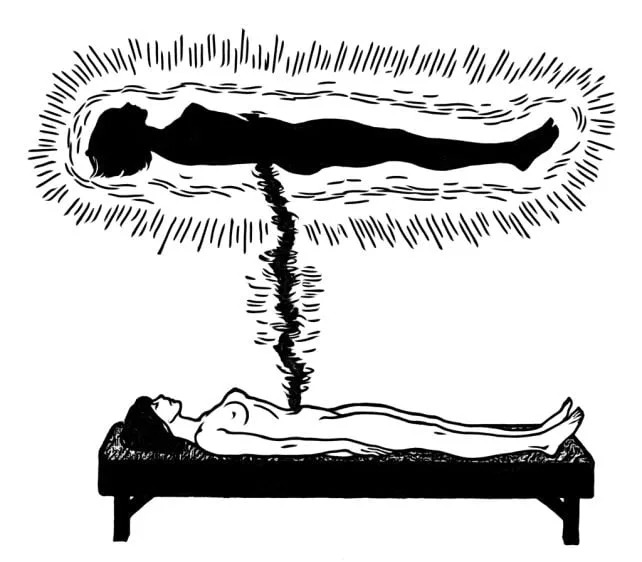
An illustration titledLeaving the Body, dated 1965 and associated with the writings of Lobsang Rampa. (Unknown author/Wikimedia Commons, CC0)
Results
Only 13 of 21 participants reported impressions they thought related to the target; eight of those said they had an OBE, while five described an internal visualization or mental "screen." The AI rankings placed the true targets between 16th and 92nd for participant descriptions — a distribution indistinguishable from chance. As a control, the same AI method reliably identified correct images when given accurate descriptions.
Unexpected Anecdotes
Although the main analysis found no evidence that practitioners perceived the laptop image in Room 3, two participants spontaneously described the actions and positions of researchers in Room 2 — details that were not pre-specified targets and therefore were not subjected to formal statistical testing.

Subscribe to ScienceAlert's free fact-checked newsletter
Participant 7 described one researcher sitting to the left at a computer and another farther back reading a book; that unusual arrangement matched what the researchers actually did during that session.
Participant 13 independently reported the researchers in mirrored positions — one on the right taking notes and the other on the left at the computer — again matching the session record.
The authors emphasize these reports are anecdotal because they were not part of the predetermined protocol. The paper notes similar, historically reported anomalies — for example, a 1960s case involving practitioner Robert Monroe who described a person later confirmed to be present outside the target room — but prior investigators urged caution and acknowledged possible mundane explanations such as sounds or procedural lapses.
Interpretation and Next Steps
The study closes one door: it provides no evidence that experienced practitioners reliably perceive static images placed on a screen in a distant room under strict, blinded conditions. At the same time, the two unexplained observations suggest a different possibility: that some nonordinary experiences might be drawn to more salient, social, or dynamic features that common protocols do not capture.
Weiler and colleagues call for hypothesis-driven follow-up studies that specifically test for perception of social activity or other types of salient targets, using equally rigorous blinding and statistical controls. They also urge caution: anecdotal reports are intriguing but not definitive, and alternative explanations should be ruled out with prospective designs.
Publication: The study is published in the journal Explore. The authors conclude that the primary analyses rule out accurate remote perception of the laptop image, while the unplanned reports about Room 2 remain unexplained and worthy of targeted investigation.
Help us improve.