The Zaccone–Trachenko paper presents a mathematical stress test showing world population could fall ~50% by 2064 if Earth’s carrying capacity suddenly dropped to about 2 billion. It is not a prediction but an extreme-scenario analysis published in Chaos, Solitons & Fractals. By contrast, UN projections anticipate a peak near 10.3 billion around 2084, with fertility approaching replacement levels. The model’s main value is identifying vulnerabilities and testing system responses to catastrophic shocks.
Math Model Suggests 2064 Population-Collapse Scenario — Don’t Panic
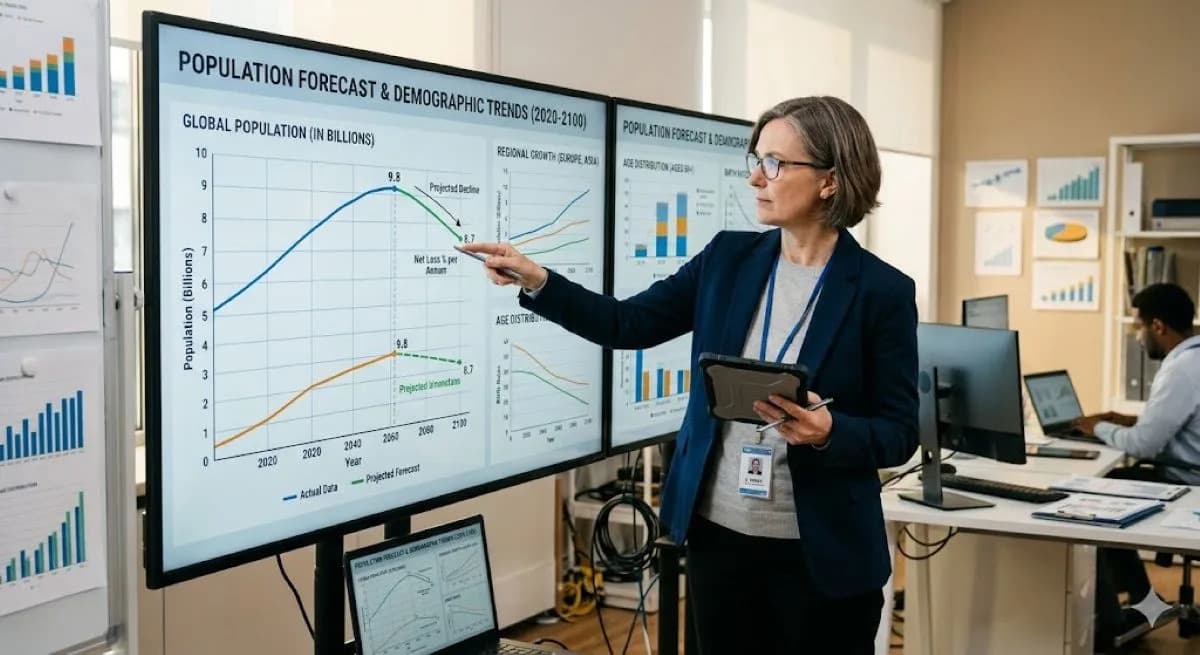
Image: Gadget Review
Pop quiz: Which sounds scarier — a pandemic that kills millions or a mathematical equation? A recent paper offers a dramatic scenario in which world population could fall by roughly 50% by 2064. That headline is attention-grabbing, but the study is a theoretical stress test, not a forecast.
What the Study Did
Published in Chaos, Solitons & Fractals, the paper by Alessio Zaccone and the late Kostya Trachenko builds a mathematical framework to explore extreme population-collapse scenarios. The authors ask: what happens if Earth’s sustainable carrying capacity suddenly dropped to about 2 billion people—for example, from catastrophic climate breakdown, a calamitous pandemic, or severe resource loss? Under those intentionally extreme assumptions, the model shows global population could decline by about 50% within ~40 years.
How To Read The Result
This is best understood as a stress test—an exploration of system vulnerability—rather than a prediction. The authors use deliberately harsh assumptions to probe how population dynamics respond to catastrophic shocks. Think of it like modeling what would happen if Antarctica melted overnight: useful for identifying weaknesses, not a likely scenario.
Key point: The paper does not claim a collapse is imminent. It tests the behavior of a model under extreme, hypothetical conditions.
How This Compares With Mainstream Projections
Mainstream demographic forecasts tell a very different story. The United Nations’ latest projections anticipate continued growth for decades, with a peak near 10.3 billion around 2084 followed by a gradual decline. Current global fertility averages are about 2.3 births per woman, trending toward replacement levels by the late 2040s. Those projections imply steady demographic transition rather than abrupt collapse.
Why The Model Still Matters
One strength of the Zaccone–Trachenko framework is that it also reproduces roughly 12,000 years of historical population patterns—from preindustrial agricultural societies through industrial expansion and modern transitions. That gives the model credibility as a tool for system analysis: it can reveal tipping points, sensitivities, and potential failure modes policymakers should know about, even if the extreme scenario never occurs.
In short: headlines about a 2064 collapse describe a mathematically possible outcome under severe, unlikely assumptions. The useful takeaway is to distinguish between a stress test and a forecast—and to use such tests to inform resilience planning.
Study: Alessio Zaccone and Kostya Trachenko, Chaos, Solitons & Fractals. Context: United Nations population projections.
Help us improve.