
The World Health Organization opened its annual World Health Assembly amid a rare hantavirus cluster linked to a cruise ship, an Ebola outbreak in the DRC, and uncertainty over announced US and Argentine withdrawals. Delegates face deep funding cuts—about 21% of WHO's budget, nearly $1 billion—program and job reductions, and unpaid US contributions of roughly $260 million. Talks on a 2025 pandemic treaty remain stalled, while the assembly will also weigh leadership succession, reforms to global health architecture, and several politically sensitive resolutions.
WHO Confronts Hantavirus, Ebola and Funding Uncertainty at World Health Assembly
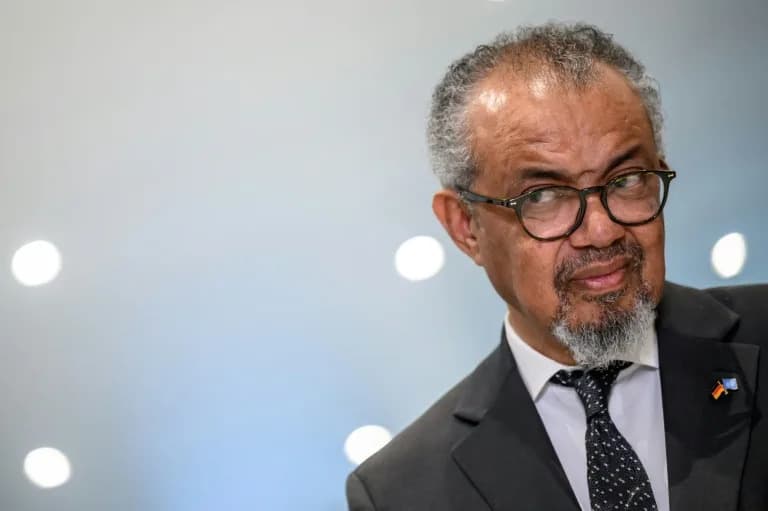
WHO chief Tedros Adhanom Ghebreyesus faces a lomming funding crisis and an Ebola epidemic in the DR Congo (Fabrice COFFRINI)(Fabrice COFFRINI/AFP/AFP)
The World Health Organization convened its annual World Health Assembly in Geneva on Monday amid mounting concerns over a rare hantavirus cluster tied to a cruise ship, a concurrent Ebola outbreak in the Democratic Republic of Congo, and growing uncertainty around announced withdrawals and funding shortfalls.
Outbreaks Dominate the Agenda
Although the unusual hantavirus cluster is not formally listed on the meeting agenda, delegates expect it to figure prominently in discussions alongside the ongoing Ebola response in the DRC. WHO Director-General Tedros Adhanom Ghebreyesus warned that these outbreaks are "just the latest crises in our troubled world," adding that "from conflicts to economic crises to climate change and aid cuts, we live in difficult, dangerous and divisive times."
Funding Pressures and Organizational Strain
United Nations Secretary-General António Guterres, speaking via video, said global health challenges "have rarely felt more daunting," noting that recent cuts to bilateral and multilateral aid have disrupted health systems and widened inequalities. Swiss Health Minister Elisabeth Baume-Schneider highlighted the scale of the funding squeeze: "The WHO's budget has been reduced by around 21 percent, or nearly one billion dollars. Hundreds of jobs have been eliminated, programs have been reduced." She added that WHO "had to, and was able to, undergo profound reform in the midst of the emergency."
Surie Moon, co-director of the Global Health Centre at the Geneva Graduate Institute, told AFP that while "the situation is still fragile," the organisation has "been successful in mobilising most of the funds" needed for the next two years. She said the hantavirus episode underlines why the world needs an effective, trusted, impartial and reliably funded WHO.
Membership Uncertainty: US and Argentina
Deep divisions persist over member-state commitments. U.S. President Donald Trump submitted a one-year notice to withdraw from WHO on his first day back in office in January 2025, and Argentina issued a similar notice. The WHO constitution does not include a formal withdrawal clause; when the U.S. joined in 1948 it reserved the right to withdraw provided it gave one year's notice and paid its financial obligations in full for that fiscal year.
Although the one-year notice period has elapsed, Washington has not paid its assessed contributions for 2024 or 2025 and reportedly owes roughly $260 million. The WHO has not formally confirmed either country's withdrawal. At the executive board meeting in January, Israel tabled a resolution to approve Argentina's withdrawal—an item expected to be discussed this week—while diplomats signalled a preference for maintaining diplomatic ambiguity over the U.S. status.
Policy Battles and Institutional Reform
Negotiations on a landmark 2025 pandemic treaty remain deadlocked, with disagreements between wealthier and developing countries likely to push talks into another year. Delegates will also debate whether to launch a formal reform of the "global health architecture"—the patchwork of agencies and initiatives that can overlap and sometimes fail to coordinate effectively. Proponents say reform is needed to reduce fragmentation, avoid duplication and ensure that contentious but critical issues such as climate change and sexual and reproductive health rights are not sidelined as aid pools shrink.
Leadership and Sensitive Resolutions
The assembly unfolds as the race to succeed the WHO director-general intensifies. No candidates have formally declared yet, but announcements could come ahead of the September 24 nomination deadline. Delegates will also consider politically sensitive resolutions on Ukraine, the Palestinian territories and Iran, any of which could provoke heated debate.
"Six years after the last global pandemic, Covid-19, the world health architecture is changing rapidly," Ghana President John Dramani Mahama told the assembly. "We are witnessing the end of an era. We must have the courage to build the next one."
The assembly runs through Saturday, and observers say its outcomes—on funding, membership, treaty negotiations and reform—will shape WHO's ability to respond to outbreaks and global health threats in the years ahead.
Help us improve.





















