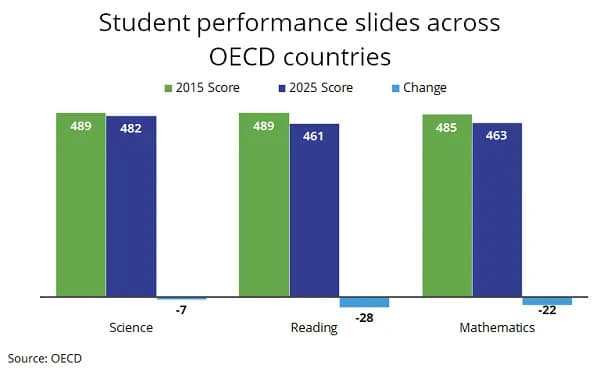
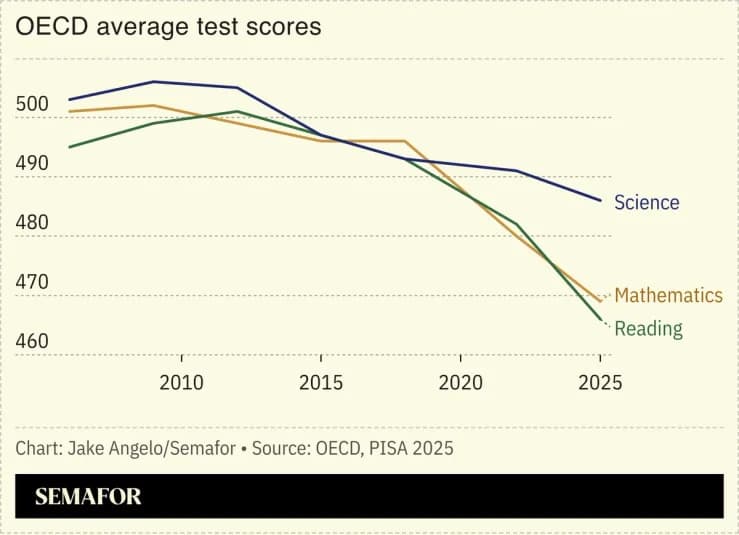
The Education Scorecard — a collaboration of scholars from Dartmouth, Harvard and Stanford — reports that the U.S. entered a "learning recession" beginning in 2013, with declines that predate the pandemic. The study highlights two likely contributors: the rollback of federal accountability after 2011 and the rapid rise of social media and near-constant online access among teens. While causal links remain unsettled, the authors call for rebuilding federal research capacity (especially the IES) and point to hundreds of districts that have made measurable gains since 2022.
Anatomy of a ‘Learning Recession’: Report Finds U.S. Academic Declines Began in 2013
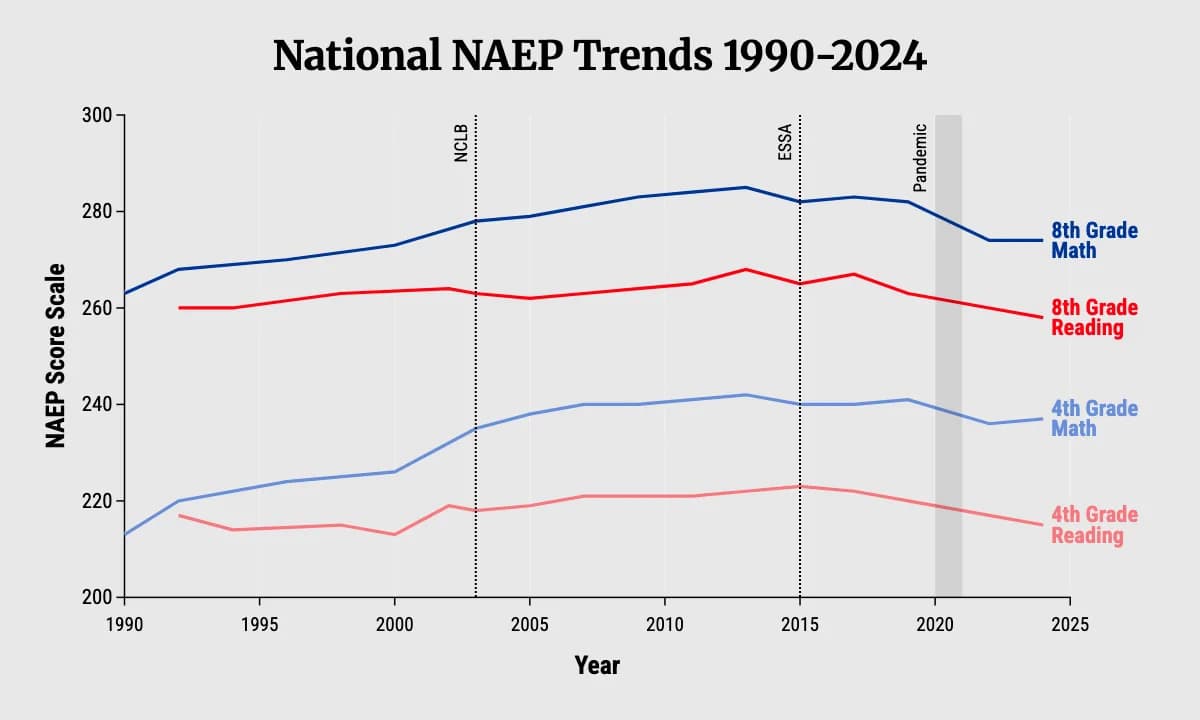
A coalition of social scientists from Dartmouth, Harvard and Stanford released a new Education Scorecard report that concludes the United States entered a sustained "learning recession" beginning in 2013 — a slide in K–12 achievement that predates the pandemic and that policymakers have struggled to reverse.

Thomas Kane (Harvard University)
Key Findings
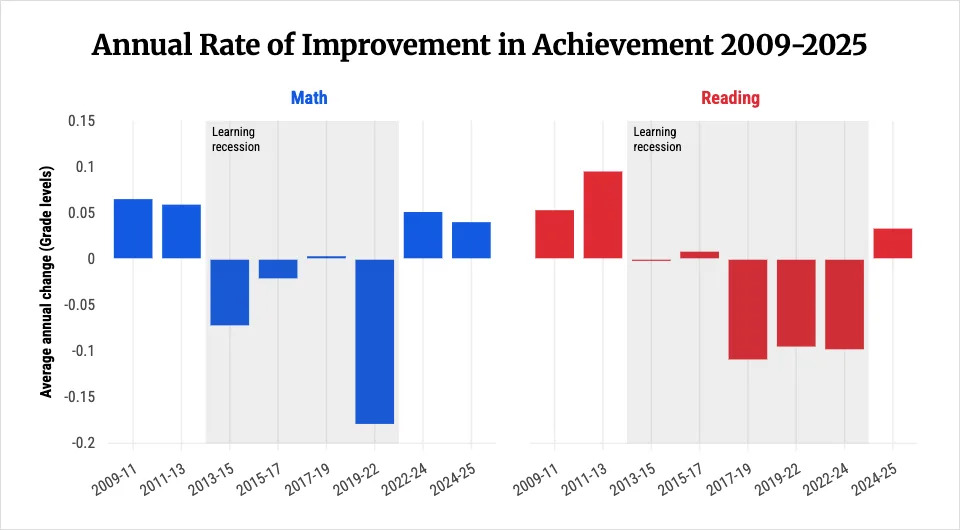
The Scorecard traces large-scale losses in student performance that were already visible during President Trump’s first term. National Assessment of Educational Progress (NAEP) data show robust gains for fourth- and eighth-graders from 1990 through about 2015 — roughly the equivalent of two grade levels of math learning — followed by a sharp and sustained downturn beginning in 2013. In some subjects, declines before the pandemic matched the size of losses seen during its worst months.

Morgan Polikoff (University of Southern California)
Possible Drivers
The report highlights two parallel trends that the authors argue likely contributed to falling outcomes, while stressing that the evidence is suggestive rather than dispositive.
Graphic by The 74. Source: Education Scorecard
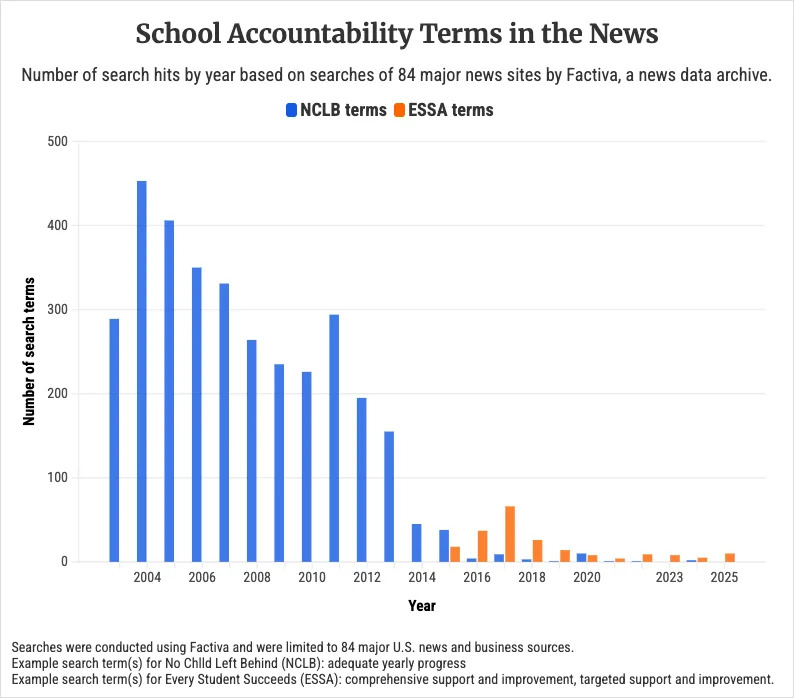
Easing of Federal Accountability. Starting in 2011 the Obama Department of Education began granting waivers to states unable to meet the rising benchmarks of No Child Left Behind (NCLB). More than 40 states sought relief by adopting new standards and teacher-evaluation systems. The Scorecard documents that many states used this flexibility to reduce scrutiny of low-performing schools: by 2014 fewer than 10 percent of schools were flagged for missing learning benchmarks. Public visibility of accountability declined sharply — the authors’ media search found a 97% drop in mentions of federal accountability categories and penalties after 2017 — and with it, the external pressure that had prompted many districts to act.
Graphic by The 74. Source: Education Scorecard
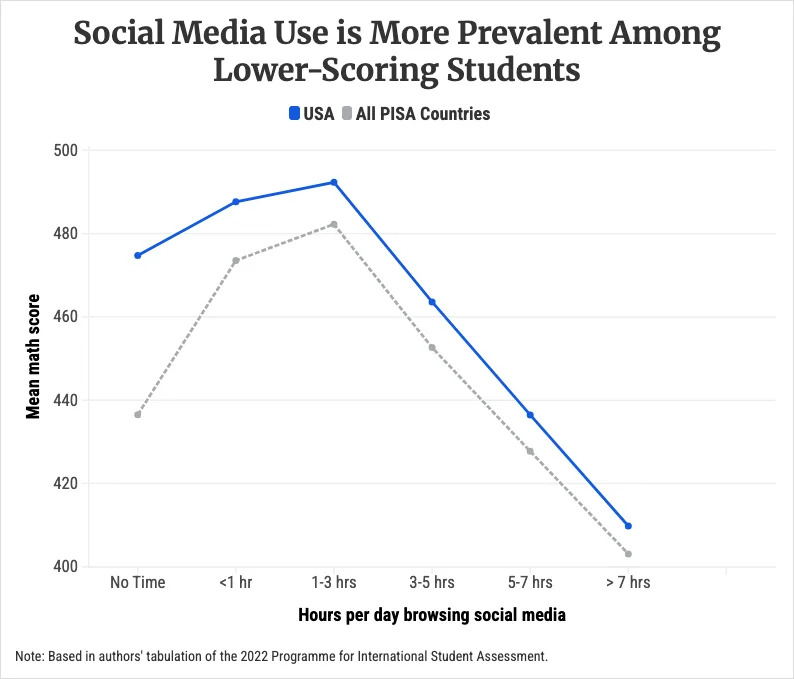
Rapid Rise of Social Media and Constant Connectivity. Teen digital habits changed fast: Pew Research surveys show about 46% of U.S. teenagers reported being online "almost constantly" by 2022. A growing literature links heavy internet and social-media use to worse youth mental health and to behaviors that can interfere with learning (sleep disruption, distraction, lower homework time). The Scorecard notes correlations between high social-media use and lower international test scores (PISA), and calls for deeper federal research into these links.
Graphic by The 74. Source: Education Scorecard
Evidence on Interventions
Schools and districts have experimented with smartphone bans and other policies. Results are mixed: a recent Stanford study found that forced phone surrender improved students’ psychological well-being after two years but produced little change in state assessment scores; earlier work reports modest short-term academic gains from schoolwide bans. Researchers stress that bans do not address home access, where sleep and study disruption may continue.

David Filglio (University of Rochester)
District Success Stories
The report also highlights encouraging examples. Since 2022 the Scorecard identified 108 districts with sizable gains in both math and reading and nearly 450 districts with large improvement in at least one subject. Featured cases include Washington, D.C., where reading achievement for grades 3–8 now exceeds 2018 levels by nearly half a grade level — improvements credited to a proprietary K–5 English curriculum, targeted teacher stipends for literacy training, and sustained local leadership.

Doug Lemov (Edutopia)
Policy Recommendations
The authors urge a stronger federal research role — particularly rebuilding and refocusing the Institute for Education Sciences (IES) — to investigate social media effects, cellphone policies, chronic absenteeism and other high-priority issues. Thomas Kane, a Scorecard co-founder, argues that convening researchers and funding large, rigorous studies is necessary to reach consensus more quickly than the academic community acting alone.
Voices From the Field
"If you had told me in 1990 that we would see that kind of rise in fourth- and eighth-grade math, I’d have said you were crazy," said Thomas Kane. "And yet it happened, and nobody celebrated."
Experts quoted in the report — including Morgan Polikoff, David Figlio and Doug Lemov — welcomed the Scorecard's broad approach while urging caution about causal claims. They emphasized the difficulty of isolating which reforms produce durable, transportable gains when districts often implement many changes at once.
Conclusion
The Education Scorecard frames recent declines as the product of long-term, overlapping changes in policy, technology and school practice. While the precise causes remain contested, the report calls for renewed federal research, attention to absenteeism and targeted dissemination of successful district practices. It also offers guarded optimism: hundreds of districts have already regained ground, suggesting that targeted strategies and leadership can produce measurable recovery.
Help us improve.