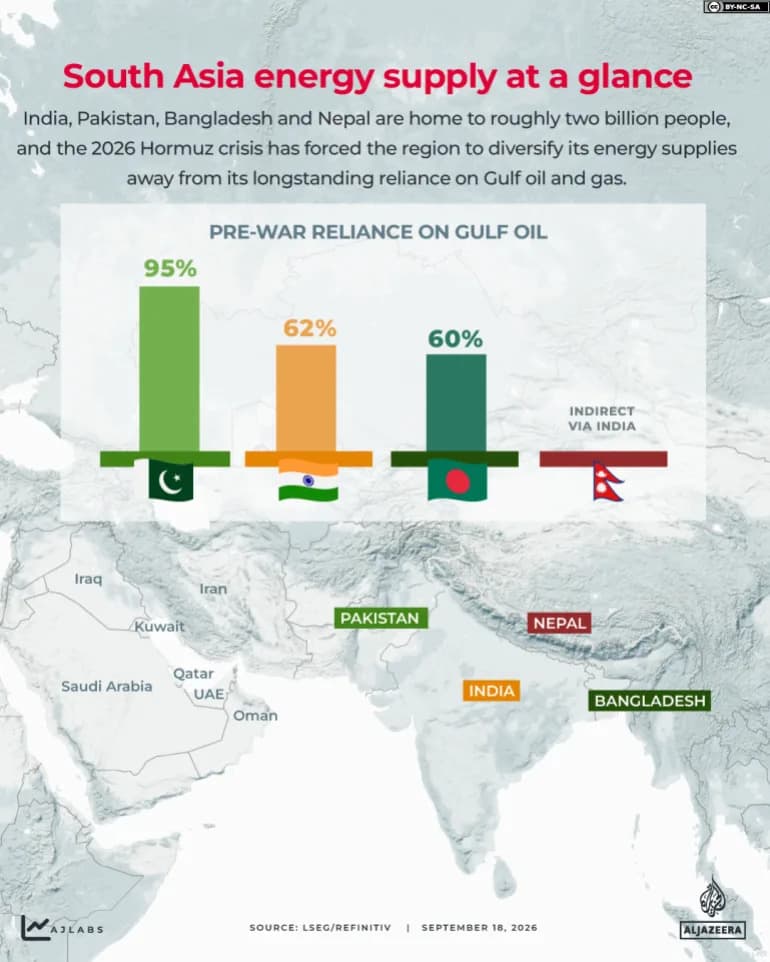
Pakistan’s worsening gas shortage has upended daily routines, especially in cities like Karachi where piped gas now arrives in short, unreliable windows. LNG imports fell from 8.2 million tonnes in 2021 to about 6.1 million tonnes by late 2025, and shipments dropped further after regional attacks on Iran on 28 February disrupted shipping. The shortage is increasing unpaid domestic work (largely borne by women), forcing small businesses to cancel or limit services and reducing study and rest time for students and households.
“Whole Morning Revolves Around Gas”: How Pakistan’s Fuel Shortage Is Reshaping Kitchens and Lives
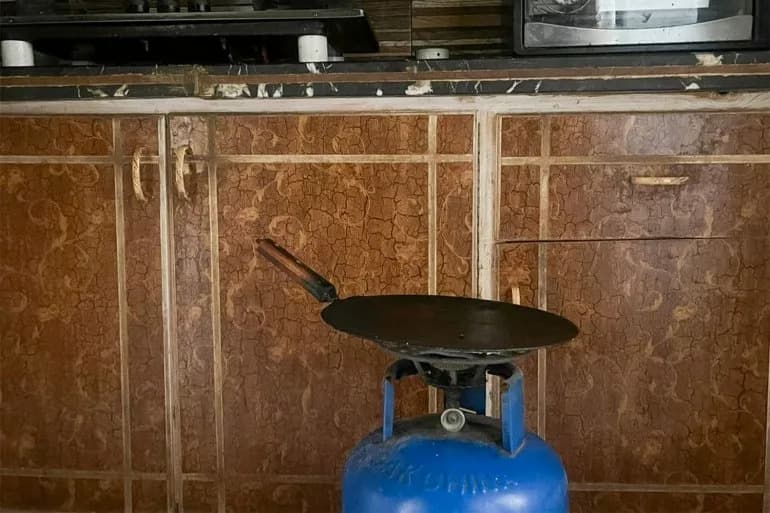
Karachi resident Shabana Hasan keeps a gas cylinder for times when the PNG is not available, or its pressure is too low [Vania Ali/Al Jazeera]
Karachi — Farhat Qureshi, 60, spent most of her life cooking without watching the clock. Today, her mornings begin with a single calculation: how much can she finish before the kitchen gas runs out again.
In Qureshi’s home, cooking gas arrives in short, unpredictable windows in the morning, afternoon and evening. Miss a window and meals are delayed, food is reheated, plans change and the kitchen simply waits.
“I don’t think I have ever seen this happening in my whole life. My whole morning revolves around gas,” Qureshi told Al Jazeera.
Pakistan’s energy problems deepened after attacks on Iran on 28 February, which escalated regional tensions and disrupted liquefied natural gas (LNG) shipments. Even before then, Pakistan’s LNG imports had fallen from 8.2 million tonnes in 2021 to about 6.1 million tonnes by late 2025 as domestic production gradually declined.
Most of Pakistan’s daily gas still comes from domestic fields, but those fields have been producing less for years. Imported LNG, largely from Qatar and the United Arab Emirates, normally fills part of the gap and supplies roughly a quarter of the country’s electricity. Since the regional escalation, LNG cargoes to Pakistan have dropped sharply: OGRA data shows Pakistan typically received eight to 12 shipments per month through 2025 and early 2026, but only two shipments arrived in March.
Lives Timetabled Around Gas
Households — and in particular the unpaid labour of women — are bearing the brunt. Women report waking earlier, cooking faster, rearranging meals, sacrificing rest and planning entire days around uncertain stove access. In many Karachi neighbourhoods, gas is typically available in short windows: roughly 6:00–9:30am, a couple of hours around midday, and again from about 6:00–9:30pm. In practice, however, pressure is low and supply is erratic, so cooking takes longer and uncertainty remains.
“It is very irritating that when it is time, the gas does not come. It is tiring to live like this,” Qureshi said. “In the evening, I want to give time to my family and home, or I have other things to do, but the gas comes only at 6pm. So I do whatever I have to do quickly.”
A 2024 policy brief from the Pakistan Institute of Development Economics and UNFPA found women in Pakistan spend roughly three hours a day on unpaid, non-market work, with the largest share of that time in the kitchen. For many, those hours are now squeezed and fragmented.
Impact Beyond the Home
Small businesses and services feel the strain too. Chef Fatima Hafeez, who runs a lunchtime meal service from home, says she sometimes cancels orders because switching to LPG cylinders is prohibitively expensive. Load shedding — scheduled power outages — compounds the problem: generators and other backup systems often depend on fuel or charged batteries. (A UPS provides short-term battery backup but must be kept charged by electricity.)
Home salons and other microbusinesses have curtailed services that require electric tools; a salon owner in Karachi said she now avoids hairstyles that need straighteners or curling irons because solar setups and intermittent power cannot handle those loads.
Students and workers describe lost study hours and rest. “My entire routine is adjusted around two things: gas and load shedding,” said Simalah Zafar Baqai, a 22-year-old university student.
The World Bank’s 2024 Pakistan Energy Survey found fewer than half of households used clean cooking fuels despite wider access to electricity. Nationally, 44.3% used low-emission clean-fuel stoves, 38.6% used piped natural gas (PNG) and 5.7% used liquefied petroleum gas (LPG). PNG is common in urban areas, while LPG is typically a costlier backup.
What This Means
The crisis highlights how energy shocks ripple through daily life: they increase unpaid domestic labour (mostly absorbed by women), disrupt small businesses, reduce study and rest time, and force households toward costlier alternatives. While a Qatari LNG tanker recently transited the Strait of Hormuz en route to Pakistan — the first such passage since the escalation — long-term relief depends on steady imports, repaired supply chains and measures to bolster domestic production and resilience.
“Our daily life is being affected. Our personal life is being affected. And obviously, the hard work has increased,” Qureshi said.
Help us improve.