
The WHO says the hantavirus outbreak linked to the MV Hondius presents a low risk to the general public, despite detection of the Andes virus in positive cases. Three passengers have died and several others are ill; around 150 people remain aboard. The ship is due to anchor off Tenerife and passengers will be transferred for repatriation flights, with ECDC and WHO teams on board to manage the response.
WHO: Hantavirus Risk to Public Is Low as MV Hondius Prepares for Repatriation
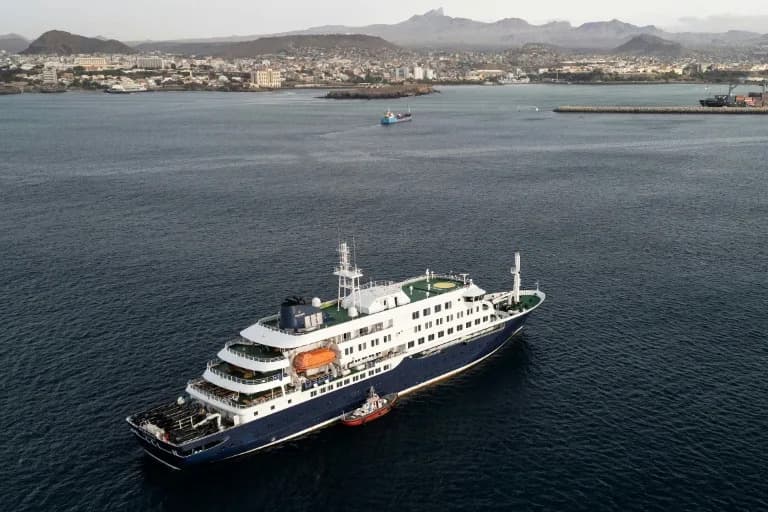
The cruise ship MV Hondius is expected in the Canary Islands early Sunday (-)(-/AFP/AFP)
The World Health Organization (WHO) said on Friday that the hantavirus outbreak linked to the cruise ship MV Hondius poses a low risk to the general public, even as countries make plans to repatriate passengers stranded aboard the vessel.
Three passengers have died in the outbreak — a Dutch husband and wife and a German woman — and several others have fallen ill. Laboratory testing has confirmed the presence of the Andes virus in positive cases; this is the only hantavirus strain known to be capable of limited person-to-person transmission, which has heightened international concern.
Situation On Board
The Dutch-flagged MV Hondius, carrying around 150 people, is expected to anchor off Tenerife in the Canary Islands on Sunday. Authorities said the ship will not dock: passengers will be transferred to shore by smaller craft and then taken by bus to the airport for repatriation flights organized by several countries.
WHO spokesman Christian Lindmeier emphasized that hantavirus is a serious illness for infected individuals but that the risk to the broader population remains very low. He noted that transmission patterns on the ship appear limited — in some cases cabinmates of sick passengers have not become ill — and said the virus "is not that contagious that it easily jumps from person to person."
Cases, Tests and Response
The WHO reported five confirmed and three suspected cases and said an update was expected later. Health officials also indicated there are no suspected cases remaining on the ship after recent assessments. Two Dutch healthcare specialists are on board: an expert from the European Centre for Disease Prevention and Control (ECDC) and a WHO representative conducting a risk assessment.
A flight attendant for KLM who had brief contact with an infected passenger and later developed mild symptoms tested negative for hantavirus, the WHO said. Spanish authorities are testing a woman who developed symptoms after being on the same flight; she remains in hospital isolation while authorities investigate, though officials describe this transmission route as unlikely.
Logistics, Precautions and Wider Concerns
Repatriation flights have been announced by Britain and the United States among others. Dutch Prime Minister Rob Jetten said authorities are coordinating closely to ensure a safe arrival and transfer while minimizing any risk of further transmission. The Canarian regional government said the evacuation must occur between Sunday and Monday because adverse weather is expected afterwards.
Passengers on board report calm but cautious behaviour: masks are being worn indoors, people are maintaining distance, and medical staff have joined the ship to care for the ill. Local dockworkers in Tenerife staged protests over the vessel’s arrival. Separately, British authorities reported a suspected case on Tristan da Cunha, one of the world's most isolated communities.
Key takeaway: While the confirmed presence of the Andes virus demands careful containment and monitoring, current evidence indicates limited person-to-person spread and a low risk to the general public.
Help us improve.





















