Senate Republicans have inserted $1 billion for U.S. Secret Service security tied to President Trump’s planned East Wing ballroom into a roughly $70 billion package to fund ICE and CBP. The draft directs about $38 billion to ICE and $26 billion to CBP, with appropriations running through September 2029. Committee language limits the $1 billion to security upgrades and bars spending on non-security project elements. Lawmakers plan to mark up the bill after the Senate recess and may use reconciliation to advance it.
Senate GOP Seeks $1 Billion for Secret Service to Secure Trump’s East Wing Ballroom in $70B ICE/Border Bill
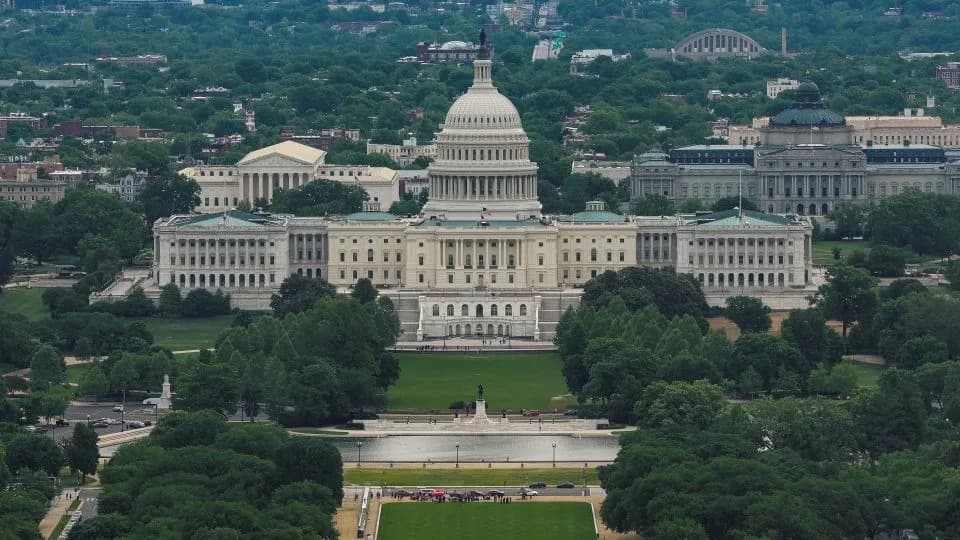
The U.S. Capitol Building seen from atop of the Washington Monument in Washington, DC, May 2, 2026. - Ken Cedeno/Reuters
Senate Republicans have placed a $1 billion allocation for the U.S. Secret Service into a roughly $70 billion immigration-enforcement package, earmarked for security upgrades tied to President Donald Trump’s planned East Wing ballroom. The funds are embedded in legislation drafted by the GOP-led Senate Judiciary and Homeland Security committees and are part of a broader effort to fund ICE and U.S. Customs and Border Patrol operations.
Package Details
The committee text directs about $38 billion for U.S. Immigration and Customs Enforcement (ICE) and roughly $26 billion for U.S. Customs and Border Patrol (CBP). Appropriations in the draft would run through the end of September 2029. Committee leaders say they intend to pass the measure with only Republican votes.
Ballroom Funding and Limits
Language tucked into the Judiciary Committee’s section would provide $1 billion "for security adjustments and upgrades … to support enhancements by the United States Secret Service relating to the East Wing Modernization Project, including above-ground and below-ground security features." The text specifies the money cannot be used for "non-security elements" of the project.
The Trump administration previously indicated the East Wing renovation would be financed largely by private donors rather than taxpayers. But after the shooting at the White House Correspondents’ Dinner last month, some Republicans argued publicly that federal funding is justified to harden the White House complex.
Davis Ingle, White House spokesman: "Congress has rightly recognized the need for these funds. Due in part to the recent assassination attempt on President Trump at the White House Correspondents’ Dinner, the proposal would provide the United States Secret Service with the resources they need to fully and completely harden the White House complex, in addition to the many other critical missions for the USSS."
Separate Measures And Support
Sen. Lindsey Graham (R-S.C.) separately urged a vote on his bill to authorize $400 million for the ballroom project, including an underground national-security annex, though Senate Majority Leader John Thune had not committed to taking up that legislation. Sen. Katie Britt (R-Ala.), who supports Graham’s effort, said any taxpayer funding should include robust oversight and fiscal controls and noted the ballroom would likely be used by future presidents because the project will not be completed immediately.
"The attack kind of showed us where we are as a nation, and it’s not a good place," Britt told CNN. "We have people that, instead of taking their fight to the ballot box, are taking their fight to people with bullets, and it’s fundamentally un-American."
Next Steps And Context
Committee leaders are expected to mark up the immigration-enforcement package after senators return from recess. Congressional Republicans have signaled they may advance the funding through the budgetary reconciliation process, which would allow them to bypass a Senate filibuster.
Last month, the president publicly directed GOP congressional leaders to finalize Department of Homeland Security funding by June 1. Before the recess, senators voted to reopen key parts of DHS after weeks of infighting, but the bill that ended the record DHS shutdown did not include additional funds for federal immigration enforcement.
Reporters and staff: CNN’s Betsy Klein contributed reporting to this story.
Help us improve.