
U.S. intelligence judges that Iran's estimated time to build a nuclear weapon has not shifted significantly since last summer despite June strikes and a subsequent campaign that began in February. About 440 kilograms of uranium enriched to ~60% remain unaccounted for, and the IAEA says Iran's HEU stockpile could yield roughly 10 bombs if further enriched. Experts say removing or destroying that material would be necessary to materially extend Iran's breakout time, while U.S. officials weigh riskier options such as ground raids to recover the HEU.
U.S. Intel: Iran's Nuclear 'Breakout' Timeline Largely Unchanged After Strikes
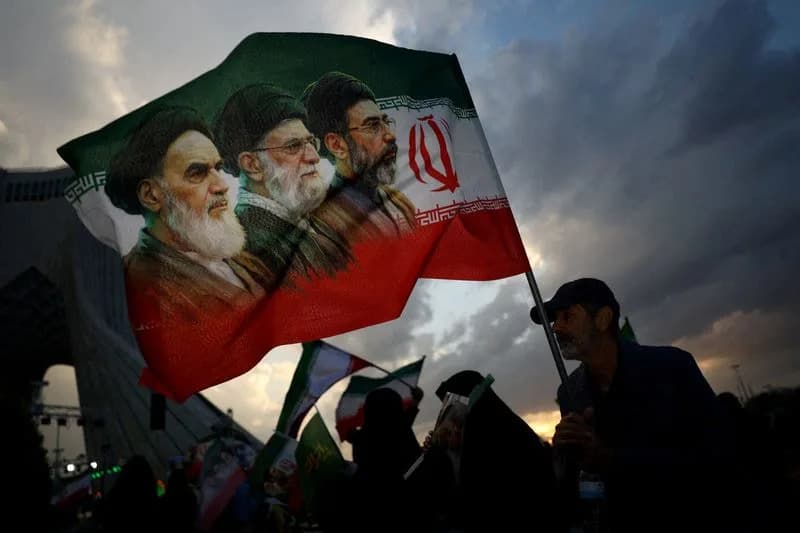
FILE PHOTO: A man holds a flag with a picture of late leader of the Islamic Revolution Ayatollah Ruhollah Khomeini, late Supreme Leader of Iran Ayatollah Ali Khamenei and Iran's new Supreme Leader Mojtaba Khamenei, during a rally in Tehran, Iran, April 29, 2026. Majid Asgaripour/WANA (West Asia News Agency) via REUTERS/File Photo
WASHINGTON, May 4 (Reuters) - U.S. intelligence assessments indicate that the estimated time Iran would need to build a nuclear weapon has remained largely unchanged since last summer, despite earlier strikes that analysts said had pushed back Tehran's timeline by up to a year.
Key findings
Analysts say the most recent U.S. and Israeli operations, which began on February 28, have concentrated largely on conventional military targets and Iran's military-industrial base, although Israel has struck several nuclear-related sites. As a result, U.S. agencies judge Iran's projected 'breakout' time remains similar to estimates updated after June's strikes.
Timeline and Targets
Before the June 12 clashes, U.S. intelligence estimated Iran could likely produce enough bomb-grade uranium and assemble a device in roughly three to six months. After U.S. strikes in June that damaged the Natanz, Fordow and Isfahan enrichment complexes, officials moved that estimate to about nine to 12 months.
The latest assessments, according to sources familiar with the matter, show little further change since last summer. Analysts say this partly reflects the recent campaign's emphasis on conventional and leadership targets rather than a sustained, focused effort to eliminate remaining nuclear materials.
Unaccounted Material and the IAEA Assessment
The June attacks severely damaged the three enrichment plants known to be operating at the time. But the United Nations nuclear watchdog has been unable to verify the whereabouts of about 440 kilograms of uranium enriched to roughly 60 percent. The IAEA estimates the total highly enriched uranium (HEU) stockpile could be sufficient to yield about 10 bombs if further enriched.
Some intelligence officials and analysts say substantially extending Iran's breakout time would likely require locating and destroying or removing that HEU, which reports suggest may be stored in deeply buried or underground complexes such as tunnels at the Isfahan Nuclear Research Center.
Options and Risks
U.S. officials have discussed riskier options in recent weeks, including potential ground operations to retrieve HEU from underground facilities. Such operations would carry significant military and political risks, and sources say the assessments reflect caution about the difficulty of safely targeting deeply buried nuclear material.
White House spokeswoman Olivia Wales said: 'President Trump has long been clear that Iran can never have a nuclear weapon – and he does not bluff.'
Uncertainties
Experts emphasize that precisely evaluating Iran's capability is difficult. Several U.S. agencies independently study Tehran's program and while there is broad consensus on many points, outlying assessments exist.
Analysts also note the potential impact of targeted killings of Iranian nuclear scientists, which may have degraded technical know-how even if documentary or material evidence remains. David Albright, a former U.N. inspector, said such losses introduce uncertainty about Iran's ability to field a functioning warhead.
Iran continues to deny pursuing nuclear weapons; U.S. intelligence and the IAEA have said Tehran halted a warhead development effort in 2003, though some experts and Israeli officials contend key elements may have been preserved covertly.
The Office of the Director of National Intelligence did not respond to a request for comment.
Context: The conflict has been at a relative stalemate since the U.S. and Iran agreed on an April 7 truce to pursue negotiations, but tensions remain high. Iran's actions in the Strait of Hormuz have disrupted global oil flows and contributed to an energy shock that heightens the stakes of any escalation.
Help us improve.





















