WASHINGTON — President Donald Trump has launched a focused campaign ahead of Indiana’s primary, endorsing challengers to seven Republican state senators who opposed his effort to redraw the state’s congressional map.
Through a string of social media posts, Trump has attacked the incumbents — calling them incompetent, “RINOs” (Republicans In Name Only) and losers — as he pushes for their ouster.
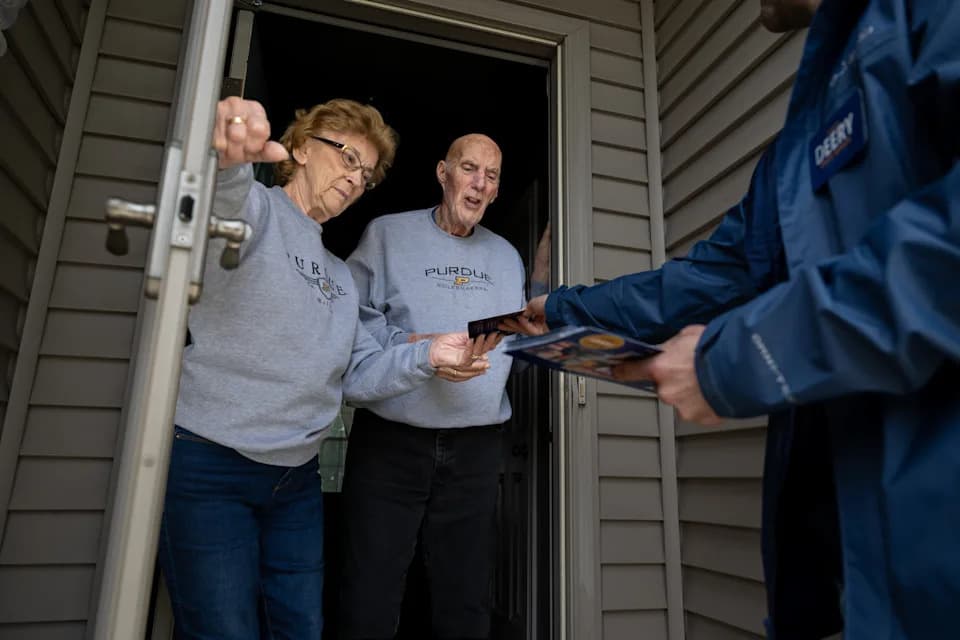
In 2025, Trump urged Republican-controlled legislatures in several states to adopt new congressional maps intended to help the party hold a narrowly divided U.S. House. Texas, Missouri, North Carolina and Ohio acted on that appeal. In Indiana, the plan failed after more than half of the state’s Republican senators joined Democrats to block the map Trump backed. Eight of the senators who opposed the proposal are up for reelection in 2026; Trump has targeted all but one of them for defeat.
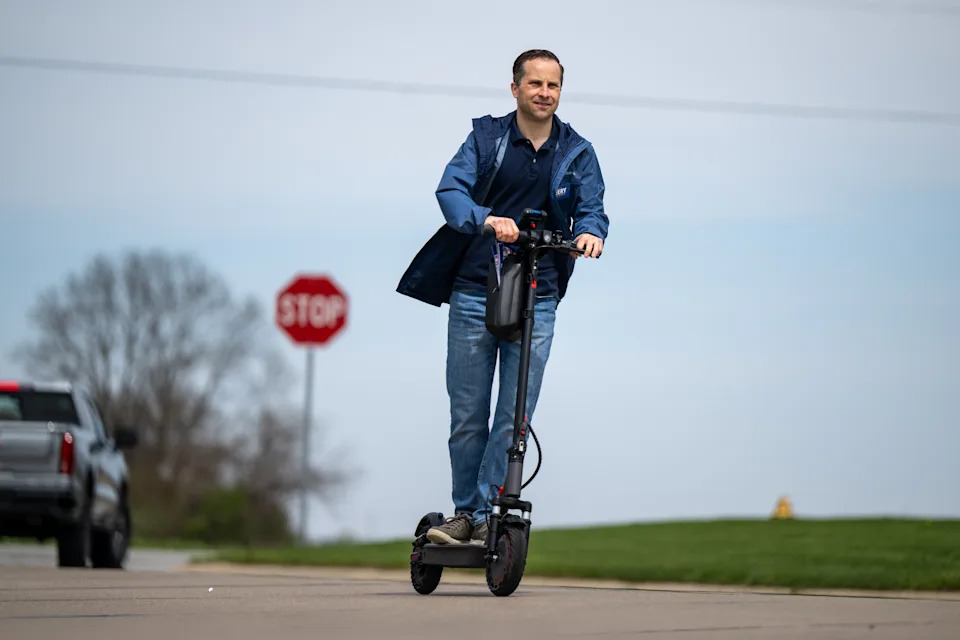
Indiana state Sen. Spencer Deery, R-West Lafayette, who represents District 23, canvasses a neighborhood on an electric scooter, Saturday, April 11, 2026, in West Lafayette, Ind. (AP Photo/Doug McSchooler)(ASSOCIATED PRESS)
Voter-approved maps in California and Virginia that favor Democrats have blunted some expected GOP gains elsewhere. Still, a new redistricting plan in Florida and a recent U.S. Supreme Court decision that reduced protections under the Voting Rights Act of 1965 have bolstered Republican efforts to reshape the electoral map ahead of November.
The seven Indiana state senators targeted by Trump represent districts he carried in 2024, mostly by large margins. His narrowest showing among those seats was in State Senate District 1, near Lake Michigan and southeast of Chicago, where he received roughly 53% of the vote — about a 7-point margin over then-Vice President Kamala Harris. His strongest showing was in District 19, along the Ohio border, where he earned about 68% of the vote — a margin near 39 percentage points.
Only one of the targeted incumbents, State Sen. Spencer Deery (District 23), faced a contested primary in 2022; he won with about 31% of the vote in a four-way race that included Paula Copenhaver, who is among Trump’s picks this year. Another targeted incumbent, State Sen. Greg Goode (District 38), was appointed to a vacant seat in 2023 and has not yet run in a full districtwide election.
Indiana state Sen. Spencer Deery, R-West Lafayette, who represents District 23, is stopped by passersby while canvassing a neighborhood, Saturday, April 11, 2026, in West Lafayette, Ind. (AP Photo/Doug McSchooler)(ASSOCIATED PRESS)
Half of Indiana’s 50 State Senate seats and all 100 State House seats are up for election in 2026. Republicans hold supermajorities in both chambers. Voters will also select nominees for the U.S. House under the existing district lines; none of Indiana’s nine seats is widely expected to determine control of the chamber this fall.
One high-profile contest to watch is the Democratic primary in the 7th Congressional District, where U.S. Rep. Andre Carson is seeking renomination for a 10th full term. He faces three challengers: attorney and political consultant George Hornedo; Destiny Wells, an attorney and Army Reserve lieutenant colonel who was the 2024 nominee for Indiana attorney general; and Denise Paul Hatch, a former Center Township constable who is appealing a 2024 felony conviction for official misconduct.
How the AP Will Cover Results
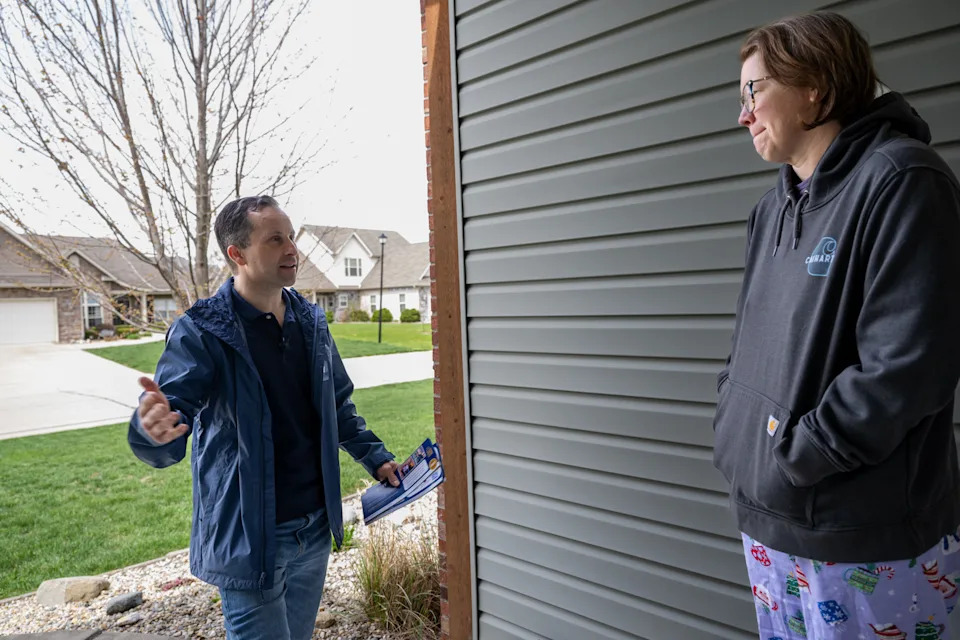
Julie Wise, 48, speaks with Indiana state Sen. Spencer Deery, R-West Lafayette, who represents District 23, as he canvasses a neighborhood, Saturday, April 11, 2026, in West Lafayette, Ind. (AP Photo/Doug McSchooler)(ASSOCIATED PRESS)
The Associated Press does not make projections and will declare winners only when it determines there is no plausible path for a trailing candidate to close the gap. If a race remains uncalled, the AP will continue to report newsworthy developments — such as concessions or victory declarations — while making clear that no official winner has been named and explaining the reason.
Recounts and Legal Challenges
Indiana has no automatic recounts. A losing candidate may request and pay for a recount regardless of the margin; costs may be partly or fully refunded depending on the outcome. The AP may call a race that is subject to a recount if the lead is large enough that a recount or legal challenge is unlikely to change the result.
Key Facts the AP Decision Team Will Track
- Poll Closing Times: Most Indiana precincts are in the Eastern Time Zone and close at 6 p.m. local (6 p.m. ET). Some counties lie in Central Time and close at 7 p.m. ET. State Senate District 1 and the final precincts in the 1st, 2nd, 4th and 8th congressional districts close at 7 p.m. ET.
- Targeted State Senate Seats: Republican incumbents face Trump-backed challengers in State Senate Districts 1, 11, 19, 21, 23, 38 and 41.
- Primary Ballots: Indiana does not register voters by party. Registered voters choose which party primary ballot to cast on Election Day. Voter ID is required.
- Party Affiliation Quirk: State law includes a rarely enforced provision that primary voters should have supported a majority of their chosen party’s candidates in the prior general election or plan to do so in the next general election. Voters whose party choice is challenged must cast a provisional ballot unless they sign an affidavit aligning with that party.
- Voter Registration: About 4.8 million Hoosiers were registered to vote as of the November 2024 general election. District registration totals range from roughly 442,000 in the 7th Congressional District to about 505,000 in the 5th.
- Turnout and Early Voting: Approximately 29% of primary votes in 2024 were cast before Election Day. As of last Friday, more than 175,000 ballots had already been cast in the combined Democratic and Republican 2026 primaries.
- Absentee Processing: Indiana allows absentee ballots to be processed when received, so some counties begin counting before polls close. More than three-quarters of the state’s 92 counties typically include nearly all absentee and early-vote totals in their first election-night update.
- Timing Examples From 2024: In the 2024 presidential primary, AP first reported results at 6:06 p.m. ET and the final update of the night came at 11:34 p.m. ET with more than 99% of votes counted. Final update times for congressional districts with contested primaries in 2024 ranged from about 9:10 p.m. ET to 11:34 p.m. ET.
As of Tuesday, there are 182 days remaining until the 2026 midterm elections.
Follow the AP’s coverage of the 2026 elections: apnews.com/projects/elections-2026.