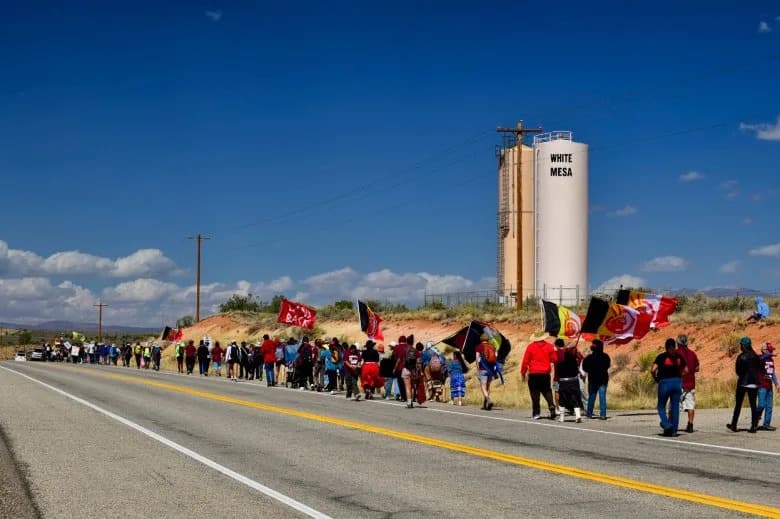
Nine Sioux tribes have sued the U.S. Forest Service and USDA to block exploratory graphite drilling near Pe'Sla, a sacred meadow in the Black Hills used for ceremonies and youth camps. The tribes allege the Forest Service approved the project in February using a categorical exclusion without consulting tribes or conducting required NEPA and NHPA reviews. Protesters and environmental groups are seeking court injunctions and report some drilling pads lie within a two-mile buffer established around Pe'Sla.
Nine Sioux Tribes Sue To Block Exploratory Graphite Drilling Near Sacred Pe'Sla In The Black Hills
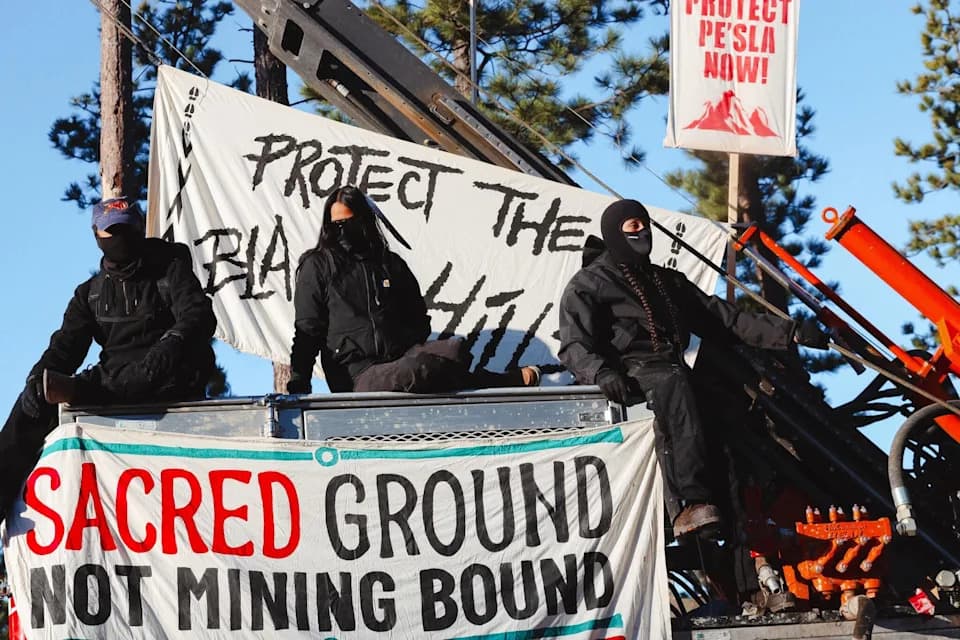
Masked demonstrators sit atop drilling equipment on April 30, 2026, in Pennington County, S.D., with a banner reading Sacred ground not mining bound. / Credit: Angel White Eyes / AP
Sioux Falls, S.D. — Nine federally recognized Sioux tribes from South Dakota, North Dakota and Nebraska have filed a federal lawsuit seeking to stop exploratory graphite drilling near Pe'Sla, a meadow in the central Black Hills that tribes use year-round for ceremonies, prayer and youth camps.
Tribes Allege Agencies Skipped Required Reviews
The complaint, filed Thursday in South Dakota federal court against the U.S. Forest Service and the U.S. Department of Agriculture, alleges the agencies approved the drilling project without required consultation or environmental and historic-preservation reviews. The tribes say the Forest Service granted the permit in February under a categorical exclusion, a shortcut the agencies say is justified for short-term projects they expect will not affect cultural or environmental resources.
Tribal leaders and their lawyers dispute that the project meets those criteria and argue that exploratory drilling often precedes larger mining operations. The complaint contends the agency failed to treat Pe'Sla as an affected area and therefore violated the National Historic Preservation Act (NHPA) and the National Environmental Policy Act (NEPA).
What Is At Stake: Pe'Sla And The Black Hills
Pe'Sla sits in the heart of He Sapa (the Black Hills), a more than 1.2 million-acre forested region revered by Sioux communities as 'the heart of everything that is.' While the Black Hills also draw millions of tourists to attractions such as Mount Rushmore and state parks, the landscape has been sacred to Sioux peoples for generations. Parts of Pe'Sla were purchased by Sioux tribes in 2012, 2015 and 2018, and an agreement with the Forest Service established a two-mile buffer on surrounding public lands.
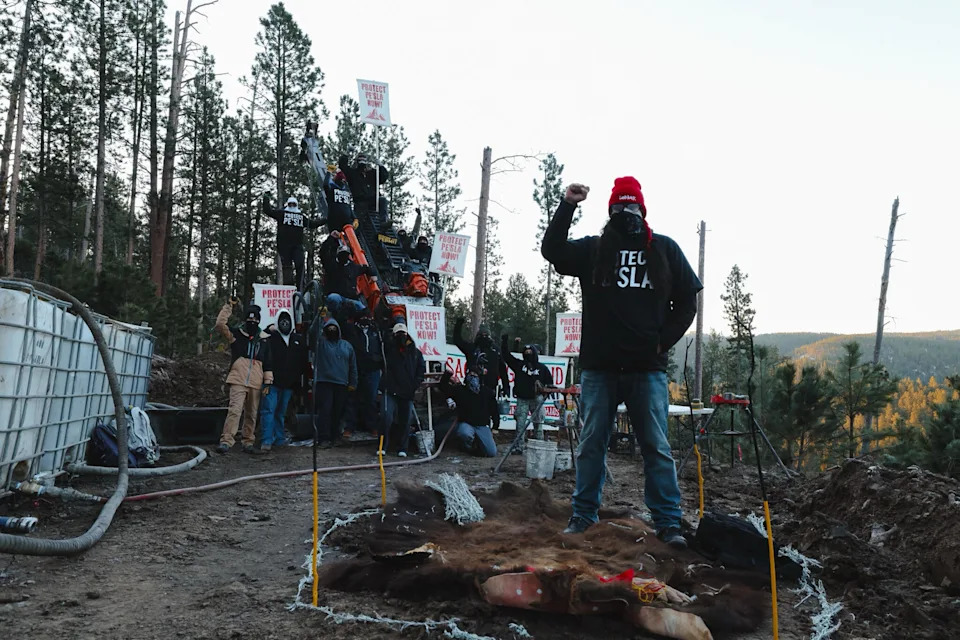
A masked demonstrator stands with their fist in the air, wearing a Land Back beanie in front of signs reading Protect Pe'Sla Now on April 30, 2026, in Pennington County, S.D. / Credit: Angel White Eyes / AP
'We as Lakota people have been coming and praying and holding ceremony at these places for over 2,000 years,' said Wizipan Garriott, president of NDN Collective and a member of the Rosebud Sioux Tribe. 'It's important that these sacred places be protected for future generations to come.'
Project Details And Response
Rapid City–based Pete Lien & Sons, a supplier of materials such as limestone, sand and gravel, is pursuing the graphite exploration. The plan calls for drilling up to 18 boreholes, each reaching roughly 1,000 feet, to collect geological samples. NDN Collective and allied environmental groups have also filed for a temporary restraining order and a preliminary injunction to halt the work.
NDN Collective says some drilling pads were placed inside the Forest Service's two-mile buffer around Pe'Sla. Protesters carrying signs such as 'Protect Pe'Sla' and 'Sacred Ground Not Mining Bound' have been demonstrating at drilling pads and at the mining company’s headquarters since work was first noticed in late April. The group reported that the Forest Service paused drilling for part of a recent day and sent contractors home; the agency declined further comment, citing ongoing litigation.
Pete Lien & Sons did not respond to emailed requests or voicemails seeking comment.
Broader Context
The Black Hills were heavily altered during the 1870s gold rush, which dispossessed Native peoples from much of the region. In recent years, higher mineral prices have prompted renewed interest from prospectors and mining companies. Tribal leaders say this lawsuit — brought jointly by nine distinct tribes who share cultural and linguistic roots — is a rare and unified effort to defend Pe'Sla and to ensure sacred places receive required legal protections.
It remains unclear when drilling initially began; NDN Collective reported seeing active drilling pads in the prior week and said protests will continue as needed. 'As Lakota, we pray as long as we need to,' Garriott said.
Help us improve.