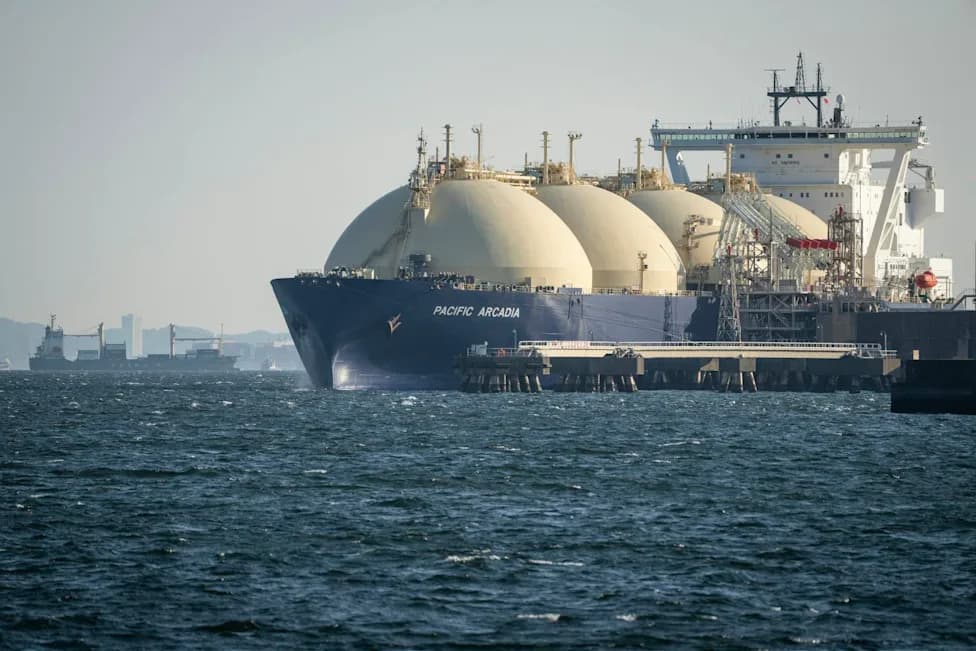
Japan's Prime Minister Sanae Takaichi visited Australia to discuss energy security, critical minerals and defence cooperation amid strains on global oil supplies. Officials emphasised the strategic role of gas, the need to diversify critical-minerals supply chains, and efforts to reduce reliance on single suppliers. The two countries have strengthened defence ties, including an Aus$10 billion deal for Mogami-class warships, and reaffirmed commitment to a "free and open Indo-Pacific."
Japan, Australia Deepen Ties on Energy, Critical Minerals and Defence Amid Global Oil Strains
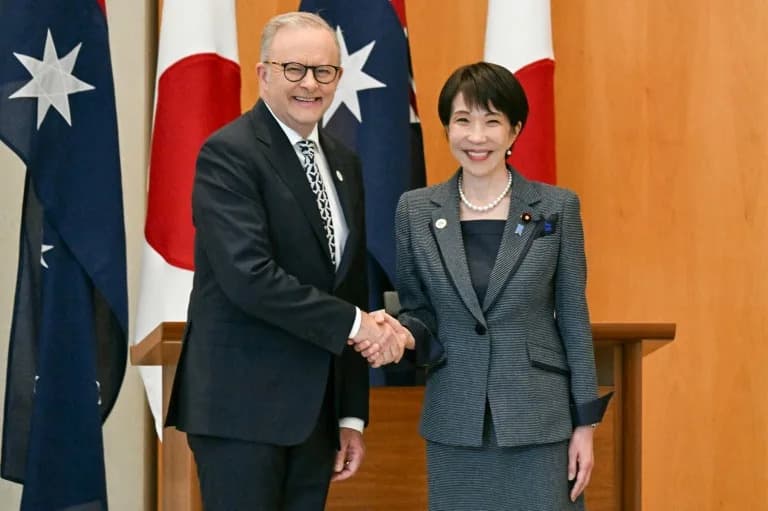
Australia's Prime Minister Anthony Albanese is hosting Japan's Prime Minister Sanae Takaichi for talks on energy, critical minerals (Saeed Khan)(Saeed Khan/AFP/AFP)
Japan's Prime Minister Sanae Takaichi began talks in Canberra on Monday with Australian Prime Minister Anthony Albanese as both countries work to manage pressure on global oil supplies and strengthen strategic cooperation.
Strategic Energy Partnership
Australia is a major supplier of coal and liquefied natural gas (LNG) to Japan, while Japan provides roughly 7% of Australia's diesel. Officials highlighted the role of natural gas in underpinning shared energy security and supply-chain reliability.
"Gas plays a role in all our discussions because it fundamentally underpins the shared energy security between our countries," Foreign Minister Penny Wong told reporters in Canberra. "Our export partners have always put to us they want reliability."
Shipping Routes and Regional Tensions
About one-fifth of the world's oil normally transits the Strait of Hormuz, a chokepoint where shipping has been disrupted in recent months amid heightened regional tensions and attacks on vessels. Both governments are watching developments closely as they assess supply risks.
Critical Minerals and Supply-Chain Resilience
Japan emphasised the importance of securing steady supplies of critical minerals—essential for semiconductors, electric vehicle batteries and defence systems. Australia has promoted its abundant mineral reserves as a way to diversify global supplies and reduce dependence on any single source, including China.
"We want to make sure that we're resilient in a time where we see a lot of economic and global disruption," Wong said. "Critical minerals are necessary for our economy."
Defence Cooperation
The two countries have deepened defence ties. Last year they signed an Aus$10 billion (about US$6 billion) agreement for Japan to supply Mogami-class stealth warships to the Royal Australian Navy, part of broader security cooperation in the Indo-Pacific.
Indo-Pacific Strategy
In a foreign policy speech delivered in Vietnam over the weekend, Prime Minister Takaichi pledged to bolster a "free and open Indo-Pacific," a policy first promoted by her mentor Shinzo Abe. The strategy—now embraced by multiple U.S. partners and allies—aims to strengthen regional rules, diversify supply chains and check influence from rival powers.
Both governments signalled that energy security, critical minerals and defence will remain central to the bilateral agenda as they work to manage near-term supply challenges and build longer-term resilience.
Help us improve.