During 2025 excavations at Kolona on Aegina archaeologists recovered 32 gold objects — beads, disc amulets and decorative gold sheets — dated to the first half of the second millennium BCE. All items were found intact inside a large stone building near a protective wall and are believed to have formed a single necklace or pendant. A needle and twelve copper fragments were also recovered. Researchers suggest the assemblage may be grave offerings, and note stylistic similarities to the historic Aegina Treasure.
32 Gold Beads and Amulets Unearthed at Kolona, Aegina — Likely Middle Bronze Age Necklace

Aerial photograph of the archaeological site of Kolona on Aegina, Greece, April 22, 2026. (photo credit: Greek Culture Ministry)
Archaeologists have uncovered a remarkable hoard of gold beads and amulets during 2025 excavations at the Kolona site on the island of Aegina. The 32 objects, all recovered in excellent condition, are dated to the first half of the second millennium BCE and are thought to have formed part of a single necklace or pendant.
Discovery and Context
The find, announced by the Greek Culture Ministry, was located within the ruins of a substantial stone building close to the remains of a defensive wall that once protected the settlement’s so-called "inner suburb" during the Middle Bronze Age. The assemblage was discovered inside the structure, suggesting it was deliberately placed or stored there.
Objects Recovered
The collection includes:
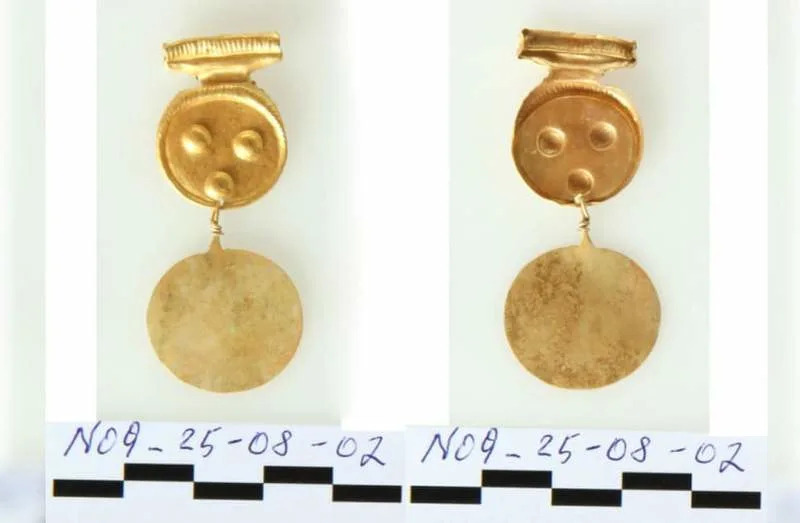
Gold bilateral discoid periapt found at Aegina, Greece, April 22, 2026. (credit: Greek Culture Ministry)
- Eight gold bilateral disc-shaped amulets and one gold non-bilateral disc amulet
- Seven gold biconical beads and one cylindrical gold bead
- Eight decorative gold sheets (gold leaf)
- Seven spherical carnelian beads
- A needle and twelve copper fragments, likely from small knives
All 32 gold and carnelian pieces were found intact and are believed to have been components of the same piece of personal ornament, most plausibly a necklace or pendant.
Interpretation and Comparisons
Excavators suggest the jewelry may have functioned as grave offerings associated with a Middle Bronze Age burial, although no surviving tomb has been identified to confirm this hypothesis. Stylistically, the amulets and beads resemble items from the so-called Aegina Treasure, a Minoan gold hoard long associated with the island. Some scholars maintain that the Aegina Treasure was found on Aegina in 1891; others argue it originated at the Chryssolakkos necropolis in Malia, Crete.
In 1892 the British Museum purchased the bulk of the Aegina Treasure from British dealers and acquired additional pieces in 1914. That hoard is dated to roughly 1850–1550 BCE and includes diadems, earrings, pendants, beads and items fashioned from gold and semi-precious stones such as lapis lazuli, amethyst, quartz, carnelian and green jasper.
Excavation Team
The Kolona excavations were carried out by the University of Salzburg in cooperation with the Austrian Archaeological Institute in Athens, under the direction of Professor Alexander Sokolicek and supervised by the Ephorate of Antiquities of Piraeus and the Islands.
Note: Further analysis—metallurgical testing, wear-pattern study and precise stratigraphic reporting—will help clarify the object's use, date range, and whether the deposit is funerary, votive or hoarded for safekeeping.
Help us improve.