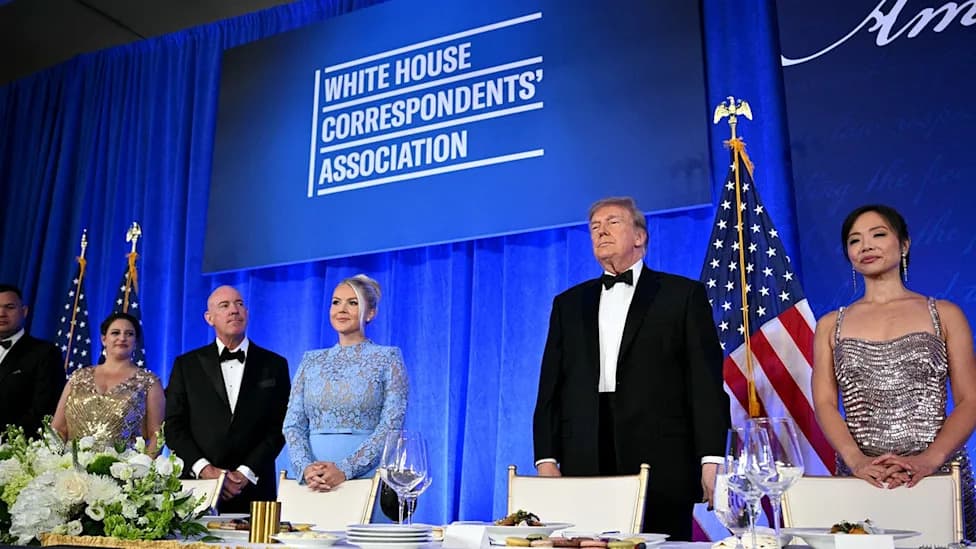
Cole Allen, 31, allegedly moved through the Washington Hilton and charged a checkpoint on a floor above the ballroom where President Trump was dining with about 2,600 people; all were evacuated safely. The breach highlights persistent hotel vulnerabilities—multiple entry points, uneven screening and blurred public/protected spaces. Industry interest in AI weapons detection is rising, but widespread deployment remains costly, operationally complex and sensitive to guest privacy concerns.
Washington Hilton Breach Puts Hotel Security Under Microscope — Costs, Privacy and Practical Limits
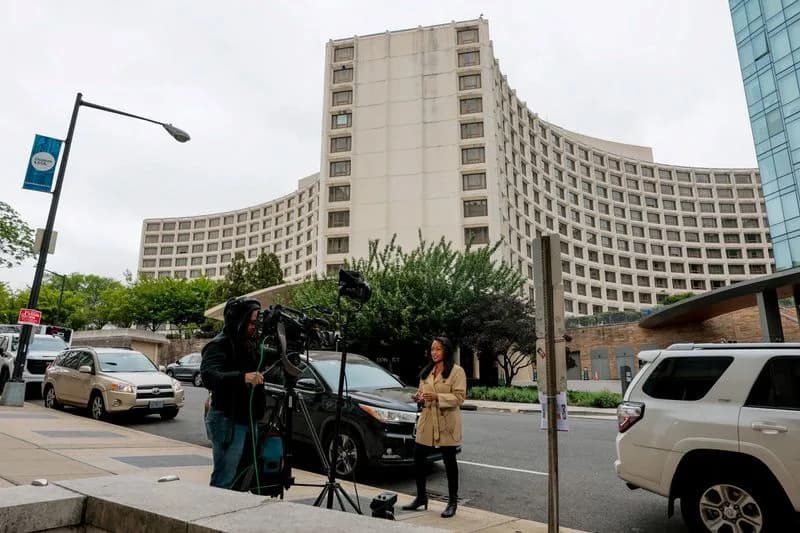
FILE PHOTO: Members of the media work near the Washington Hilton hotel, where a shooting incident at the annual White House Correspondents' Association dinner, in Washington, D.C., U.S., April 26, 2026. REUTERS/Kylie Cooper/File Photo
The Washington Hilton security breach during the White House Correspondents' Association dinner has reignited a familiar debate in the hotel industry: how to tighten protection without undermining the welcoming atmosphere that defines hospitality.
Law enforcement has identified the suspect as Cole Allen, 31. According to authorities, Allen moved through public areas of the hotel and charged a security checkpoint on a floor above the ballroom where President Donald Trump was dining with roughly 2,600 guests. Trump and attendees were evacuated safely and no guests were injured.
“I expected security cameras at every bend, bugged hotel rooms, armed agents every 10 feet, metal detectors out the wazoo... What I got is nothing,”
The suspect's pre-attack manifesto criticized the hotel's protections and underscored the challenge: threats often come from inside a property rather than from outside.
How Hotels Secure Major Events
Security professionals say hotels typically take a layered approach for major events: site surveys, credential systems, restricted elevators or floors, access-control zones and close coordination with law enforcement. Securing a large property can take several days to a week of planning and staging.
Still, hotels face structural vulnerabilities: multiple entrances, constant guest turnover, heavy foot traffic and porous boundaries between public spaces and protected zones. "Not every guest in the building is screened the same way, which is why zoning and access control become critical," said Morgan Stevens of Crisis24.
Technology, Cost and Privacy Trade-Offs
Vendors are pitching AI-powered monitoring and weapons-detection systems, but hotel operators remain cautious. Technology can detect anomalous behavior, yet deploying systems across large properties presents steep costs and operational challenges—particularly where many entrances and luggage flows exist.
Experts also raise privacy and guest-experience concerns. Nicolas Graf, a hospitality professor at NYU, summarized the tension: security can improve with technology, but hotels are a hospitality business where customers must still feel welcome.
Industry Context And Historical Precedents
High-profile attacks have driven industry changes worldwide. The 1981 attempt on President Ronald Reagan outside the Washington Hilton led to physical changes such as a secure garage and increased screening. The 2008 Taj Mahal Palace Hotel attack in Mumbai and the 2017 Mandalay Bay mass shooting in Las Vegas further pushed hotels to rethink protection measures.
Economic constraints complicate upgrades. The top nine hotel, casino and resort companies by revenue generated about $102 billion in 2025, but chains have faced margin pressures, making large-scale security investments more difficult.
Aftermath And Charges
After the incident, the Washington Hilton said it had been operating under what it described as "stringent" Secret Service protocols. Law enforcement sealed portions of the hotel, retraced the suspect's path and continues to investigate the breach.
Allen has been charged with attempted assassination, discharging a firearm during a crime of violence, and illegally transporting guns and ammunition across state lines after traveling by train from his California hometown. He has not yet entered a plea.
Takeaways
Short-term responses will likely include reassessments of credentialing, zoning and coordination with federal agencies. Longer-term changes could involve selective technology adoption, design adaptations to limit unscreened access, and budgetary trade-offs between guest experience and security resilience.
Help us improve.