Political power should not be prized so highly that people feel compelled to use violence to obtain it. The apparent attempt on Cole Tomas Allen at the White House Correspondents' Association dinner highlights a broader rise in U.S. political violence, with CSIS and START documenting recent surges. Surveys show higher endorsement of political violence among younger adults and those who identify as "very liberal," while partisan rhetoric and gerrymandering increase the sense that government will be used as a weapon. Reducing the risk of escalation requires lowering the stakes of elections and restoring norms and institutional guardrails.
Why Government Shouldn't Be Worth Fighting Over — The Rising Stakes of Political Power
Government Shouldn't Be Important Enough To Fight Over
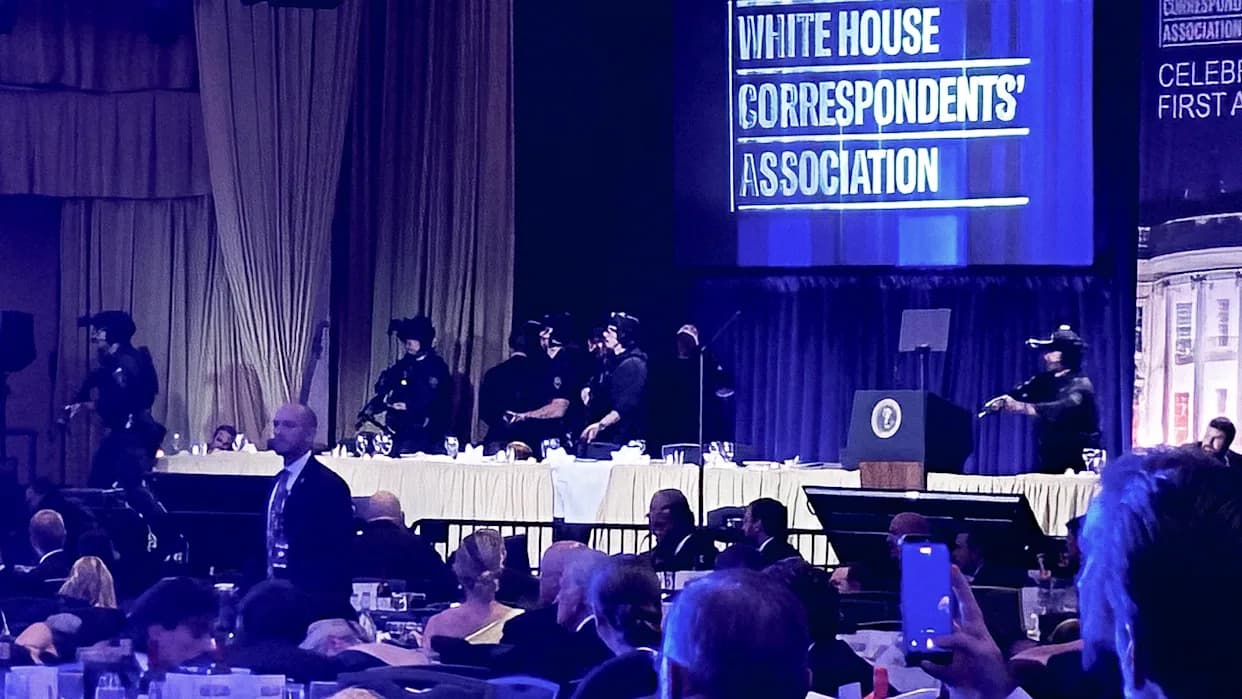
Political power should never be prized so highly that people resort to violence to obtain it. Those who choose to seize the instruments of government by force have no legitimate claim to rule. That message matters now more than ever after the latest apparent assassination attempt at the White House Correspondents' Association dinner.
The alleged attacker, Cole Tomas Allen, opened fire at the event, and a Secret Service agent's vest stopped the round — thankfully limiting injuries. Allen's manifesto read like familiar protest rhetoric: he complained that he would "no longer permit a pedophile, rapist, and traitor to coat my hands with his crimes," and insisted he was "not the person raped in a detention camp... not the fisherman executed without trial... not a schoolkid blown up or a child starved or a teenage girl abused by the many criminals in this administration." Those are grievances commonly aired at demonstrations — yet Allen armed himself and targeted dinner attendees. While still a minority, too many people are making comparable, violent choices.
Political Violence Is Increasing
How incidents are counted matters, but the trend is unmistakable: political violence in the United States is rising. The Center for Strategic and International Studies (CSIS) has reported that "domestic attacks and plots against the U.S. government are at their highest levels since at least 1994." The University of Maryland's START consortium found that political violence, which peaked during 2020–21, surged again by 34.5% in the first eight months of 2025 compared with the same period a year earlier.
Profiles of perpetrators are shifting. Allen, 31 and left-of-center in his views, is part of a changing pattern: CSIS analysts Daniel Byman and Riley McCabe observed in 2025 that it was the first year in decades where left-wing terrorist attacks outnumbered violent far-right attacks.
Generational and Ideological Trends
Survey data show notable generational differences. Analysis of the American Political Perspectives Survey by the Skeptic Research Center found roughly one in three younger adults (Gen Z and Millennials) expressed support for political violence, with the highest endorsement among respondents who described themselves as "very liberal." The breakdown showed Gen Z more likely than Millennials to support violence, Millennials more than Gen X, and Gen X more than Baby Boomers.
Across generations, those who self-identify as liberal were more likely to endorse violence than moderates or conservatives. Combining cohorts, 44% of respondents who called themselves "very liberal" agreed that "violence is often necessary to create social change," compared with lower percentages among other ideological groups.
Why The Stakes Are Rising
Contemporary politics has intensified perceptions that government will be used as a weapon against opponents. Partisan leaders often treat rivals as less than representative: after "No Kings" rallies last October, former President Donald Trump shared an AI-generated clip mocking protesters and said they "are not representative of this country." New York Governor Kathy Hochul told Republicans in 2022 to "just jump on a bus and head down to Florida where you belong," and President Joe Biden has warned that "MAGA Republicans do not respect the Constitution." Such rhetoric compounds the sense that state power will be wielded against those outside the ruling coalition.
Institutional maneuvers that raise the stakes of elections add fuel to the fire. Voters in Virginia recently approved a congressional map widely regarded as drawn to favor Democrats — a plan that could produce 10 of 11 seats despite a closer partisan vote split — and similar redistricting battles have unfolded in Texas and elsewhere.
"If in this country law has always been king, its empire has never been so expansive. More than ever, we turn to the law to address any problem we perceive... we are inclined to use national authorities to dictate a single answer for the whole country."
— Supreme Court Associate Justice Neil Gorsuch and Jane Nitze
When government reaches deeply into public and private life, holding office becomes a greater prize and losing feels existential to those on the other side. That perception — rational in many cases — makes words less important than the structure of power itself.
What Needs To Change
Reducing politically motivated violence requires lowering the perceived stakes of elections and restoring institutions and norms that reassure losers they will not be crushed. That will not happen overnight: it demands clearer guardrails around the use of state power, more restrained public rhetoric from political leaders, and reforms that make representation feel fairer to broader swaths of the public. Until the prizes of politics cease to look worth dying for, the risk of escalation will remain.
Help us improve.