Researchers analyzed 18 scorpion species with high-resolution electron microscopy and X-ray microanalysis and discovered a consistent two-layer metal architecture in their weapons. Zinc accumulates at stinger tips and along claw cutting edges, while manganese lies deeper under stinger zinc layers; some pincers also show iron. Unexpectedly, zinc was often highest in long, grasping claws—suggesting a role in durability and wear resistance, not just hardness. The study, published in the Journal of The Royal Society Interface, opens doors for comparative work on metal reinforcement across arthropods.
Metal-Reinforced Scorpions Evolved to Kill: Zinc Tips and Manganese Layers Harden Their Weapons
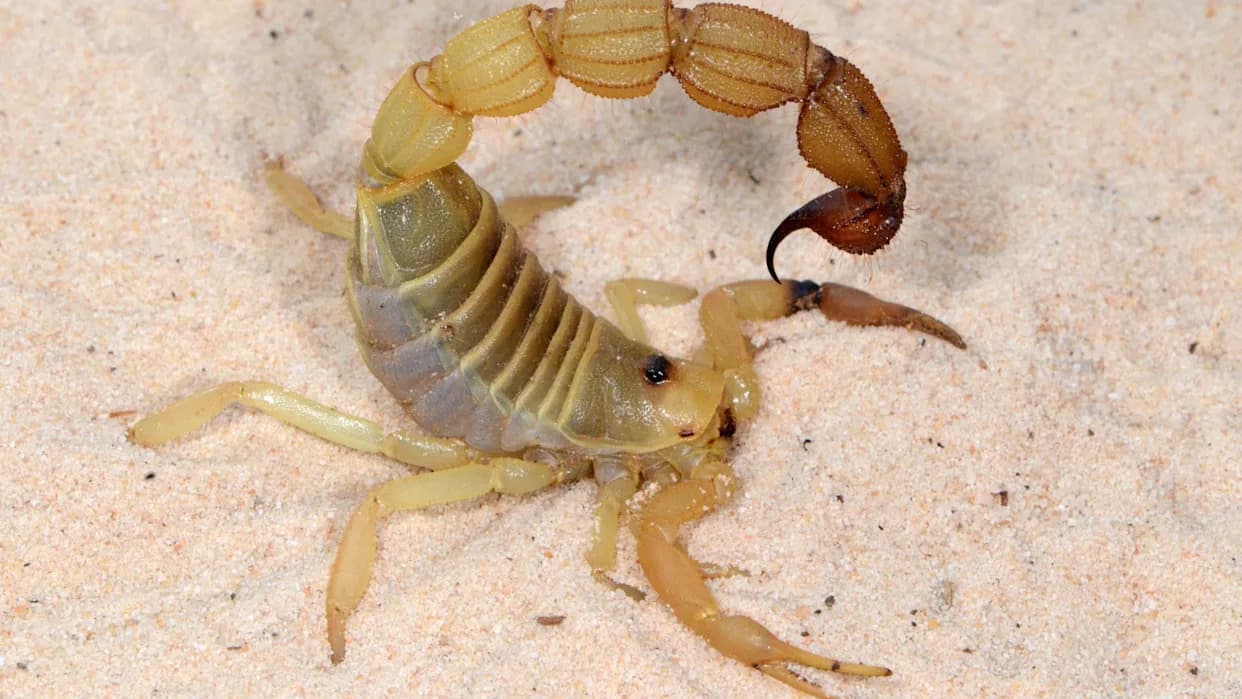
Rough thicktail scorpion (Parabuthus raudus). Paratuthus scorpions' venom is quick-acting, so they do not need to rely as much on their pincers to capture prey.
Scorpions are highly adapted predators whose bodies—armored exoskeletons, powerful pincers and venomous stingers—have been refined over millions of years to catch insects, small mammals and reptiles and to defend against predators. Recent research shows they also sometimes deploy a microscopic secret weapon: trace metals embedded in their weapons' cuticle.
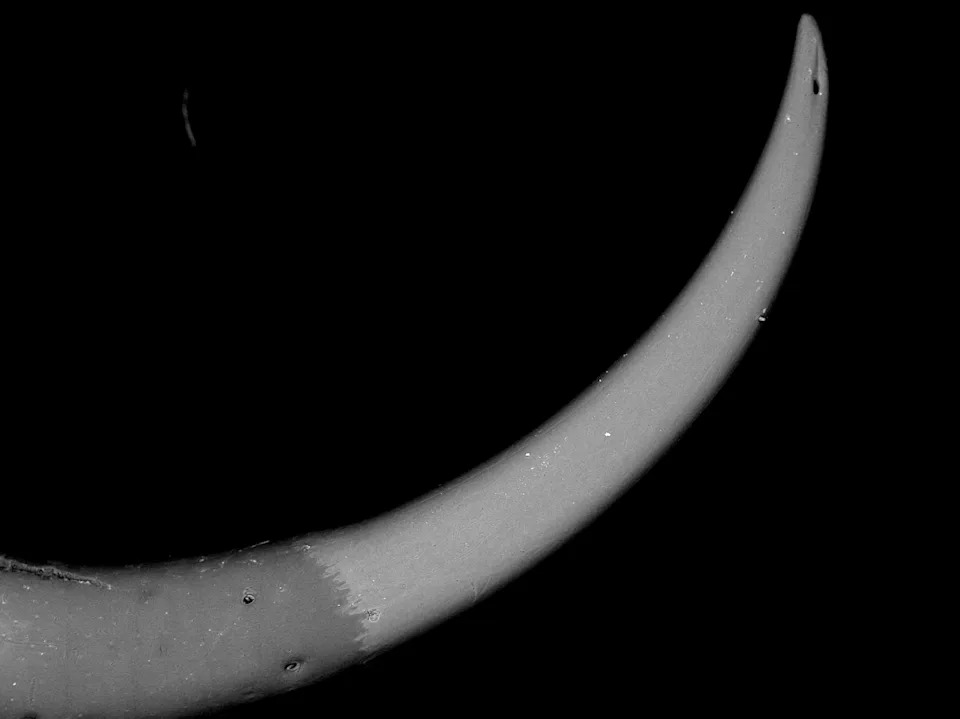
Back-scatter electron (BSE) scanning electron micrograph (SEM) of the telson of The yellow-fat tailed scorpion (Androctonus australis). Similar contrast of enrichment is present in the telson (stinger), highlighting the presence of metal. Also present is a clear line, we are terming the enrichment transition zone, where metal enrichment abruptly ends. Stingers in both msueum and wild specimens have been shown to snap break at, or near, this region. Credit: Sam Campbell/Smithsonian Museum Conservation InstituteJEOL
Researchers led by Sam Campbell of the University of Queensland examined specimens from 18 scorpion species using high-resolution electron microscopy and X-ray microanalysis while on a Smithsonian fellowship at the National Museum of Natural History in Washington, D.C. Their study, published in the Journal of The Royal Society Interface, maps how transition metals are distributed within stingers and pincers.
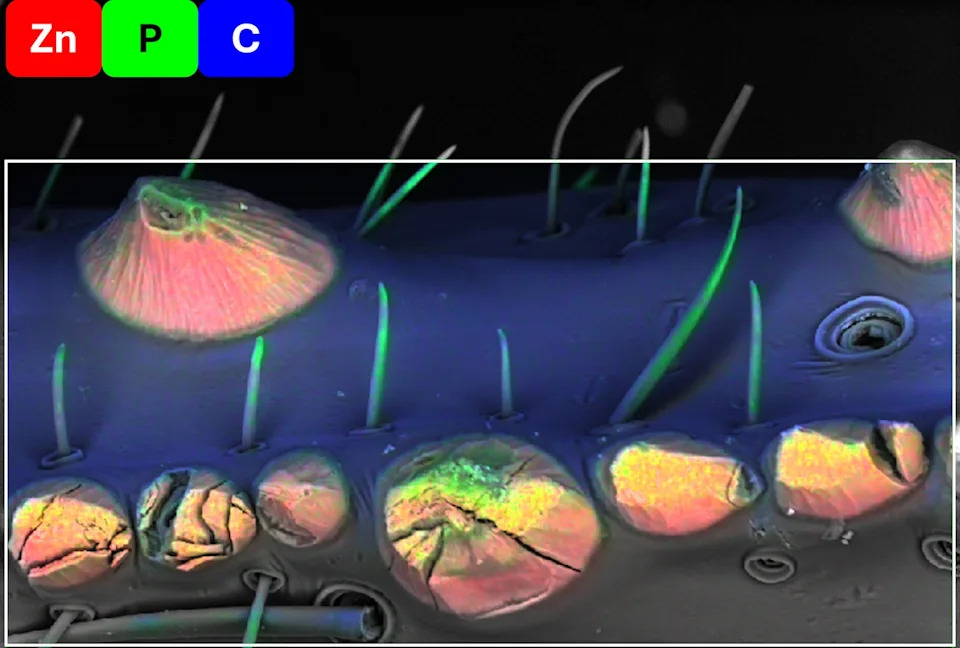
An X-ray spectral image superimposed on a scanning electron microscope image of the denticles (claw “teeth”) on the pincers of a giant hairy scorpion (Hadrurus arizonensis). The spectral image shows selective enrichment of zinc (red) in the denticles, in addition to phosphorous (green), and carbon (blue). Credit: Smithsonian Museum Conservation Institute
Campbell and colleagues noted that metals appear to strengthen some species' weapons, but the extent and patterns were unclear until now.
What They Found
Detailed imaging and chemical mapping revealed a consistent two-layer pattern in scorpion weapons. The very tip of the stinger concentrates zinc, while a deeper layer beneath it is enriched in manganese. Pincers show a related pattern: in the movable tarsus segment researchers detected either zinc alone or zinc combined with iron along the cutting edge of the claw.
Contrary to the team's initial expectation, zinc was often higher in long, slender pincers—those used to grasp prey—rather than in stout, crushing pincers. This suggests zinc's role may extend beyond simply increasing hardness; it likely contributes to durability and resistance to wear so claws can hold struggling prey long enough for venom to take effect.
Edward Vincenzi, a research scientist at the Museum Conservation Institute and co-author, emphasized that the National Museum of Natural History's large collection made it possible to survey more species with these techniques than before.
Broader Implications
The findings highlight an underappreciated strategy in arthropod evolution: precise, microscopic use of transition metals to tune mechanical properties of biological tools. Scorpions are not unique—other insects and arachnids, including bees, wasps and spiders, also incorporate trace metals into jaws, stings and mandibles. The microanalytical approach used here provides a template for comparative studies to explore how widespread and functionally diverse metal reinforcement is across the animal kingdom.
Vincenzi added that the microscopic methods allowed the team to identify individual transition metals in extreme detail, revealing how nature engineers these materials at tiny scales to produce effective biological weapons.
Help us improve.